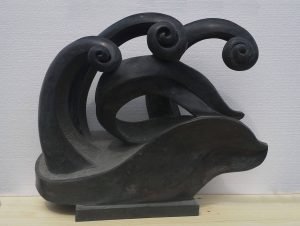
You wouldn't say so from the posts on this blog, but I've been very busy these past few weeks. In preparation for the exhibition at Kunst en Kastelen (Art and Castles) I've done all kinds of work, and created a few new sculptures in stone. Here is the first one: a sculpture in Anröchter Grünstein, or dolomite.
It is about 50 cm high and wide. The rear curl is carved completely detached. This sculpture is actually a brother of my bigger one 'Ferns’, that I made previously in dolomite as well.
The sculpture is still quite dark now. But this stone, which, incidentally, does not come from the Italian mountains but just from Germany, has a special feature: once it is left outside for a while, it will gradually turn bright green all by itself, which I find very beautiful. So over time it will only become more beautiful!
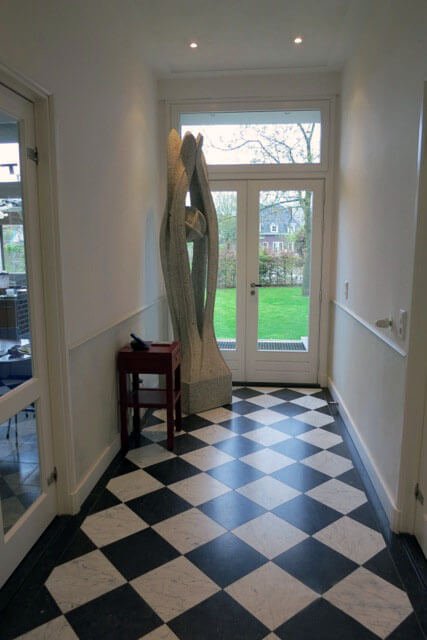
The statue "Ferns’ went on a trip to North Brabant today. There it had to go over a narrow gravel path, a set of steps and a threshold, and up to the end of the hall. How do you do that with a sculpture of more than 600 kilos? Well, just, like they did it in the olden days. On rolls.
But his little brother was still in the way: the customer had temporarily my sculpture ‘Turning A New Leaf‘ on loan, while I worked on their sculpture. But with four man, a hoist, wooden rollers from pieces of railing, and a wooden frame for the sculptures, it's all worked out well.
Garden sculpture and interior sculpture
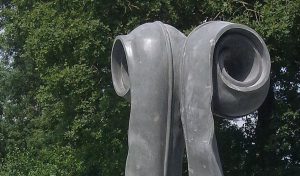
detail of ‘Turning A New Leaf’
However instructive it is to maneuver with a heavy stone sculpture in a limited space, it was even more instructive to see how different one sculpture looks from the other one. The granite piece (Turning A New Leaf) is slightly taller, but because it's almost the same color as the surroundings, it nearly blends in. It also has a very rough surface.
It's meant for in a garden, where it will gather algae and moss and engage in a kind of interaction with the environment. The base of that sculpture is also quite heavy, because later all kinds of plants will grow around it, hiding the base from the viewer and making the sculpture seem as if it has grown up between the plants. That base also provides a counterweight, So even without anchoring it would stand firmly.
detail of 'Ferns’
An indoor sculpture requires a different approach. I like it when you can touch and feel sculptures, and in that I'm certainly not the only one. That is why 'Ferns’ is much easier to the touch, with a smooth polished skin and curly shapes. The base plate is much thinner, and octagonal instead of square. What they do share is that the light behind the corridor plays through the sculpture from the garden. That was also a specific request of the customer, and the cause of the similarities between the two images.
I was quite happy to see the sculpture on the spot for which it was designed, and to find that it's doing what was intended: being an eye-catcher and keeping the attention indoors without blocking the garden completely. The dog seems to like it in any case.