• Unique project in Veghel-1

    In the deepest secret

    It's been rather quiet on this blog over the past year because I had to keep still about a huge project. It was a gift to the Lambertus Church and the people of Veghel, sponsored by the Van Eerd family, owners of supermarket chain Jumbo. This project had actually since 2017 been in preparation, but only in february 2021 did we actually start carving the first ornaments. However, this was preceded by a long process of studying grainy old photos, enlarging, enhancing, drawing, modeling designs and researching sources.

    Two facades

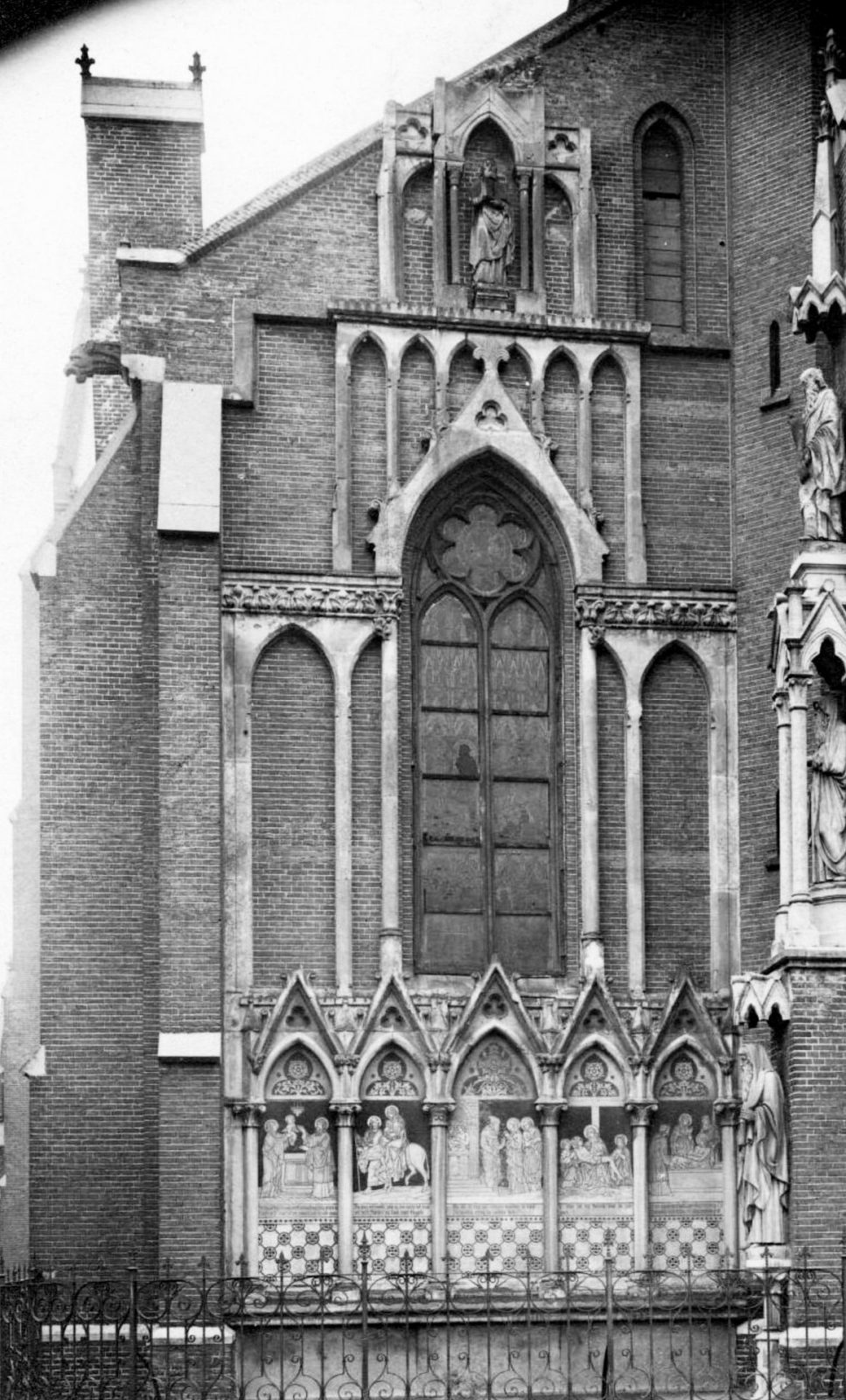
    black and white photo old niches Veghel

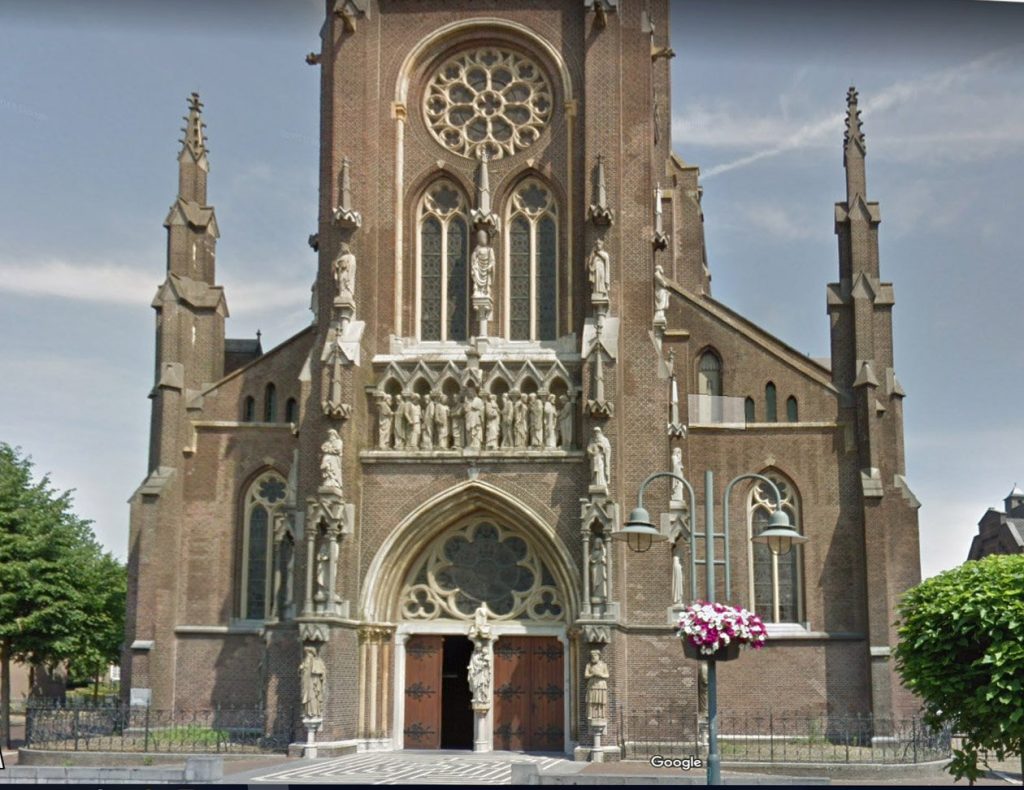
    It concerned two facade claddings for the side gables on the west side of St. Lambert's Church. The entrance side. This church was only the second one that the later famous architect Pierre Cuypers was asked to build, and it was also quite a bit simpler than many of his later buildings. But the building pastor at the time thought that was too meagre. From 1850 (ten years before the start of construction) Catholics were allowed to openly proclaim their faith again and that had to be celebrated in a big way. It had to be richer. More decoration on the outside. And that's how almost 30 statues were added to the tower and how the side facades were covered with natural stone moldings and arches. Until the year 1960, when in the context of a major 'restoration’ the claddings of both side facades were removed. The sculptural parts on the tower were to remain. But the ornaments on the sides had all become a bit jaded, people thought, and in addition, there was still visible damage that had originated during the Liberation of 1944 at the end of the Great War. Good riddance.

    Renewed interest

    condition of the facade of the Lambertuskerk in Veghel before the restoration of the arches

    If we fast forward to the year 2017 we notice that there is renewed interest in the old front view of the church. There were still faded traces on the church that made it clear that at one time something must have been there before, and when some old photos appeared as well, the desire to restore this again arose. It is thanks to the volunteers of the Lambertuskerk that this has been taken up energetically, that a sponsor has finally been found and that it has now come about. On 3 October 2021 the whole project was unveiled by the bishop.

    How to tackle such an undertaking?

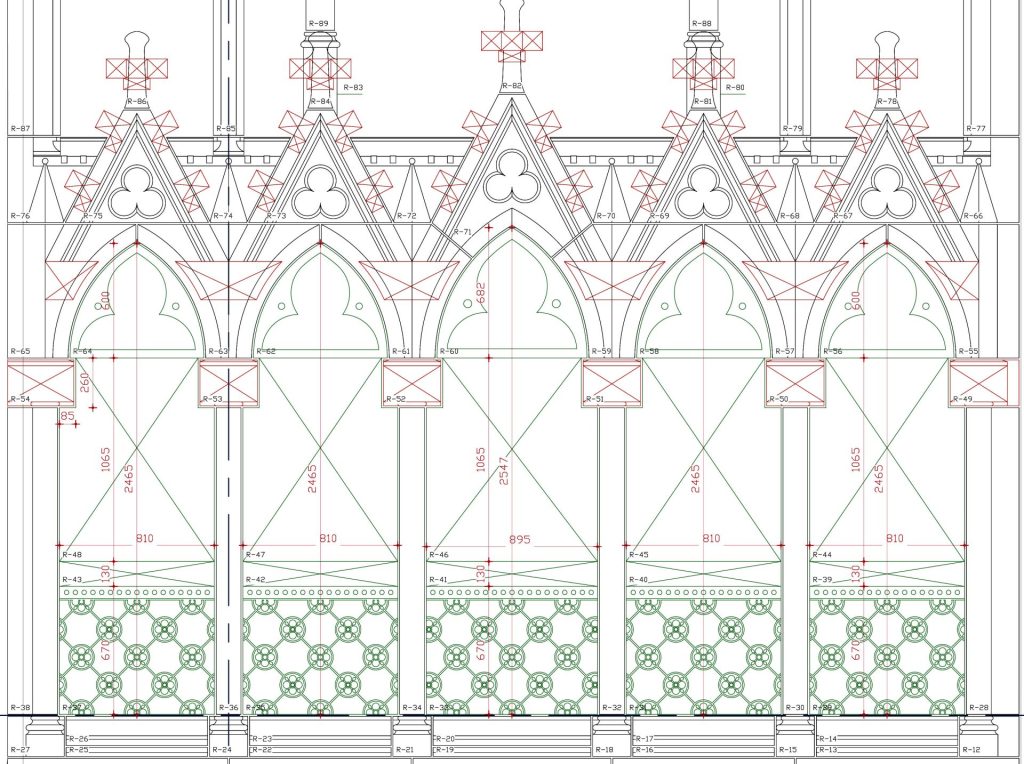
    CAD drawing of the arches for reconstruction and stone carving

    Already in 2017 I was asked about my thoughts about this reconstruction, but in the end I was involved as a subcontractor of Slotboom Stonemasons in this project. At Slotboom, the existing facades have been accurately measured and compared with the photos, and every part has been worked out in a large three-dimensional computer drawing. The ornaments we were to carve later on fitted snugly inside this main drawing.

    I started by blowing up the photos a lot, sharpening them, clarifying details and trying to understand what the project entailed.

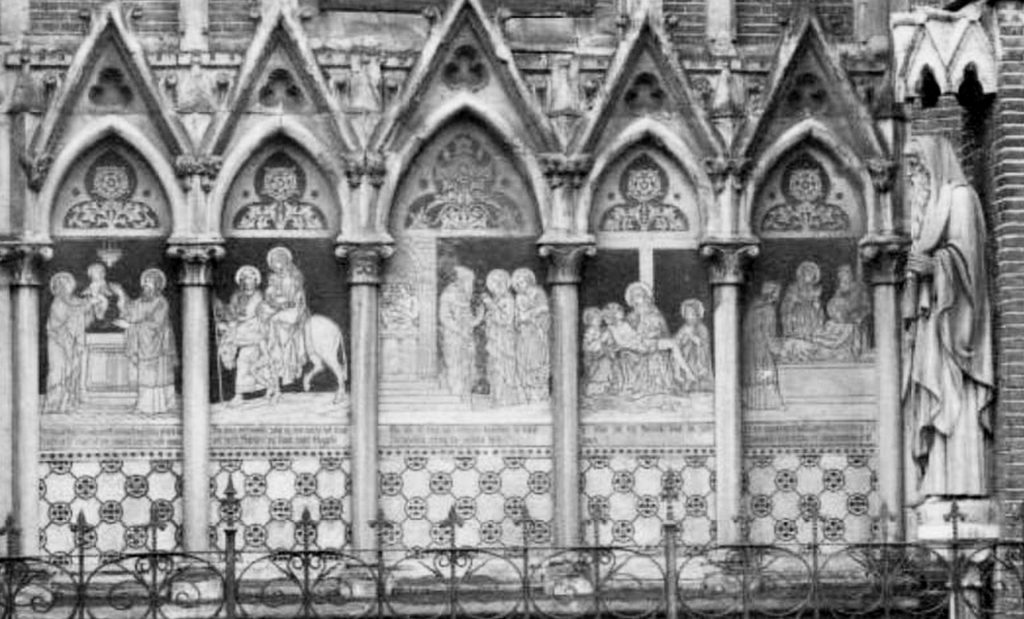
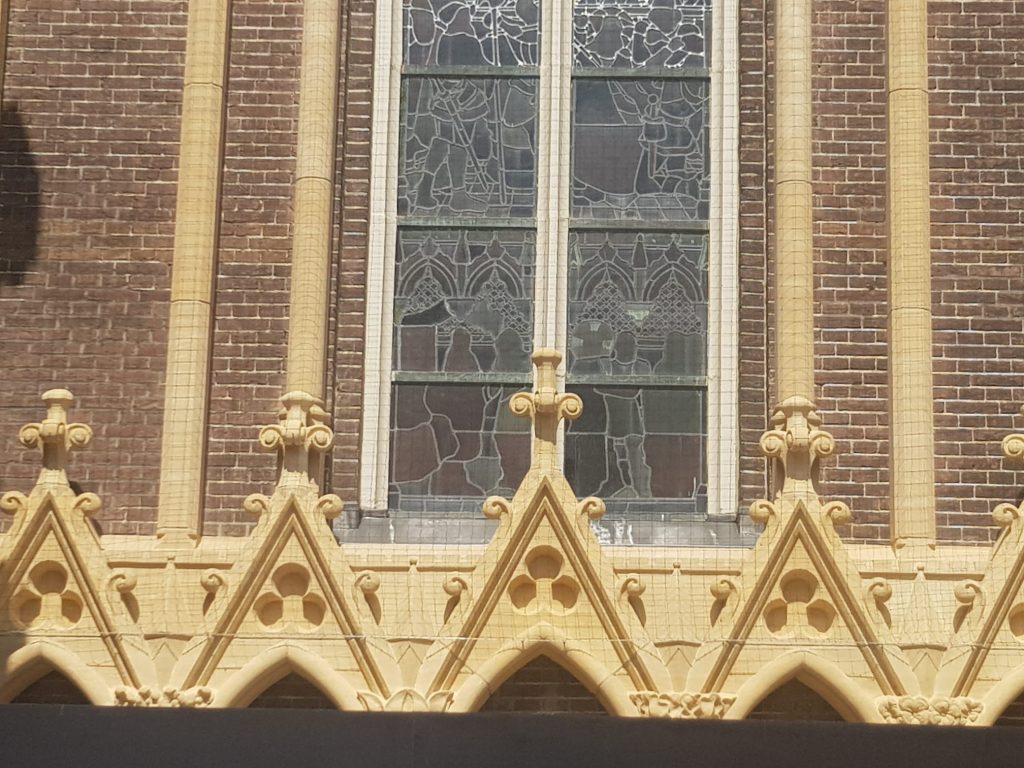
    Actually, what we see here is a set of arcatures: ten niches with pointed arches and a roof-like structure, which ends in several vertical lines around the neogothic arch window of the church itself. At the start of this window arch we see a horizontal line on the left and right, after which the vertical lines are narrowing again until they end in a niche with a statue of a saint, crowned with a few small finials. The most striking part were the depictions in the bottom ten niches. At first I thought these were ceramic panels, but apparently it was originally done in two-tone stucco. We were asked to also reconstruct these parts. I decided to take it on together with Jelle, and later Nico also joined the team.

    Unfamiliar territory

    Because there is still yellow Jaumont Limestone to be found at the capitals of the portal, it was quite an obvious choice to carry out most of the natural stonework on these parts in Jaumont as well. It's easy to carve and it also creates nice shadows. Cutting ornaments is not new to me, so I wasn't too worried about this part. After all, gradually many things become clear by themselves if you go at it one thing at a time. Making a proper quotation is sometimes more difficult than the implementation!

    However, the design was much more stylized than I normally find in Gothic and Neo-Gothic churches, so that was a bit of a switch. At the top were two statues of St. Peter and Paul, and though the pictures were quite blurry, one will find a way through it if you just tackle it step by step: first a small model at scale 1:4, then at full size and then reproduce that into stone.

    Panels

    But the most difficult were the panels with ten scenes from the life of Jesus. I honestly don't know much about ceramics and thought I had to outsource this part, until someone suggested I carve it in basalt lava and then have it enameled. And as planned, we got moving. About that later meer↑.

    The limestone ornaments

    After working in Photoshop and a number of other programs (including the fantastic free program Faststone Image Viewer, in which you can also do some editing at lightning speed) to get the old images enlarged and sharpened, I was able to get a good impression of most of the ornaments and the two statues of the saints. With prints of these photos I could model the maquettes for the ornamental work and cast them in plaster. Jelle took care of the capitals, while Nico already started carving the first pieces inside the top of the niches: leaf motifs in basalt lava that would later be enamelled.

    Meanwhile, all the photo editing added up unnoticed, until I had been staring at it for days, but it gave me a nice handle for the reconstructions. With one exception that we couldn't really get a grip on. At the bottom of the frames at the start of the large gothic arch window are a total of four very unclear ornaments. You can discover one in the photo above. This is the clearest of the four, but the meaning of it completely eluded us. Taking the plunge, I then proposed to replace these four corbels with the four evangelist signs according to tradition.

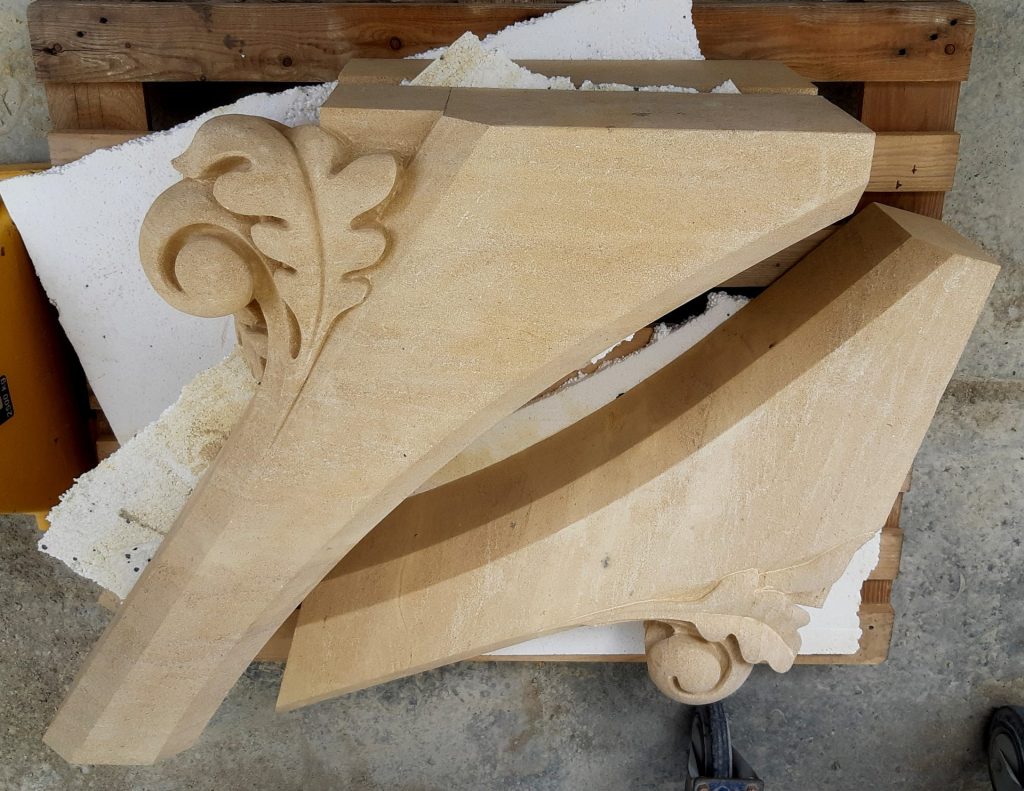
    small corbels with the four evangelists fot the Lambertus Church in Veghel

    The Four Evangelists

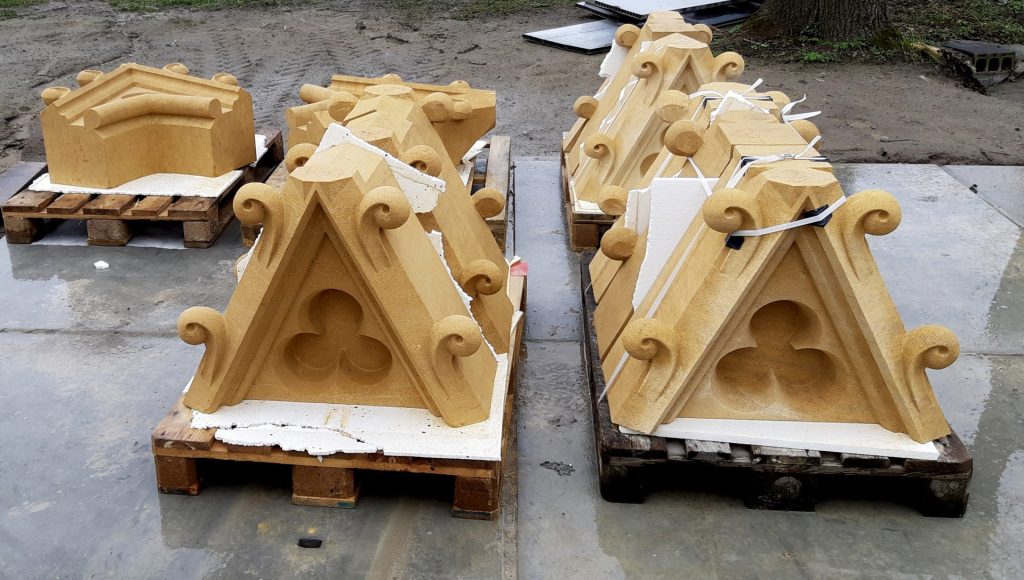
    roof parts with ornaments

    Halfway through the facade you will now find four small corbels with an angel on them, a lion, a bull and an eagle, all four with a book. They are the age-old symbols of the evangelists, in response to a text in the Bible book of Revelation:

    Revelation 4:6-8: In the midst of the throne and around the throne were four creatures . The creatures were full of eyes in front and behind. The first creature looked like a lion. The second creature looked like a young bull. The third creature had the face of a human. The fourth creature looked like a flying eagle. Every creature had six wings and every creature was full of eyes inside and out.

    Although I don't think this is about evangelists at all, also because this bible book is full of astronomical and astrological references, in later centuries people invariably represented the evangelists Matthew, Mark, Luke and John according to these four symbols. In any case, as a sculptor you can make something fun out of it.

    Playing with composition

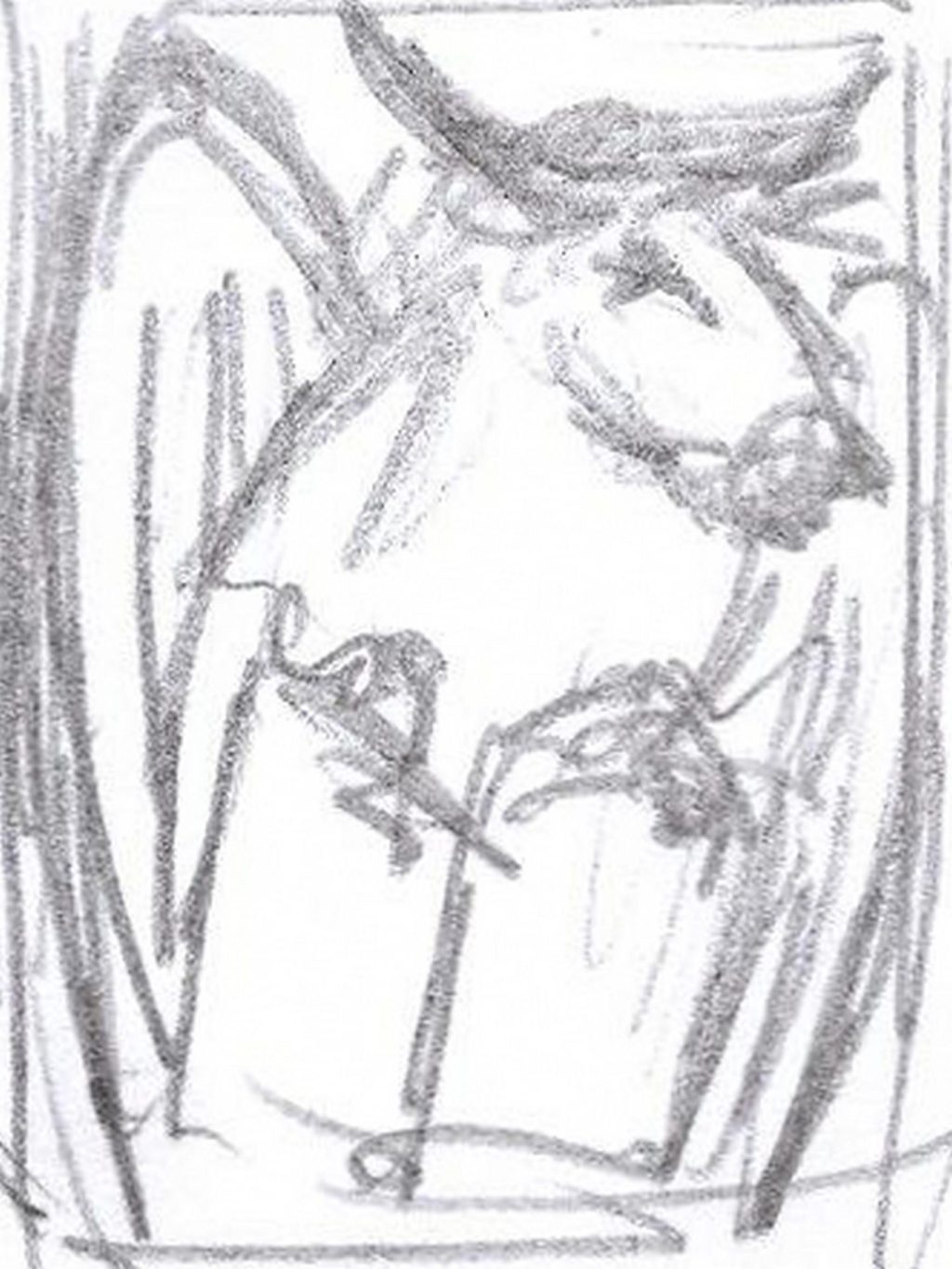
    sketch for corbel with bull

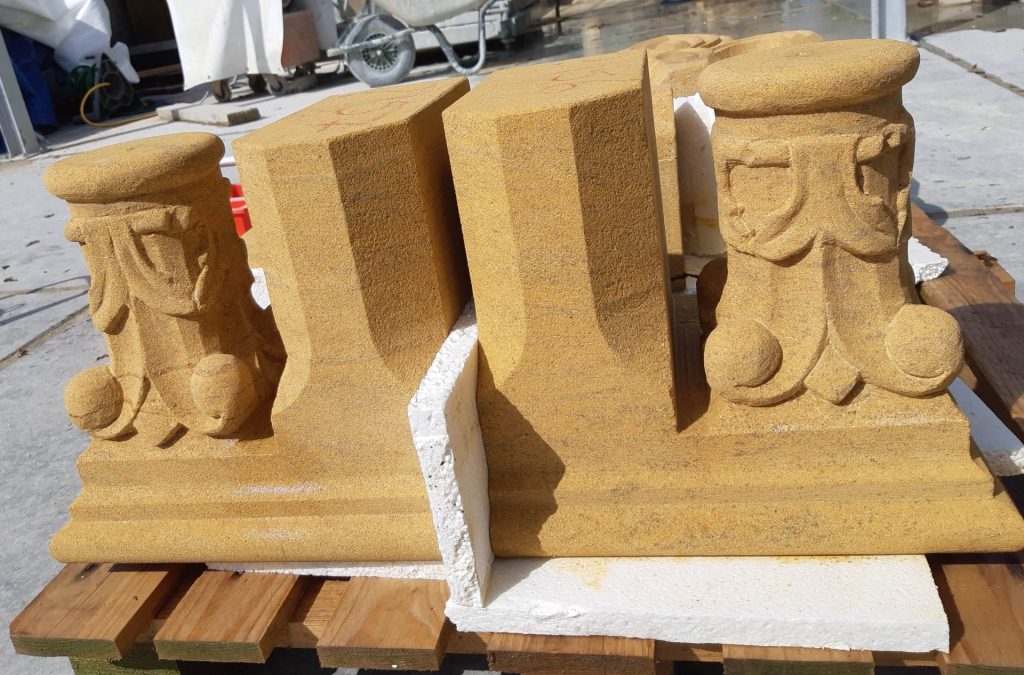
    These are the parts we like to make the most. How do you design something like this? Just the four heads or the whole beasts? With or without wings? Should we add a book or a scroll or neither? Do we just carve a very cubist, Art Deco-esque head or emblem? These were very small and shallow blocks in which we had to fit the ornament, with a continuing column on one side. So after a few quick little sketches and a bit of rough sculpting, we carved these corbels in a sort of mix between direct carving and working from a model.. Jelle made the angel and the lion, I did the bull and the eagle. I made a clay model of the bull after a tiny drawing, the eagle was done a bit more in the direct carving method.

    corbel stone St. Luke's Bull Veghel

    We always have a lot of fun putting little details into it and making it a little bit odd, just like this sort of thing is always meant to be. Of course they are often not quite anatomically correct and the stone was actually a bit coarse for these kind of small details, but it's a lot of fun to cram it all in and find an interesting composition for it. Jelle made his angel and lion so that they looked down, and I thought that was a good idea, that I followed for my eagle. The bull is the only one looking over his bible book and holding it with his paws. On the left facade you see Matthew and Mark: a downward flying angel and lion, each with a book. On the right facade we have Luke and John: a seated bull with book and a descending eagle with book. The book indicates that these are the four evangelists.

    Carving voluptuous ornaments

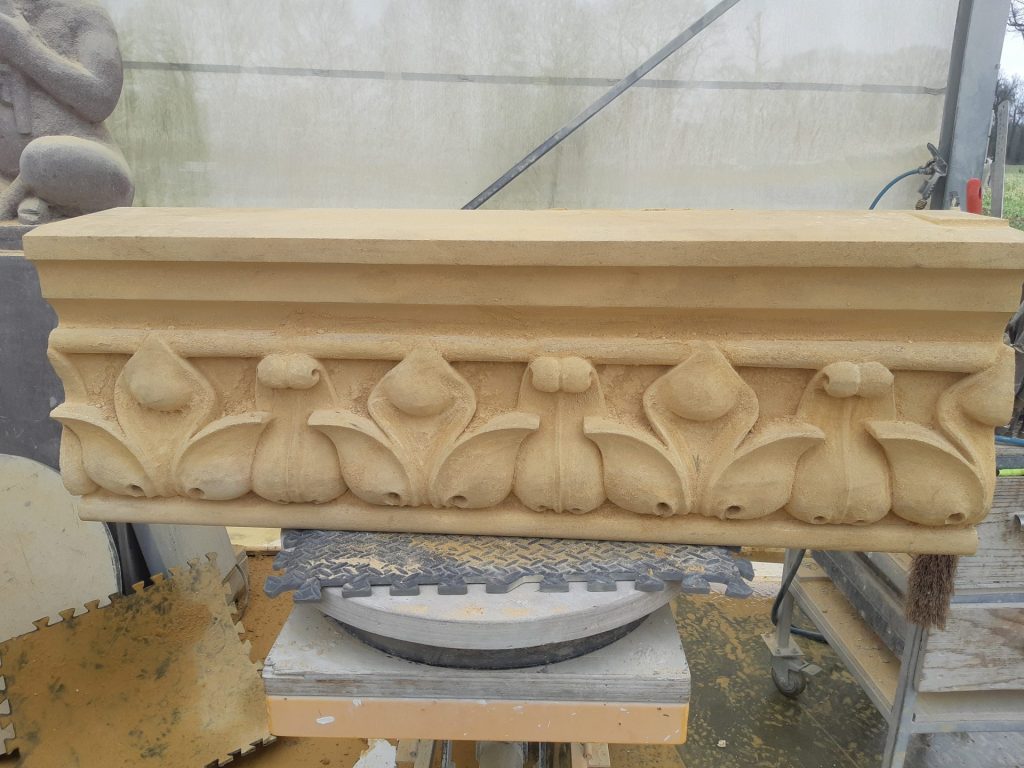
    band with ornaments in yellow limestone for the church of Veghel

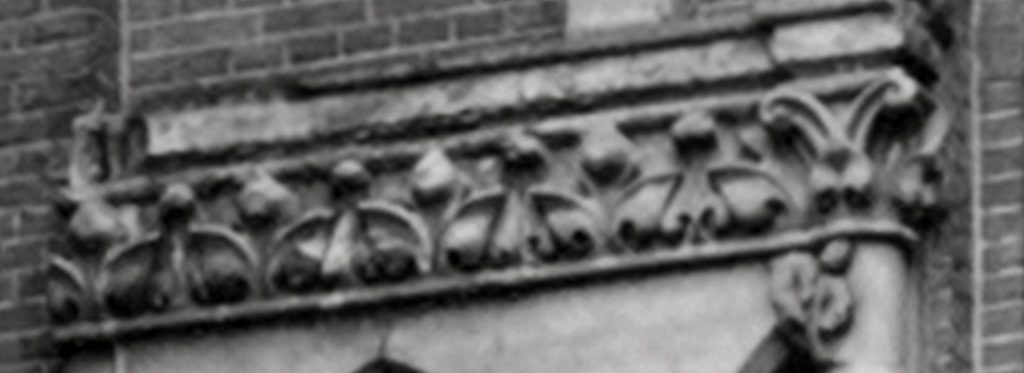
    There is a horizontal band with ornaments on the two facades, for which I first made a plaster model to explore the shapes. Gradually I got some fun carving the curvy shapes of these bands, that somehow reminded me of a well-filled lady. Jaumont is also a type of stone that lends itself to this work, because it is easy to finish with a sharp wood rasp and it also draws nice shadows with that yellow.

    All ornamental work in Jaumont limestone

    the left facade with arches, here without enamelled panels (photo: Bas Mulder, Slotboom Stonemasons)

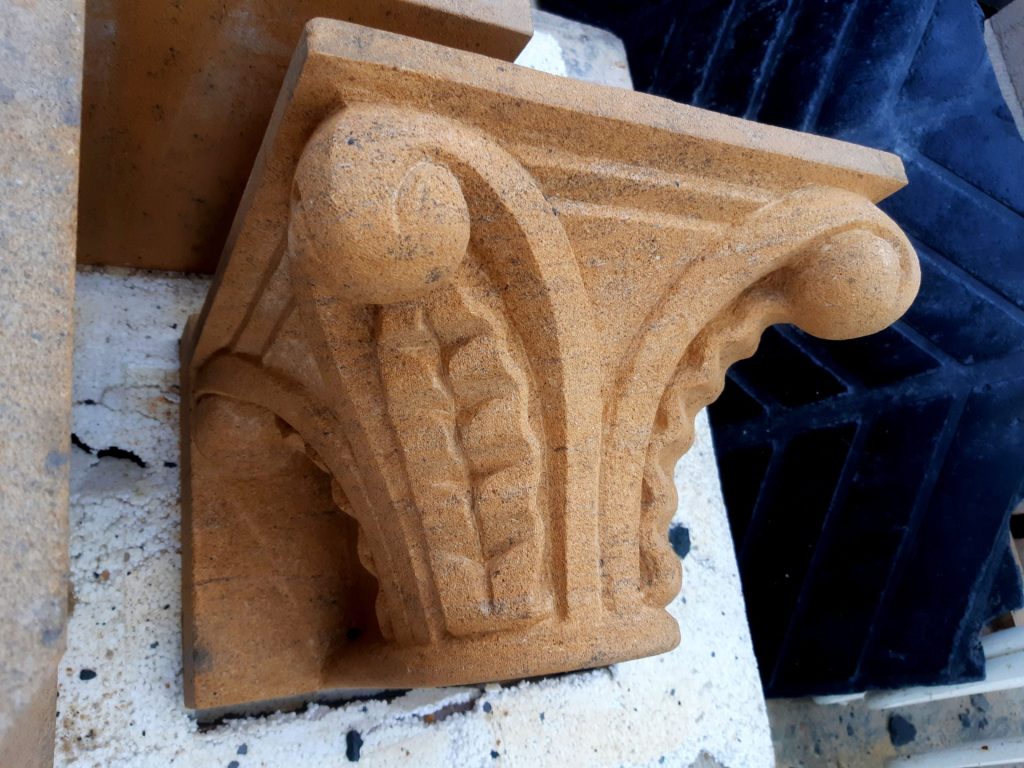
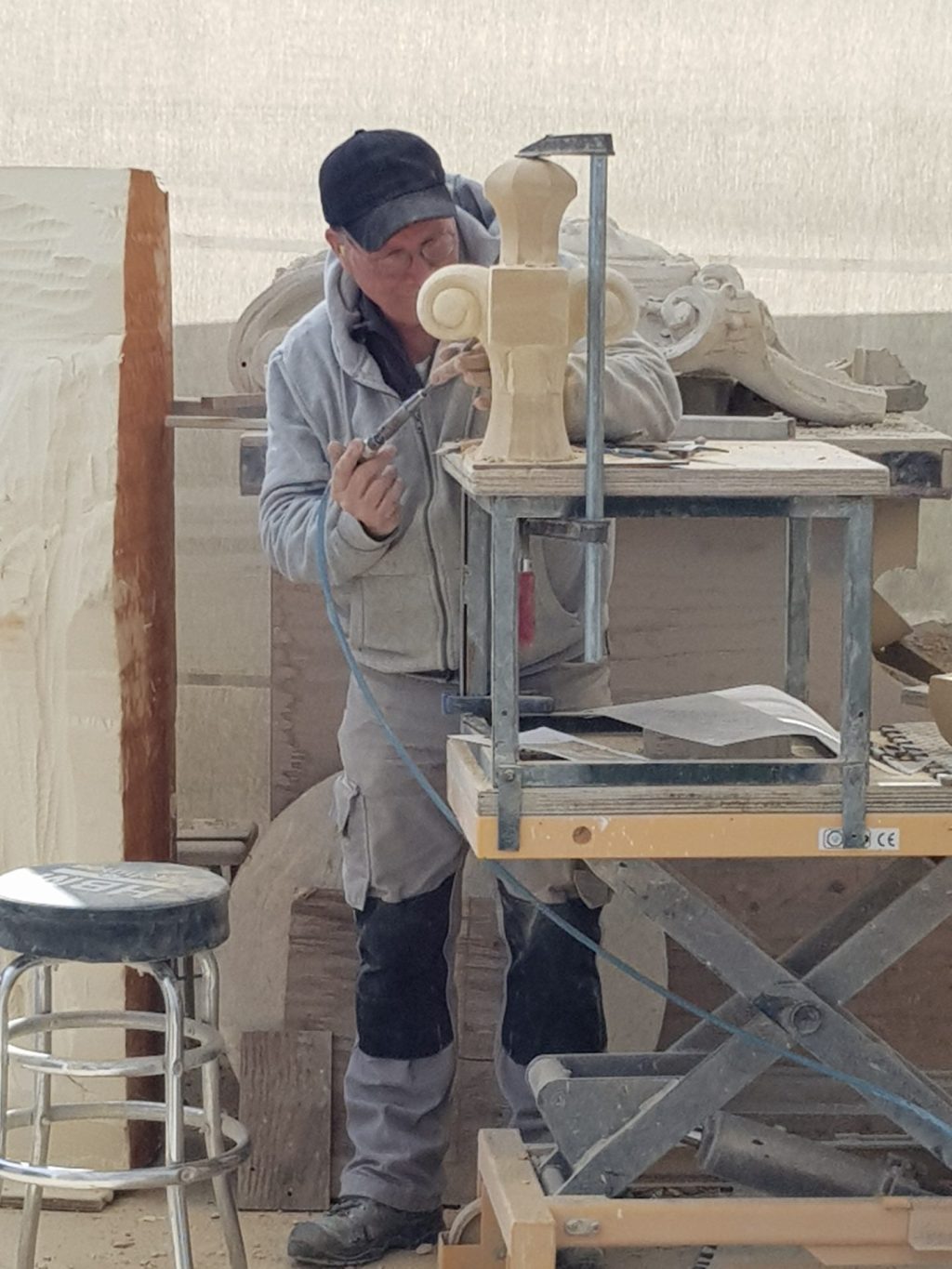
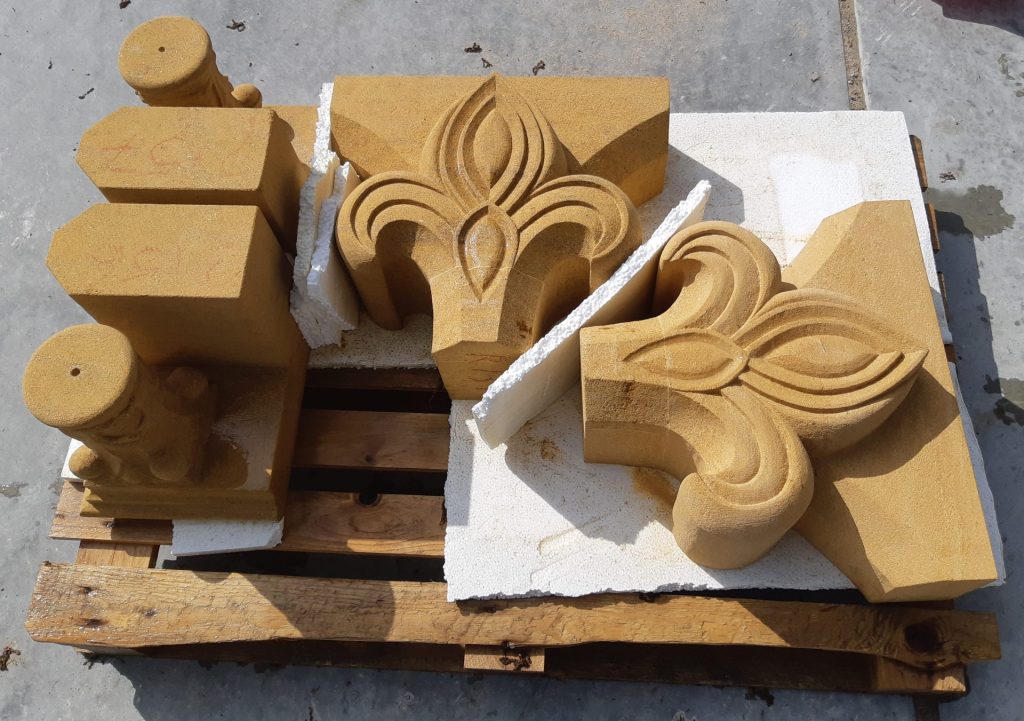
    Thus we carved all the ornaments on the two facades. Above the pointed arch window you will find four large crockets on each facade, Nico made two more French lilies, there are two small capitals next to each statue and at the very top you will find two small pinnacles and a small finial. All other yellow natural stone parts were supplied by Slotboom Steenhouwers, who also took care of the installation.

    Gallery
    Nasty the next post about this project →

    the right facade with arcatures, here without enamelled panels (photo: Bas Mulder, Slotboom Stonemasons)
  • Year review of 2020

    Strangest year ever

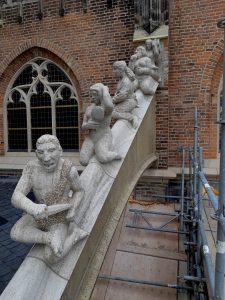
    flying buttresses with the Apostles

    Year review of 2020? Well that was quite the year I guess! The strangest year that I've experienced until now out of the almost 58, but certainly not a bad year. There were many challenges and throughout everything I've grown personally. We sculptors have probably had it much easier than most other people. We enjoyed working outside, have been sitting in the lovely sun, had plenty of space and because we do our own thing, we have actually not noticed much of the measures, except when we had to do some shopping or wanted to go to a museum.

    Production

    The old flying buttress statue The Hope made of tuff stone
    The old sculpture of Spes, Hope

    So what do you do when all the nicer things disappear one by one? Work work work. That was one of the most striking things this year. We've had whole wagonloads of stone go through our hands, and there were lots of nice carving jobs among them. As in previous years, we have been working on St. Eusebius's Church, and we've now arrived at flying buttress statue no. 80 at the moment. We only have another 3 to go, because the last 13 sculptures will not be replaced. There will a new work of art instead. I believe that we will also have to do a little bit of work for that. On my blog you can read about the flying buttress statues that I carved myself last year: the Flute Player, Apostle St. Andrew, the Accordionist, St. James the Lesser, St. James the Greater, Temperantia andCaritas from the arc of the Seven Virtues, and an Goat nibbling on a crocket. I also carved a copy of the statue Spes, Hope, but we were so busy that I forgot to take pictures of it!

    face of James

    I did report about our work in an article with a video tour (as a studio visit could not take place due to corona) and an in an overview of the last three flying buttresses that were completed: the Seven Sins, the Musicians and Six Apostles. Sometime in October I started working on a double-headed eagle for arch no. 17/18. You can recognize it in the background of some photos, but that project is temporarily halted because other things demanded priority. Likewise, Stide will be carving a lady with a cross (Fides of the Seven Virtues) and Jelle still needs to carve a man with a watering can who's watering a crocket, from arch no. 20.

    -click on a photo for the corresponding article-

    flying buttress figurine of Flutist 1
    Flute Player
    side view Saint Andrew
    St. Andrew
    new flying buttress figurine accordionist
    Accordionist
    copy of flying buttress statue of James the Lesser in Muschelkalk limestone
    James the Lesser
    copy of sculpture of Apostle James the Greater
    James the Greater
    flying buttress statue Temperantia for the Eusebiuskerk in Arnhem
    Temperantia
    Caritas
    Flying buttress figurine Goat nibbling on a crocket completed 1
    Goat
    three flying buttresses

    Farewells

    Sculptors Jan and Koen van Velzen rowing

    It was an uncomfortable year in another sense too: there were departures. My father and my brother-in-law both died of cancer, but both of them had lived towards the end in such a grand way that we could all find peace with their departure. Especially in my father's case, there was nothing but gratitude. Normally I would go to India again in November, but I haven't had much vacation this year. My beloved Swami Gopala Krishna also left his body this year and even if we could have gone to South India, then everything would have been different anyway.

    In August I posted an article about my father's life that I actually wrote in the week of his death, but at the time I didn't have any pictures yet. I discovered that I could have written five more articles about his life, but this blog is not the right place for that. There will be an article about what I learned from him as a sculptor. On 31 October I I installed his sculpture "Surrender’ in the cemetery where he is buried, in Onderdijk.

    Annual Review 2020

    I am currently working on making his tombstone in dolomite; it will be a lotus flower in relief and some waves. I first had an elaborate design with a graceful lady, but the family opted for a simpler design, and that will work out very nice as well. I hope to get it all installed before 19 January. But it doesn't happen as fast anymore 30 years ago anymore and I noticed that I also need my time to rest physically after a week of hard work. I had made the part with the waves quite deep at first, but it turned out too restless. After I had made everything 8 cm thinner it looked more like the way I had imagined it. At the moment I'm carving the Lotus flower.

    Annual Review 2020

    Pope and lantern

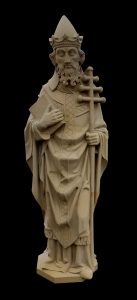
    A number of projects always overlap the year's end, and this year those were Pope Leo and the granite Japanese Lantern for Clingendaal. There are three articles about the Pope Leo statue on this blog: the outline sawing, the first rough carving work and its completion. This statue of Pope Leo the Great is a copy that I carved in Udelfanger sandstone, for St. John's Cathedral in Den Bosch. I was asked to assemble this new sculpture out of two separate parts, which was quite a difficult job, but in the end I managed just fine. It's actually great when a tough challenge succeeds so well. Because this went so well, my colleague Serge asked me if I could repeat this trick for him on a similar one, an angel for the same cathedral. Only this one wasn't so easy: the first block had a big crack. As a result, I have been able to gain a lot of experience in assembling blocks of Udelfanger sandstone.

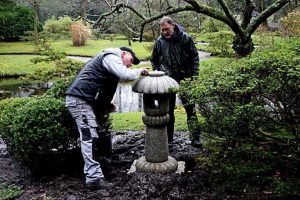
    The lantern for Clingendael park at Wassenaar I carved out of granite, and in terribly wet weather I installed it in the mud in the park. Nevertheless, it is now completely embedded in the beautiful park, hopefully to be admired again next year.

    Griffin

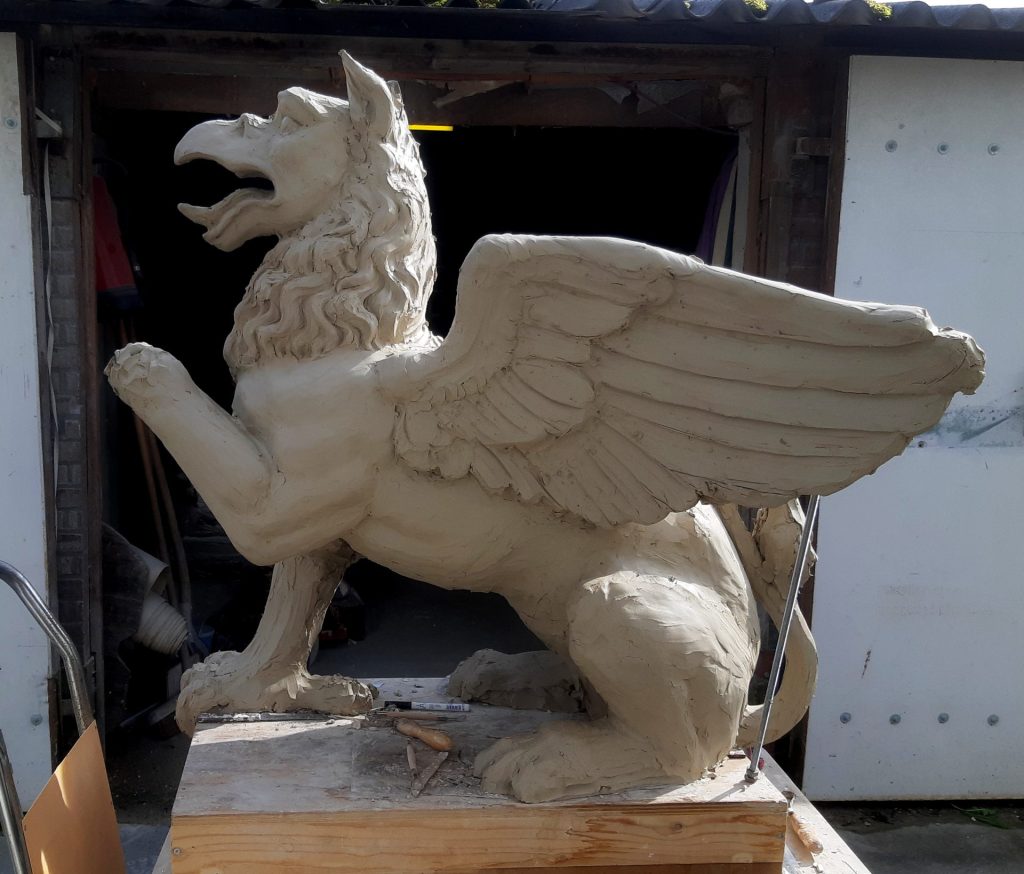
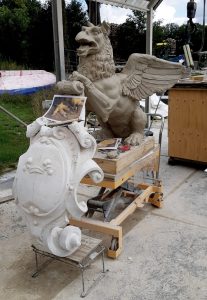
    In the summer we finally had a bit of a quieter time. Time to move on with the large mirrored griffins. I put the foam model aside and Jelle and I worked together to make clay models of the shield and the body of the griffins. We then encased it in plaster casts and cast it in plaster again. Next will be the carving in Obernkirchener sandstone, for which the large blocks have already arrived. It was quite a large and difficult project, from which we learned a lot.

    Read more in the extensive report on this project↑.

    frame for griffin
    griffin shield in clay 3
    modeling of the shield
    blocks of sandstone for a mirrored griffin
    blocks of sandstone for a mirrored griffin

    A green lady

    Annual Review 2020 seated woman dolomite

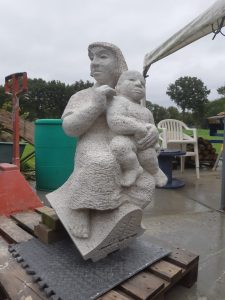
    One of the commisions that I haven't published on this blog before, is that last summer for another sculptor I carved a sculpture in Anröchter Grünstein (dolomite) out of a large block of stone. Below is a video of splitting the block, that I could almost reach through with my chainsaw. In the picture, the whole sculpture still needed to be polished to a shine.

    Ornamental work for the Latin School

    ornaments in Baumberger stone for the Latin School in Nijmegen

    An accident never comes alone, but so it is with workload as well, it seems. Just at the point that I got the feeling that it was becoming an awful lot of work all at once, the urgent project for the Latin School in Nijmegen came in between. But we made it, and in time! All of it was blocks of Baumberger stone with ornaments on three sides, in the style of the Dutch renaissance.

    Finials and side crockets, for the Utrecht Dom Tower

    detailing new finials for Utrecht's Dom Tower

    This year we also got a lot of ornament work done for the Dom Tower. Big, bigger, biggest was the motto. A very large finial of 80 cm wide kept Jelle and me each busy for over three weeks, and then pallets full of large crockets and tailpieces were dropped off, for the upper eaves of the stair tower, at about 90 to 100 meters up.

    Annual Review 2020 large crocket for Dom Tower in portland stone

    There are a total of seven of these window frames, each with about ten of these large crockets, so no worries about enough work for the time being. And that's only a small part of the ornamental work on the Dom Tower in Utrecht. An article about this project will follow.

    St. Lambert's Church, Veghel

    year review 2020 St. Paul

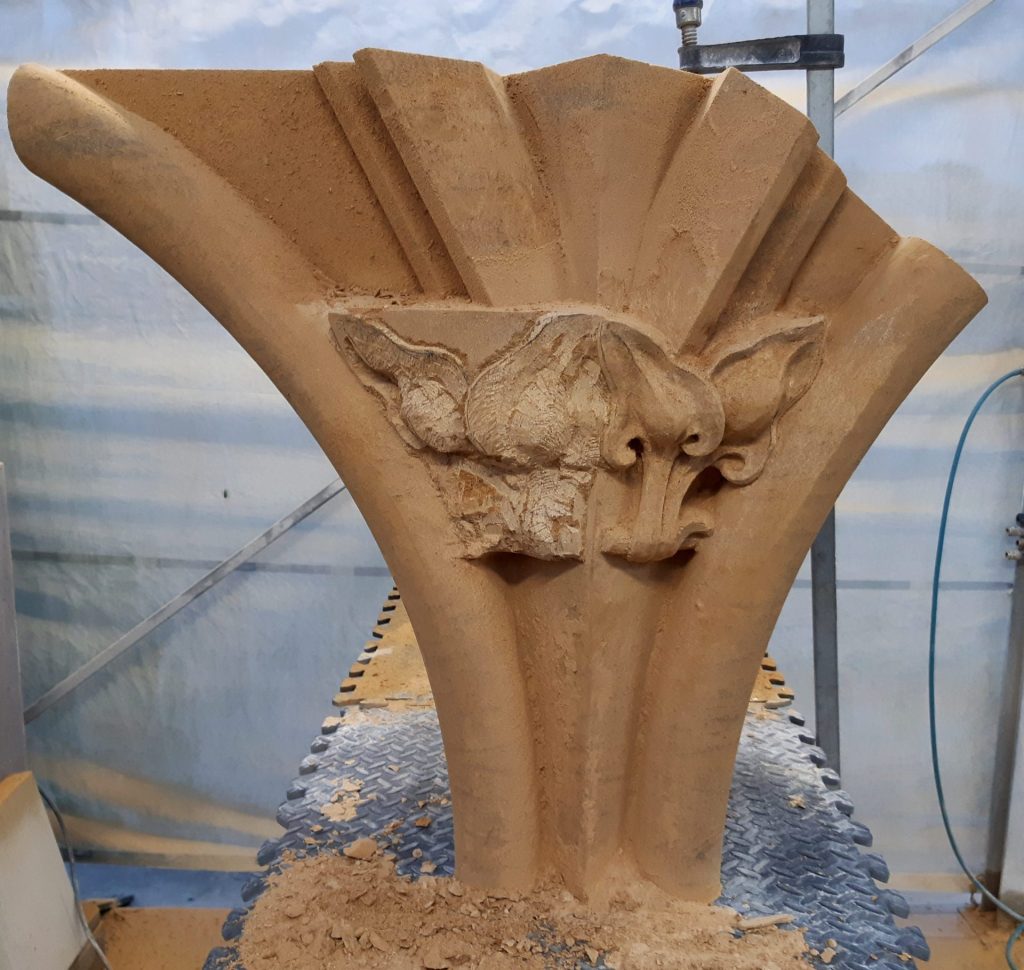
    There is one project that I haven't actually shared so far, but that I've already done a lot of work for in the past year. Two neo-Gothic façade claddings will be reconstructed next year at the Lambertus Church in Veghel. Among other things, there will be ten reliefs with scenes from the life of Jesus, two statues of saints and all kinds of ornaments, capitals and pinnacles on it. Jelle and I have already modeled a number of maquettes and carved several capitals for this, made test pieces and I have been staring for hours at vague old photos to see what it might have looked like. For St. Paul I already made a small model in plastiline, that I am going to enlarge in foam. The stone has already been sitting in the yard for a while. Jelle and I are going to do this together, and Jelle will take on St. Peter. There will certainly be a new blog article about this next year.

    Small tasks

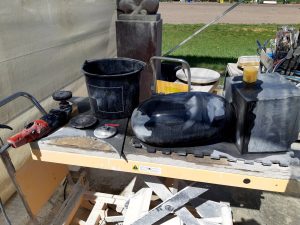
    polishing the lingam
    the sanding and 'sweetening’ of the lingam

    Fortunately, there was still time for all kinds of small work in between, this year. And so I've been singing Shivabhajans while carving a Shivalingam in black Swedish granite, I've carved two small family crests in a granite headstone, I was asked to repair the Little Drummer with a new drumstick at St. John's Cathedral and I carved a pine cone for an eighteenth-century garden vase and was able to find a few more spare hours to continue working on my red porphyry statue of Pan with the pan flute. I also did a small part of the work on the ornaments of the South Portal of St. Eusebius's Church, but because of the work load, colleague Serge took the lion's share of that part. Finally, in Badhoevedorp, Jelle and I have been working on the repair and reinstalment of the figurines of the Four Seasons.

    -click on a photo for the corresponding article-

    fine sanding the Shivalingam
    coats of arms in black granite completed
    Granite coats of arms
    repairing the drumstick of the Little Drummer Boy on the flying buttresses of St. John's Cathedral in Den Bosch
    Flying buttress figurine Saint John
    restoration garden vase lid
    Pine cone for a garden vase
    Annual Review 2020 garden statue Pan with pan flute- WIP
    Pan
    ornaments south portal Eusebius Church, in Baumberger stone
    South Portal
    figurine Spring Four Seasons reinstalled
    Spring

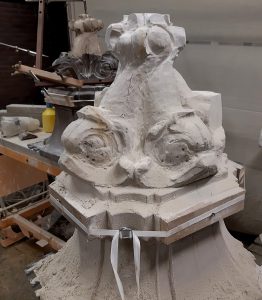
    Four fishes (dolphins) for a hotel

    Then there were the four fish propped up for a façade of a hotel in Amsterdam, that were seriously damaged in a fire. These kinds of ornaments are usually called dolphins however, although today we have a different perception about these creatures. These fish usually sit mouth down and tail up, sometimes spewing water from their mouths.

    I am now carving a copy of this in new sandstone; an very elaborate piece of high quality. This is quite a difficult thing for me too, which needs to be exactly similar because its brother is just a few meters away. By coping it point by point I'll gradually arrive at an accurate copy. The chisel traces are still clearly visible on the original, so I'll have to emulate that in the copy. I'll write a full article on this project later on as well.

    Expansion

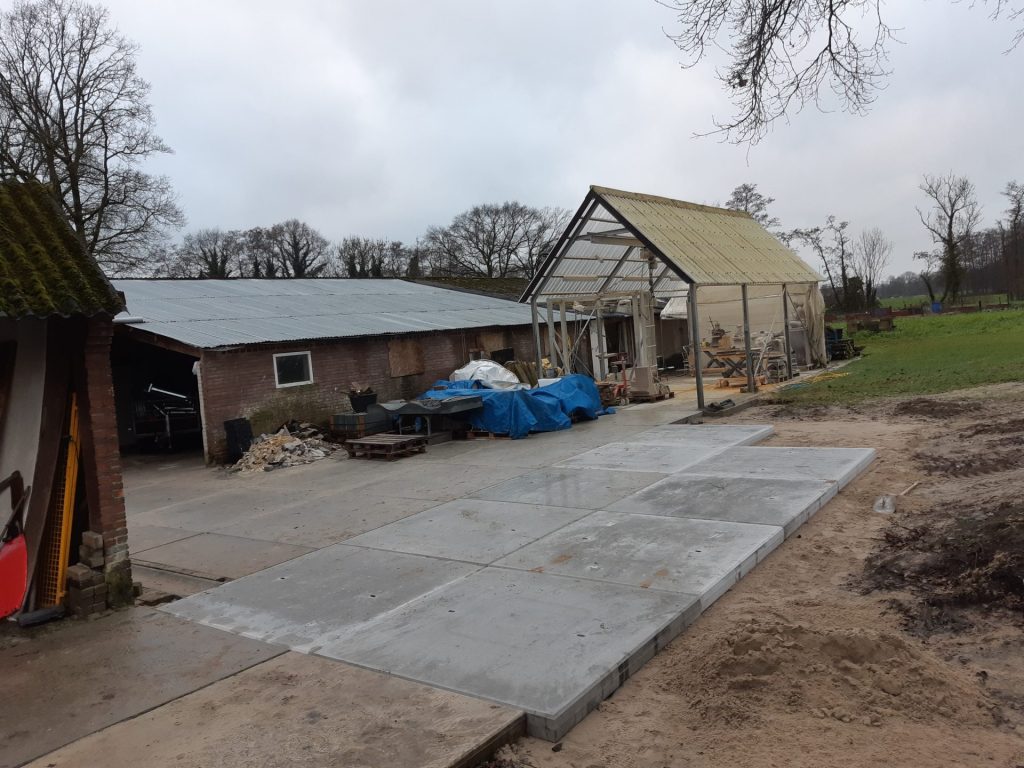
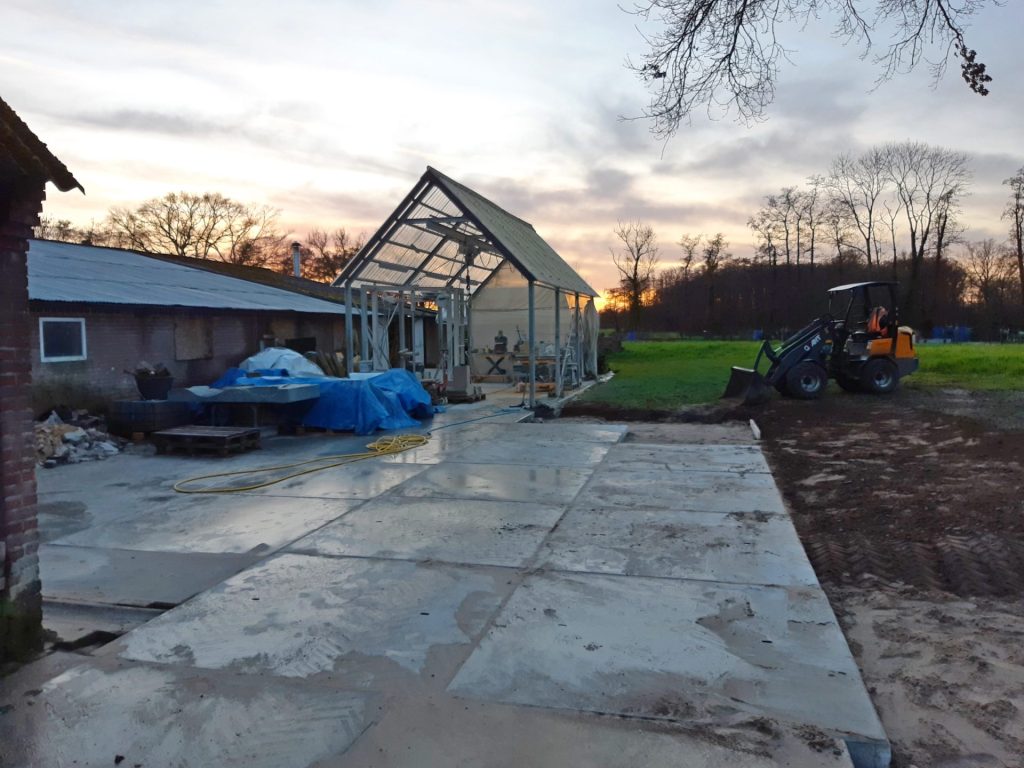
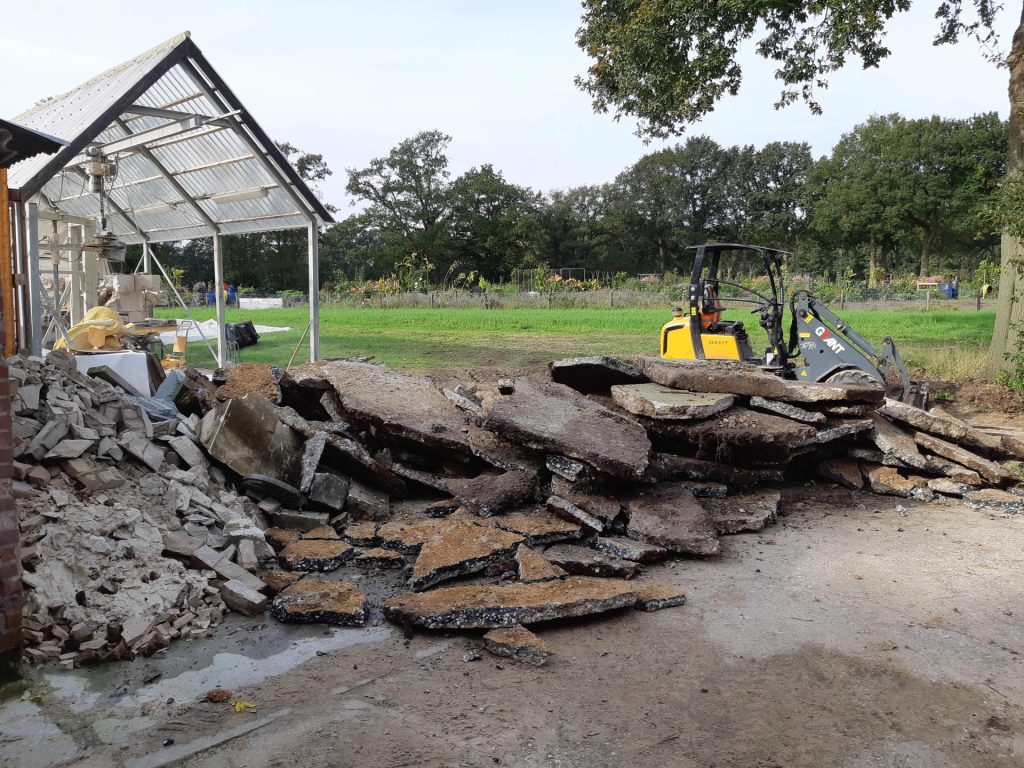
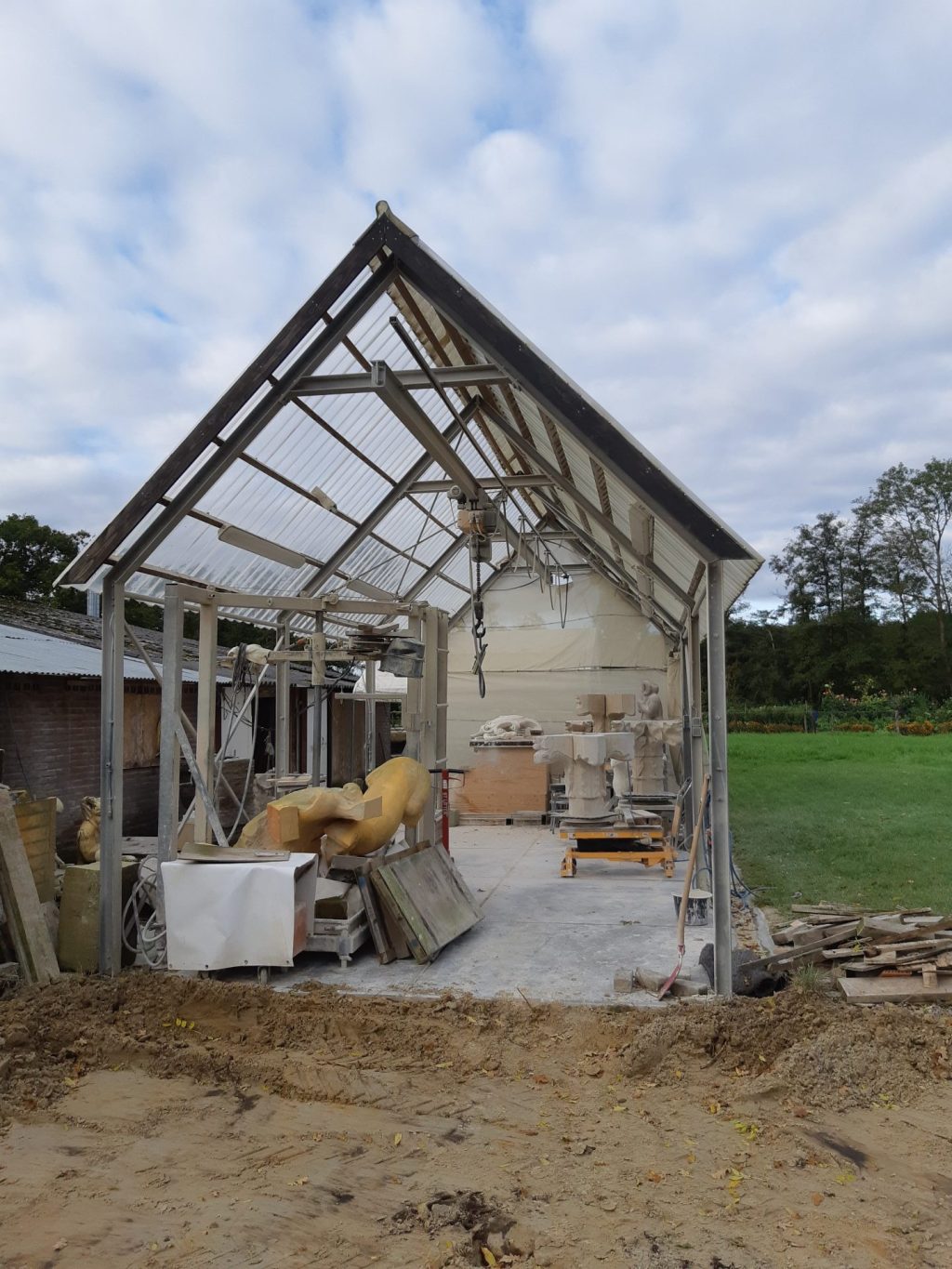
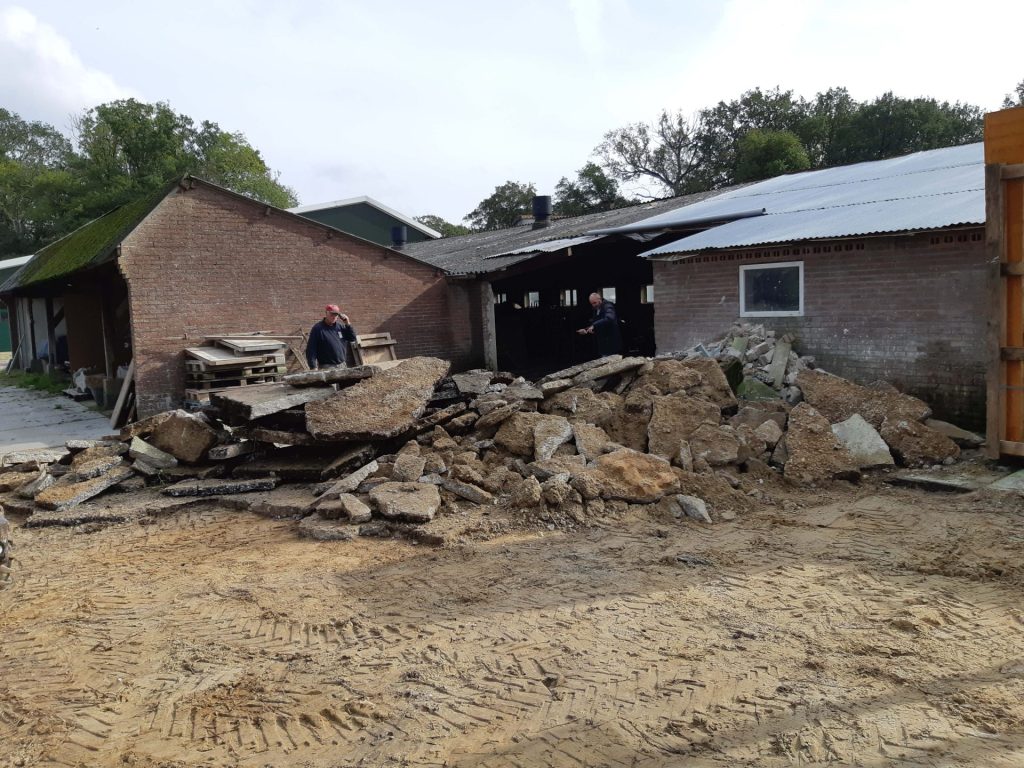
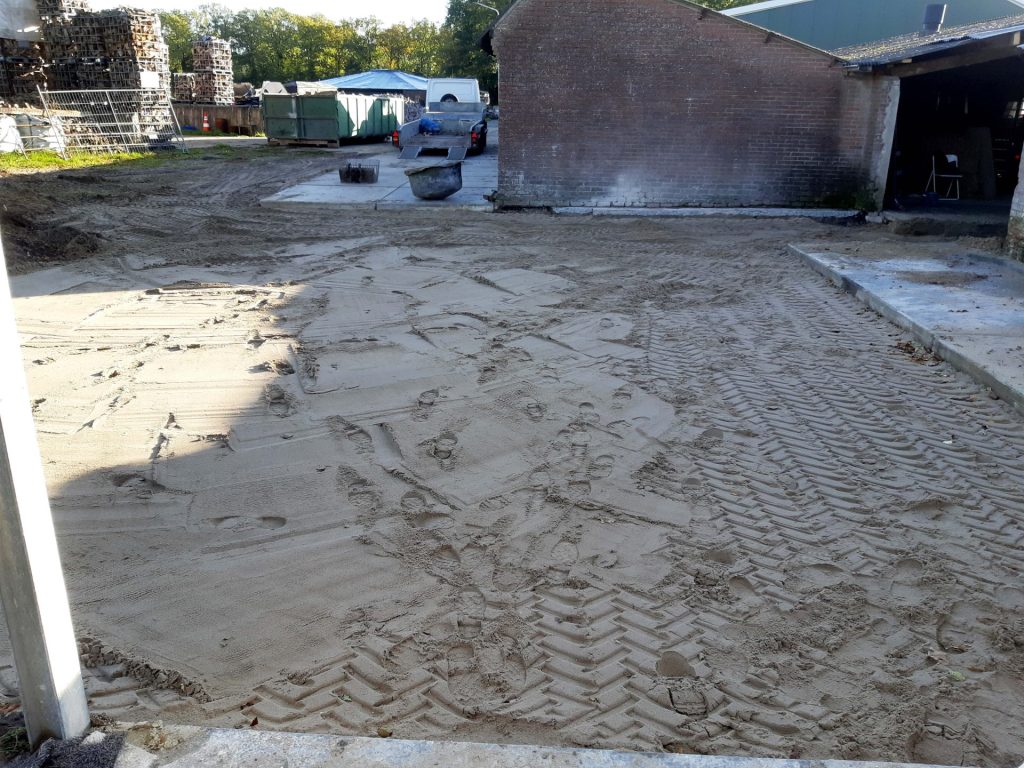
    It all got a bit tight under the shelter with all the half-finished projects and the sawing machine and pallets with finished work. So there is a big change going on: the roof, that I installed in 2017 together with my son Joram, gets an extension of 4 metres, and the concrete slabs on which it will sit have already been installed too. The old concrete floor was so uneven that it was almost impossible to drive on with a pallet jack. The new truss is already made, now the waiting is for the roof plates and the extension of the hoistway.

    Heavier equipment

    air hammer FK 702.5

    I also bought a new compressor this year, with an air dryer, because in wet and cold weather it was getting harder to work with air tools and whenever it was freezing, the air hammers and pressure regulators would immediately freeze up. And a nice heavy new air hammer, with a little more kabam in it. I am all set for the new year. Bring it on!

    (This annual report only tells you what I myself have been up to this year. But I've cooperated a lot with Jelle Steendam, Stide Vos and Serge van Druten, with whom I share the larger projects. I work a lot with Jelle in particular; he has found a permanent place under the shelter. So have a look at his website!as well ↑)

No more messages to show.

No more messages to show.