An angel and a Shivalingam

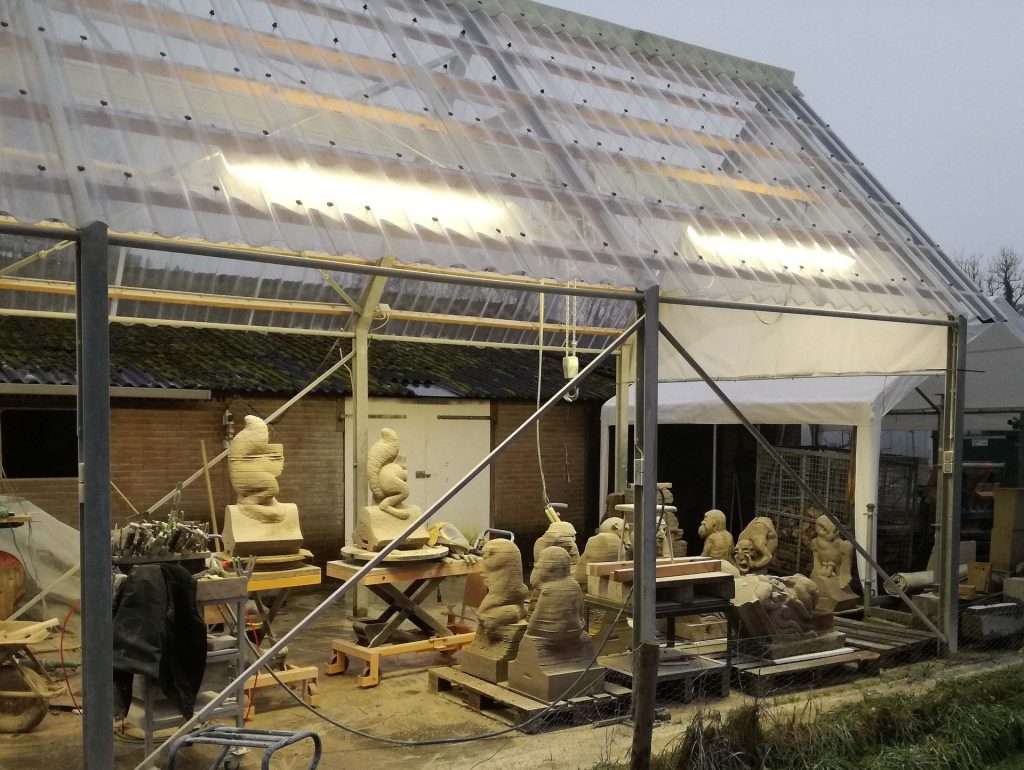
It's not all about carving (flying buttress no.)sculptures in the Sculptor's Workshop. Last week I copy-sawed an angel and made a Shivalingam.
Shivalingam

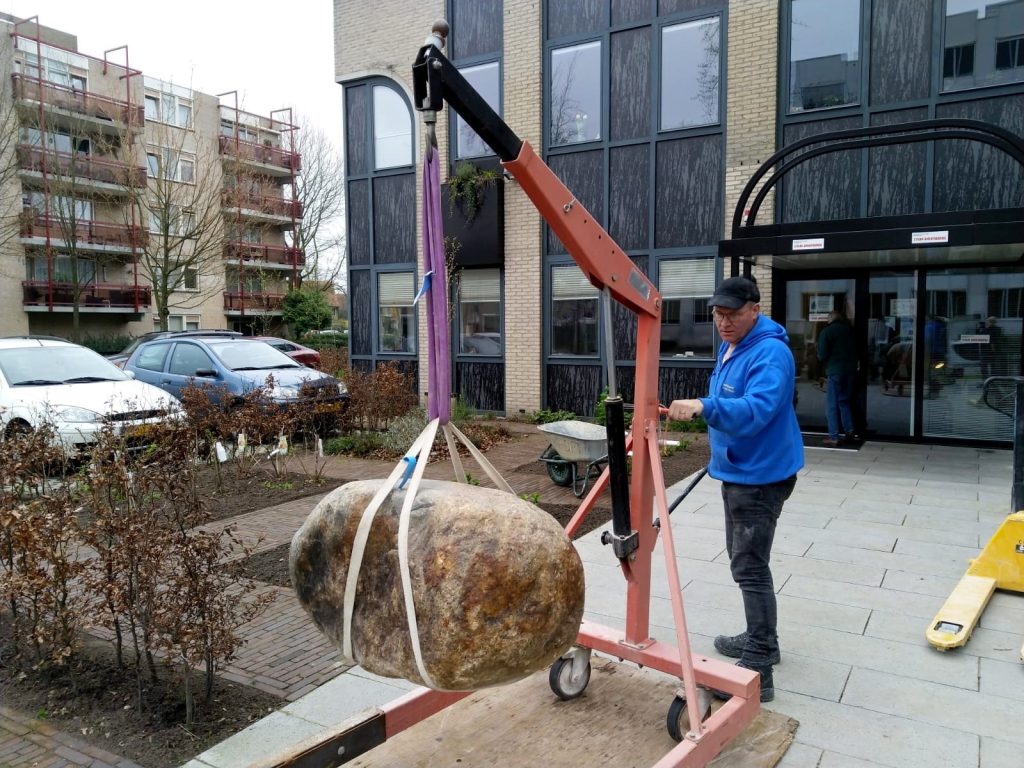
A customer told me he would like to own a Shivalingam. Not because he has a special religious connection with it, but he just liked the shape, he said. Now he still had a piece of Black Swedish granite lying around, from which it could be made. He himself drew the outline on a piece of drawing board. I traced this contour onto a piece of plywood, which allowed me to cut this shape out of the granite with my copying saw.
Fortunately I did not have to polish the lingam, but after the copysawing I spent more than a day of sanding the stone. He wanted it to be finely sanded up to grit 200. The most difficult thing is to get all false dents out of the oval shape, so that a nice smooth shape is created. You can feel it best with your eyes closed. During the work I sang all the Shivabhajans that came to mind, a beautiful meditation.
What is a Shivalingam?
A Shivalingam is an egg-shaped stone, a symbol for God in his unformed state of being. The male principle of Being-Awareness-Bliss (Sat-Chit-Ananda), resting in itself, all-encompassing but unformed. Often this egg-shaped stone is placed in a yoni or panipitha (water seat), a kind of foundation that is a symbol of the feminine principle (Shakti). The Shiva- aspect is Being, Shakti is Becoming. Shakti stands for the expression in all-that-is, the entire creation. So the same energy is Shiva when it is unformed, and the moment it decides to unfolds itself into full creation, you get the feminine creation energy, the Shakti. These are two aspects of the same energy. During rituals, Shiva is worshiped by pouring water and milk over it.
Read here a number of posts about the lingams and panipithas I made earlier.
An angel in two attempts

Then there was the sandstone angel I was going to copysaw for my colleague Serge. It is a commission from St. John's Cathedral, similar to my statues of Thomas Aquinas and Pope Leo the Great. He will make a fine copy of this pre-sawn angel again . Last time, Jelle sawed a similar angel, read here now.
However, it was a chore with a few snags. A few months ago I received a large block of Udelfanger sandstone for this angel. I immediately thought I saw something that wasn't right, and sure enough: the block was more than 10 centimeters too small!
After some deliberation it was decided to attach the bottom 15 centimeters of the statue separately. The reasons are the same as I explained earlier with Thomas Aquinas and Pope Leo: preferably they have the layering (the layers in the block of stone) run horizontally through the statue, instead of vertically, because otherwise whole slices can suddenly fall off. In contrast, you could argue that the thin wings might have been better made from vertical layers, because for that part that position is actually more favorable. It remains a struggle to find the best solution.
Cracked!


So I had recieved a block of stone that was way too big, but not tall enough. I cut it lengthwise with my concrete chainsaw in two pieces, and made a separate base from the lower part of the spare. I glued it to the bigger piece and started copy-sawing. But it soon turned out that the small black line I had found was a big crack, that ran through the block, from top to bottom. Oops! I put the block aside and made some phonecalls, and a week later I received a better block.
Second try

contour templates are next to it for the sizes
I cut up this block lengthwise with the chainsaw as well. Then I hoisted it upside down onto the copy-sawing machine, where I cut a nice flat surface. The spare part also underwent this treatment, and I cut a slice of about 20 cms from it. I was asked to glue these two pieces together. But if you have been reading along for a while, you'll know that I can't just put a thick layer of epoxy glue between them. You'd get a waterproof layer that will cause all kinds of problems.
I put both pieces upside down. After I made the surfaces to be glued as flat as possible, I prepared a special mortar in the right colour. I applied this thin mixture on the surface and lowered the smaller block onto it. For just a little while I was able to move that block, until the parts suddenly sucked tight .

It worked, a minimal, permeable connection was made. After the weekend, the mortar had cured and I drilled two deep holes with the diamond drill. In these, two stainless steel rods were glued with epoxy. A day later, everything had set and I was able to turn the block and start copy-sawing the sculpture.
Careful

It was not for nothing that this angel was to be replaced: it was heavily weathered and Serge had filled in all the missing parts with modeling material. That stuff is easy to remove afterwards, because it never hardens. But as far as I am concerned it is very difficult to work like this. I had to hoist and move the statue a few times, so I had to be very careful not to distort anything. And it's extra difficult during copy-sawing, because I could easily push through the surface of the clay with the feeler disc. I prefer plaster or hard mortar for repairs, because then I have to be much less careful. Fortunately, I managed to do it with a lot of patience.
You can see in the photos of the end result that I was very careful especially at the nose.
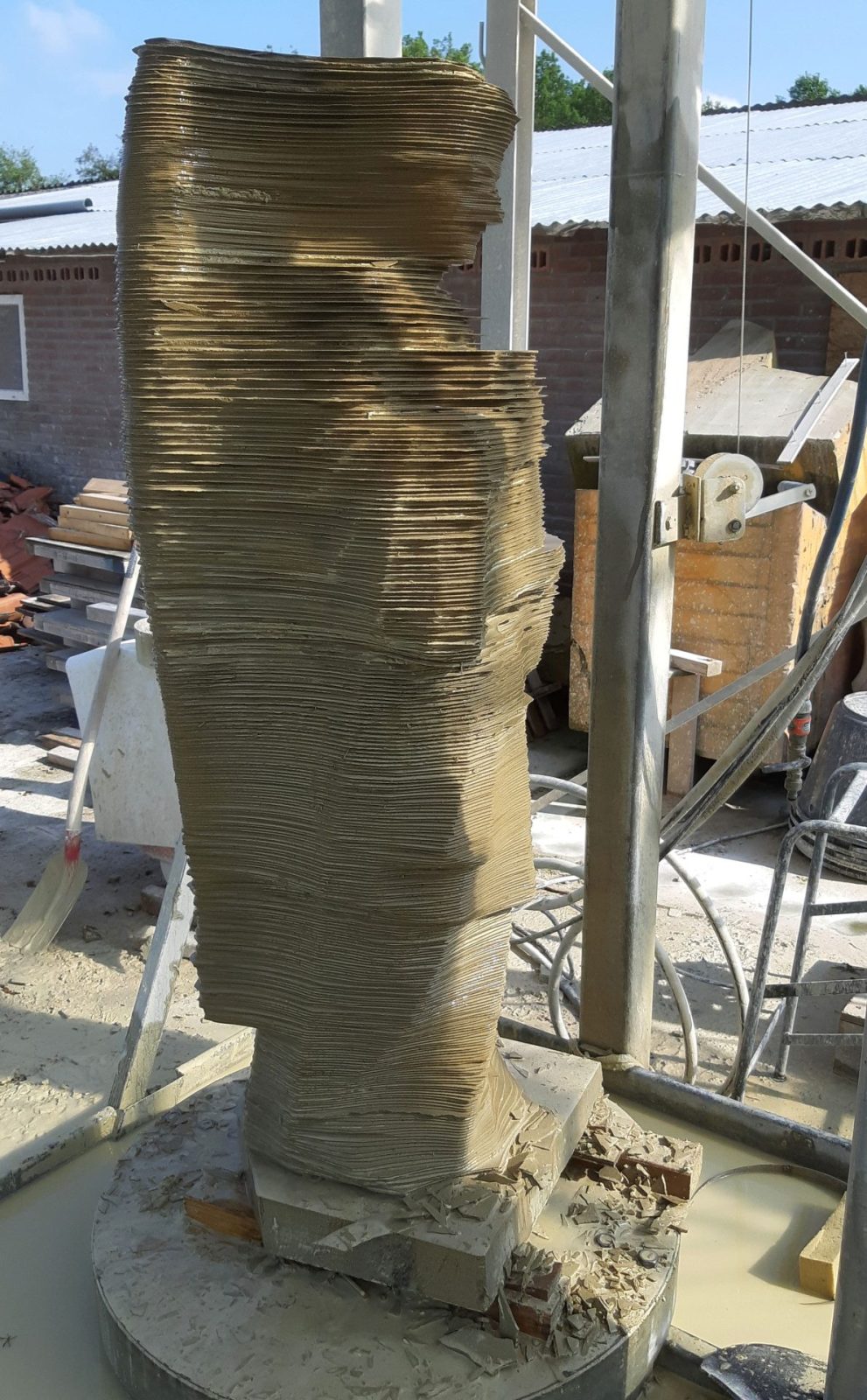
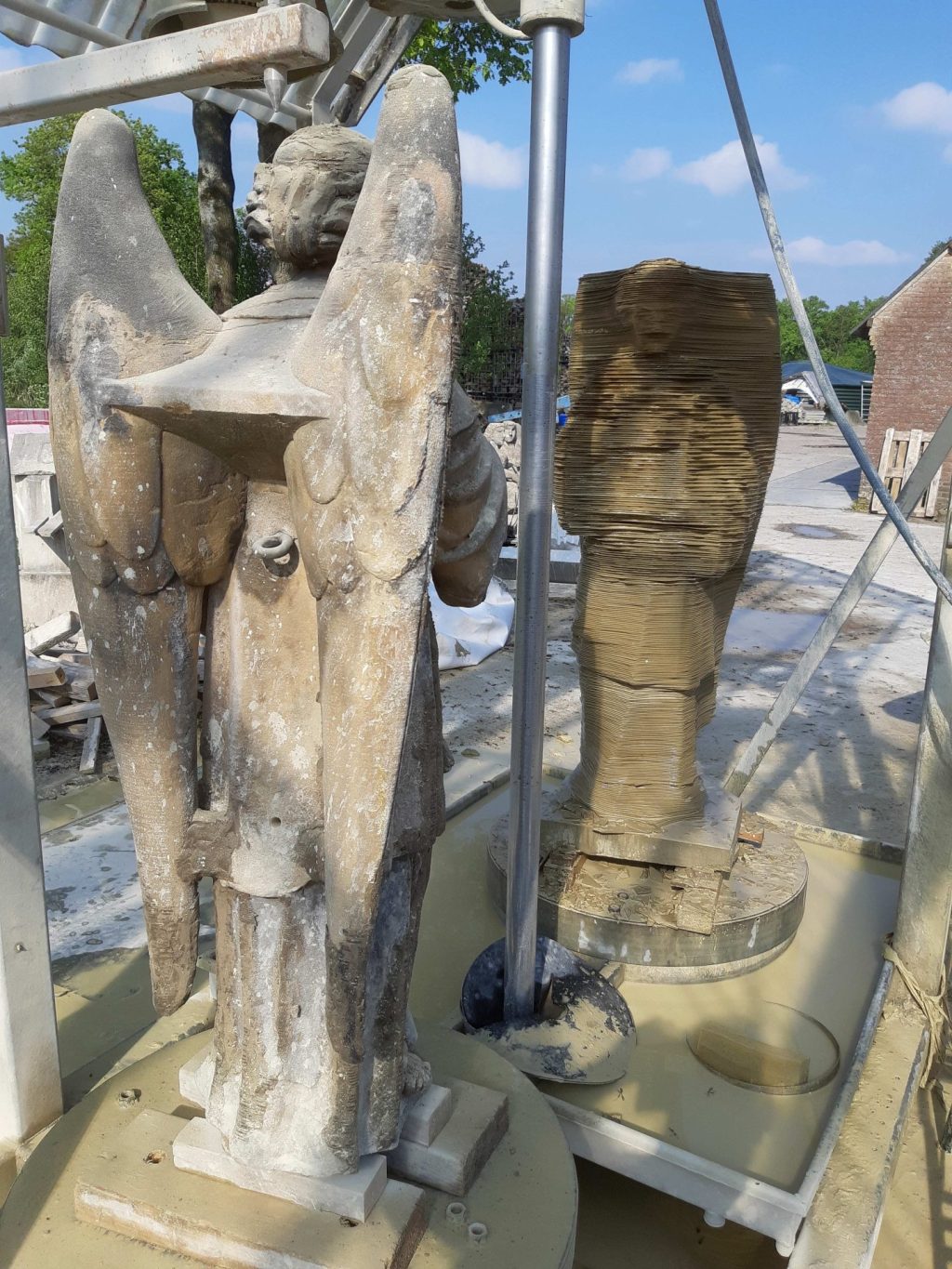
If I'd pushed through the clay there, this would have also happened on the cutting side, in the stone. One saw cut that ends up a little too deep, would create a lot of problems. In that case, the whole head will have to be adjusted, and be made further back. So rather a fraction too much material than too little in that place! And it turned out that the glue seam was almost invisible, you really need to know where it is, to spot it. It might end up a bit more visible in the sanded end result, but even then it will barely be visible.

Beeldhouwerijblog.nl is the blog of Koen van Velzen, sculptor in stone and bronze.
Look up my website as well: beeldhouwerijvanvelzen.nl
Follow me Instagram, Twitter as well & YouTube