• Thomas Aquinas, part 2: sawing
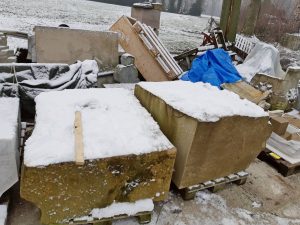
    Thomas Aquinas, part 2: sawing. Two large sandstone blocks
    1. Two large sandstone blocks of Udelfanger sandstone: 1 for the statue of Thomas Aquinas, 1 for Serge's angel

    Two large blocks

    The work on the on copy of the statue of Thomas Aquinas has finally started. I had received two large blocks of Udelfanger sandstone some time earlier: one destined to make two angels out of it and one block from which I had to carve the two parts of the statue of St. Thomas from St John's Cathedral in Den Bosch, The Netherlands and fit them together. So the first step was to divide both blocks into two with the diamond chainsaw.

    Presawing Thomas

    After that I put one block on my copying saw or contour sawing machine and started presawing Thomas' lower half. The dividing line of the two parts was meant to be near the line of his hood, so that

    it's almost invisible. Reminder: in an earlier post I wrote that the old statue was made from a single piece of stone, in which the layers run vertically. Because it's more desirable that the layers run through the statue horizontally (in that case, there's less chance that an entire big slice comes falling down at once, after weathering) it will be different in this copy. But the quarry has no banks in which the stone is higher than 120 cms wide. Therefore, the head was to be made from a separate piece.

    Thomas. Aquinas, part 2: sawing.  I halved the block with the diamond chainsaw
    2. The block is cut in half with the chainsaw
    Thomas Aquinas, part 2: sawing. Presawing the lower body
    3. Sawing the lower body

    Because of the large color differences between separate blocks of Udelfanger sandstone I was sent a very large block from which I had to cut the two parts. From this I made the body and the head of Thomas.

    Thomas Aquinas, part 2: sawing. Upper body presawed.
    4. The upper body was cut from the second half
    Thomas Aquinas, part 2: sawing. Rough carving the head and body
    5. The head and the body are roughly carved

    Fitting together of the two parts

    Then, the two pre-sawn parts of the head and body had to be made to fit to each other snugly. That wasn't so easy, because the dividing line doesn't run straight. It follows the wavy line of the hood and needs to be higher at the right hand, because otherwise the joint seam would run through the knuckles. These inclined faces need to fit together well. For this, it should first be clear what will be located where, and for that I needed to rough carve the two parts for quite a ways. I carved the upper body and the lower body so that I could see where it all would be going, and I could see where the dividing line was to run. Then I could find the joint surfaces.

    Thomas Aquinas, part 2: sawing. Making both planes fit
    6. The joint surfaces are being made to fit
    Thomas. Aquinas, part 2: sawing. The head and body are bonded.
    7. the two parts are bonded together

    Joint surface

    Because I made this joint line visible on both pieces, I could demarcate the joint surface and carve away the excess stone. By keeping on fitting the pieces together and scribing the excess stone, I could ultimately achieve a tight seam. When the fit was tight enough, I scribed off where I wanted to put the stainless steel pins and drilled four holes. Two holes in each piece, so I could adhere both parts with strong epoxy glue and two thick threaded rods. Also, the joint plane itself was bonded with a suitable breathable mortar. You should actually never make a horizontally extending closed off gluing surface on a statue sitting outside. The stone above such a dense glue layer can't lose its moisture and will start to rot right above the glue seam.

    Serge's angel

    Copying an angel for St. John's Cathedral
    The other block was halved as well. From the one half this angel was presawn for Serge

    My colleague Serge had an commission in Udelfanger sandstone as well for St. John's Cathedral in Den Bosch. He was asked to copy this angel. He had previously made one and asked me if I wanted to saw this one as well. Jelle did a perfect job for him.

    Read more about the continuation of this project in the next post.

  • Refurbishing a war memorial

    Recently I, along with assistant Gerard van Esveld, added some sandstone cappings to a brick wall in Amersfoort.

    These videos were made by Rob Lampe, who creates local reports for Amersfoort Gezien. He lives in the Westerstraat in Amersfoort, where in the year 1945 a bad policeman was shot by the resistance. In retaliation ten prisoners from camp Amersfoort were executed on the Appelweg just around the corner by the Germans. The wall where that took place was decorated as a monument very soon after the war was over, made possible by a gift from the doctor who lived there. The bullet holes are still visible.

    The texts and the wreath were carved in Bentheim sandstone. This stone can keep for hundreds of years, but it all needed some maintenance. There was some salt efflorescence and some joints had come loose. Also, the text in some places had deteriorated due to rain, but especially by cleaning off graffiti under high pressure. Some experts had inspected it before, and came to the conclusion that the salt efflorescence was not too serious and that it would be sufficient to carefully clean the monument. However, it was recommended to add a good capping layer of the same stone.

    In March I had already been at the wall for cleaning work. Because I was still recovering from a serious wound in my arm, my son Joram helped me at the time.

    The old capping of the wall consisted of a layer of bricks, on their side. To ward off intruders lots of glass shards were embedded in the cement. Perhaps effective, but far from beautiful. It didn't work that well for the wall itself either; the top bricks were soaking wet and the jointing had also suffered considerably.

    I ordered twelve sandstone pieces of sixty centimeters long for the new capping, with the same dimensions as the old layer of brick, in order to allow the connection at the remaining bricks on either side. They were cut to size by the stone supplier in Germany. The square center cappings however were carved in profile by myself, because the connection of each piece had to be different. At the underside I added a gully (for shedding dripping water), which ensures that the water does not flow along the wall, but stops at that place, and drips down.

    Gerard and I cut away the old rowlock layer and first positioned the center capstones, after which we fit the intermediate parts in between. It's an old wall that curves a bit as well, so everything had to be adapted on site.

    Why did I, being a sculptor, choose to do this work and not for example a bricklayer, or a stonemason? I was asked if I wanted to do the cleaning, and one thing led to another. It's a local project, something for someone with experience in sandstone, and there was some carving to be done. Because I've lived near the monument myself and know it very well, I had an affinity with it.

    Often there is a lot of grief in such a place, much heaviness of unprocessed sorrow. I hope that with the refurbishing and a positive work attitude, I have been able to contribute something positive to the whole atmosphere of this monument.

    In the first video from 5:00 minutes my colleague Stide Vos can be seen, working in the studio next to me on a series of statues for the Latin school in Nijmegen. He is copying old statues from Baumberger stone into new Obernkirchner sandstone.

    Read more…

No more messages to show.

No more messages to show.