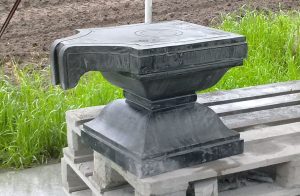
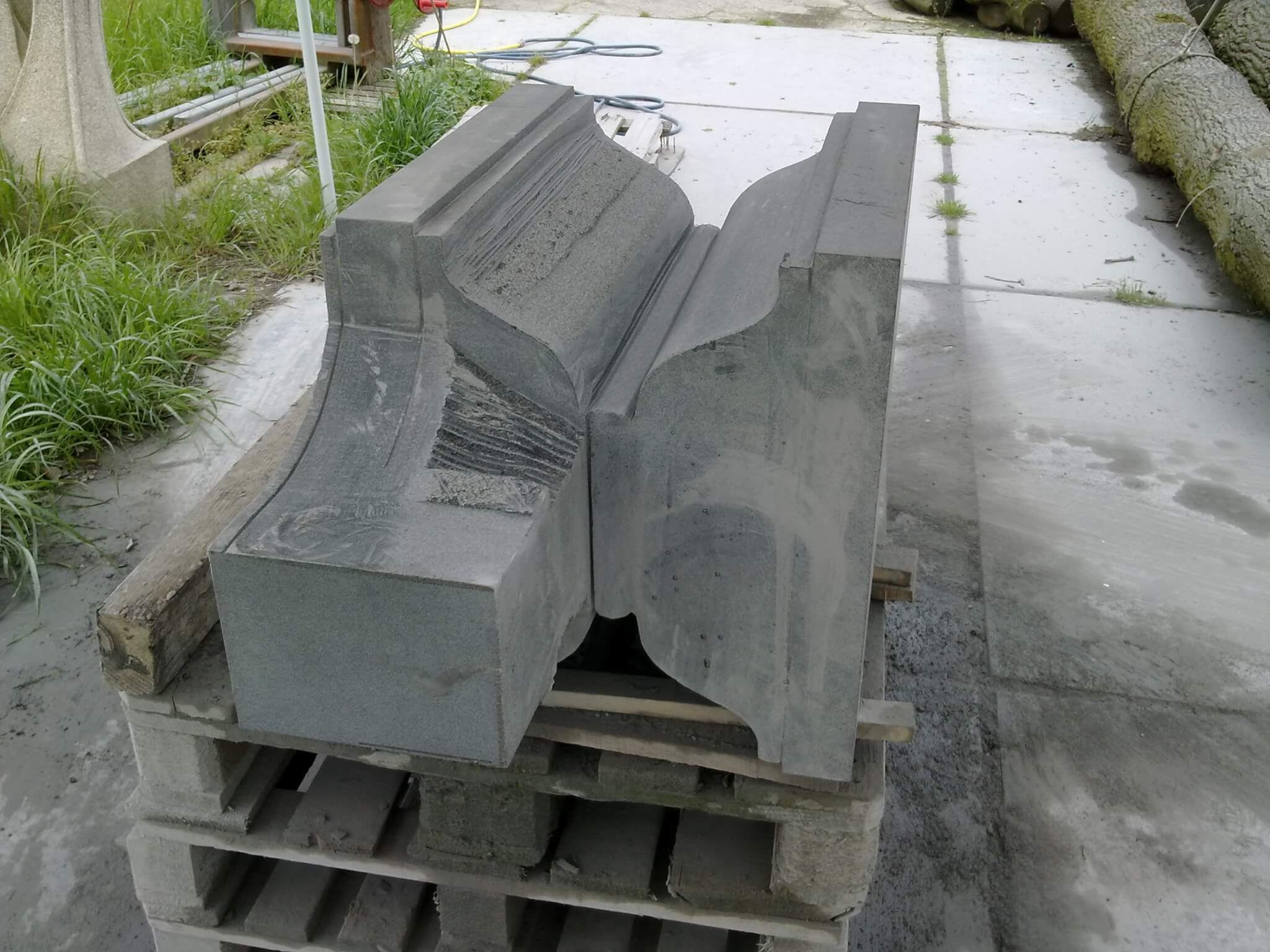
Actually, the work that I am doing now on the black-granite panipitha is not so much sculpting, but stonemasonry parts. With a lot of sawing and bush hammering I'm carving the ogee profile on the four sides of the block of granite .
On the basis of the previous designs I have created an exact profile template for this, that I can draw on both sides, after which I can take away the excess material, with the saw, hammer and chisel. The material is tough and carving takes quite some time. And of course it should be accurate, and that means working precise and a lot of measuring. It starts to take shape a little bit. On purpose, I left too much material for the spout; which will be defined at a later stage.
A good knowledge of stone masonry techniques always comes in handy, even in jobs when you're not actually carving in stone. Because of the stone mason's training I have learned how to tackle these kinds of shapes systematically. It's just like the knowledge of secondary school: at the time I often wondered what the use for a lot of the subjects was. 'I will never use that again later anyway', I thought at the time. But with these kinds of projects, and with enlargements, I find that I actually apply quite some maths lessons. Beginners lessons, that is, I've never been a high flyer.
Same with stone mason's techniques. I never even think about it twice, but after working with them for all those years, these are things I execute automatically. Without that background one would often be lost or messing about because you don't know how to go about it. So that half year's training in Utrecht wasn't wasted…
Tip: in this earlier message a play list is embedded with video's of the most important stone mason's techniques for flat planes.
Nasty the first message about this project.
Nasty the next post about this project.