• Two stolen facade reliefs: a head and a spoonbill

    My comeback on this blog!

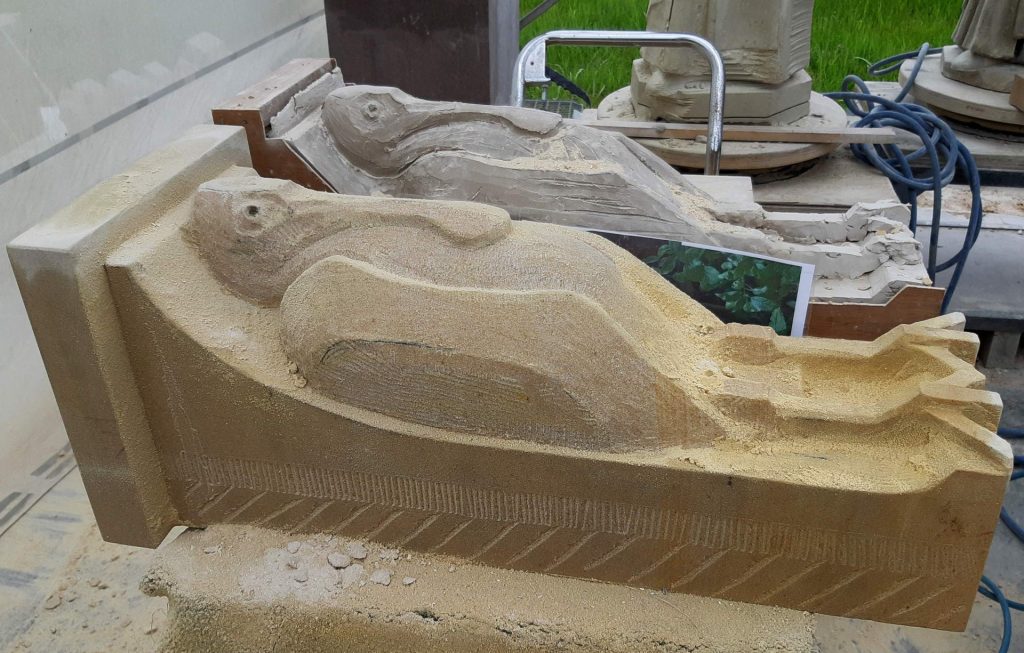
    I've recently had many different projects in progress and have just not gotten round to post any messages about them on this blog. But, fortunately we still have the pictures, as the businessman said when he saw his million dollar yacht sinking. This project has been an interesting challenge in between all the ornamental work. The job on hand was about two facade reliefs of a spoonbill and buddha head from Haarlem.

    The original stone ornaments came from the façade of the Lutheran Orphan's and Old Men's Home, which was built in 1906. After the demolition of this home, the stones were reused in the garden wall of the Vitae Vesper Elderly Nursing Home that in 2015 was demolished again itself. An apartment building was constructed on this site and the reliefs remained behind, discarded and orphaned. The Lutheran Church Council wanted to provide these ornaments a final resting place in their garden wall between Frans Loenenhofje and the Lutheran Church in Haarlem.

    A stolen spoonbill, pelican and buddha head
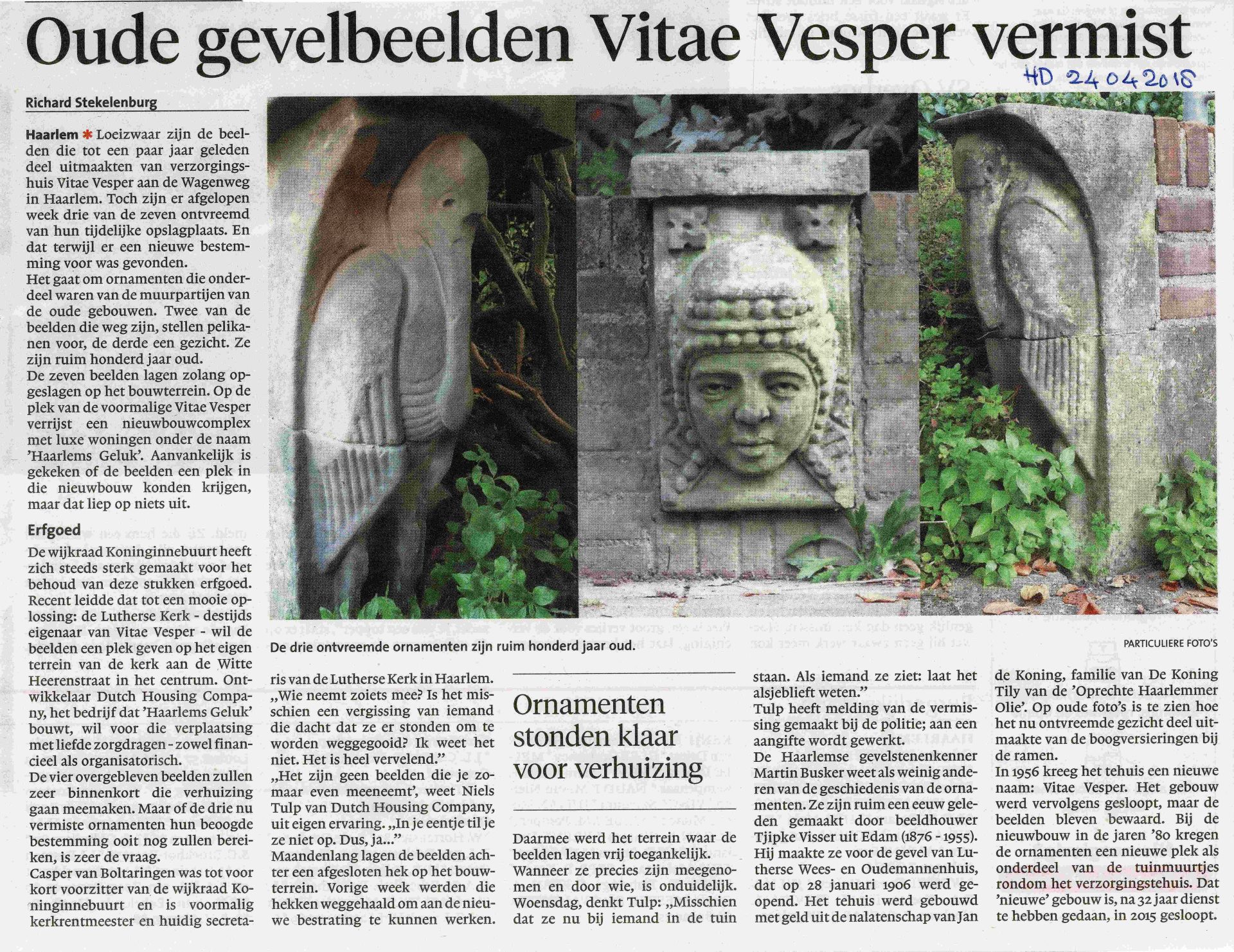
    -click on the photo for the article-

    The seven facade reliefs were removed from the original garden wall and kept separate. But three of those reliefs, of a pelican, a spoonbill and a Buddha head,  were stolen from the construction site. Fortunately, the pelican was found again three days later. Apparently there is a market for stolen ornaments.

    Stylized

    The carvings are quite stylized and I thought for a minute that they were made in the Art Deco-style. But Art Deco only started from the 1920s, so although around 1906 there was already a stylization going on, it was not yet Art Deco.
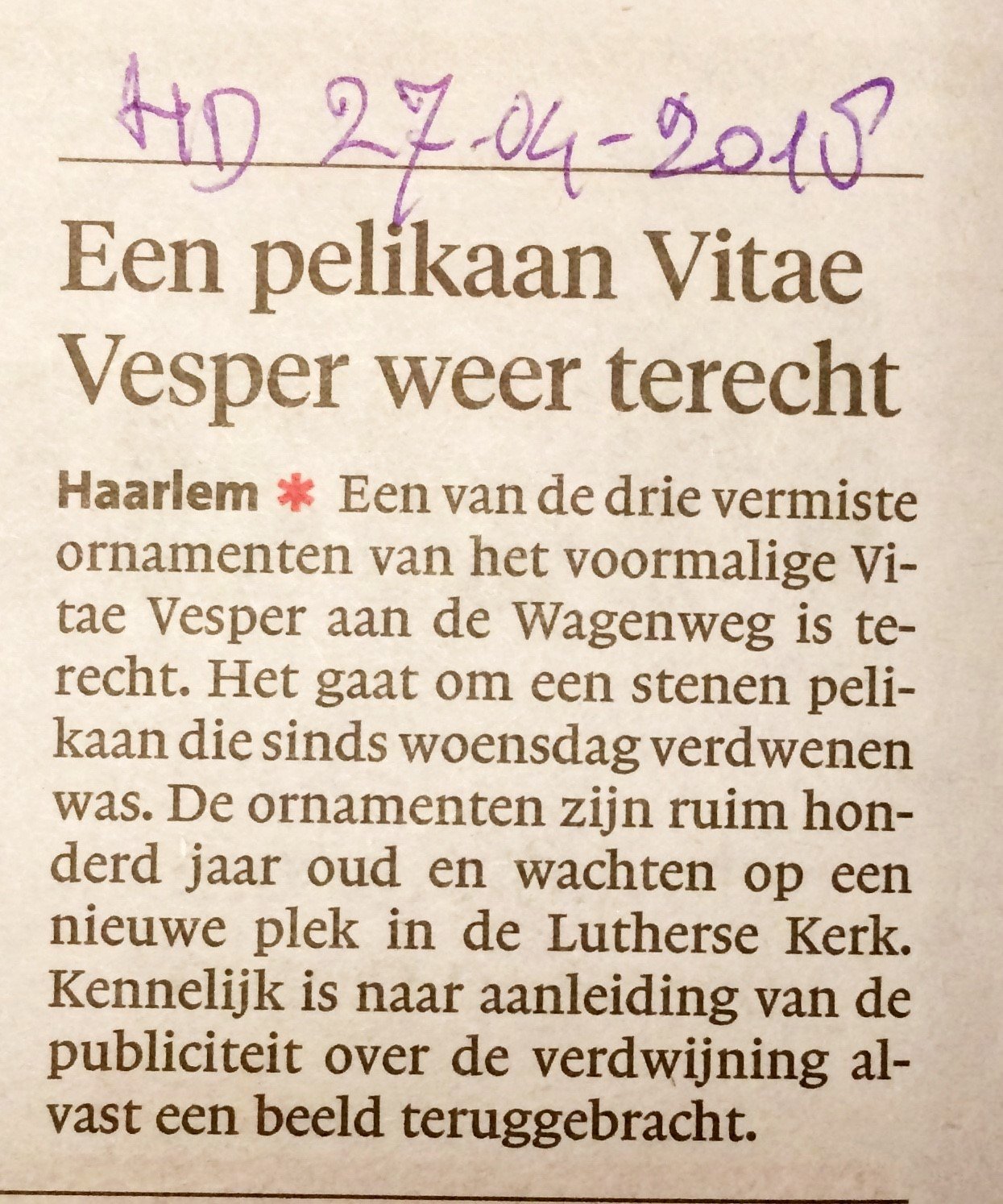
    The emphasis must have been on their decorative function, because I can't imagine what relation a heron and a Buddha head should have to a Lutheran orphanage. Or an Old Men's Home, for that matter. As the article mentions they were carved around 1905 by sculptor Tjipke Visser from Bergen, North-Holland. He made seven of those, a Buddha head, a head of a native American woman, two feline heads, an ibex, and a pelican and spoonbill. The spoonbill and the pelican are placed on opposite sides of an existing memorial in the garden wall of the Lutheran Church. The other reliefs got a place further down the wall.

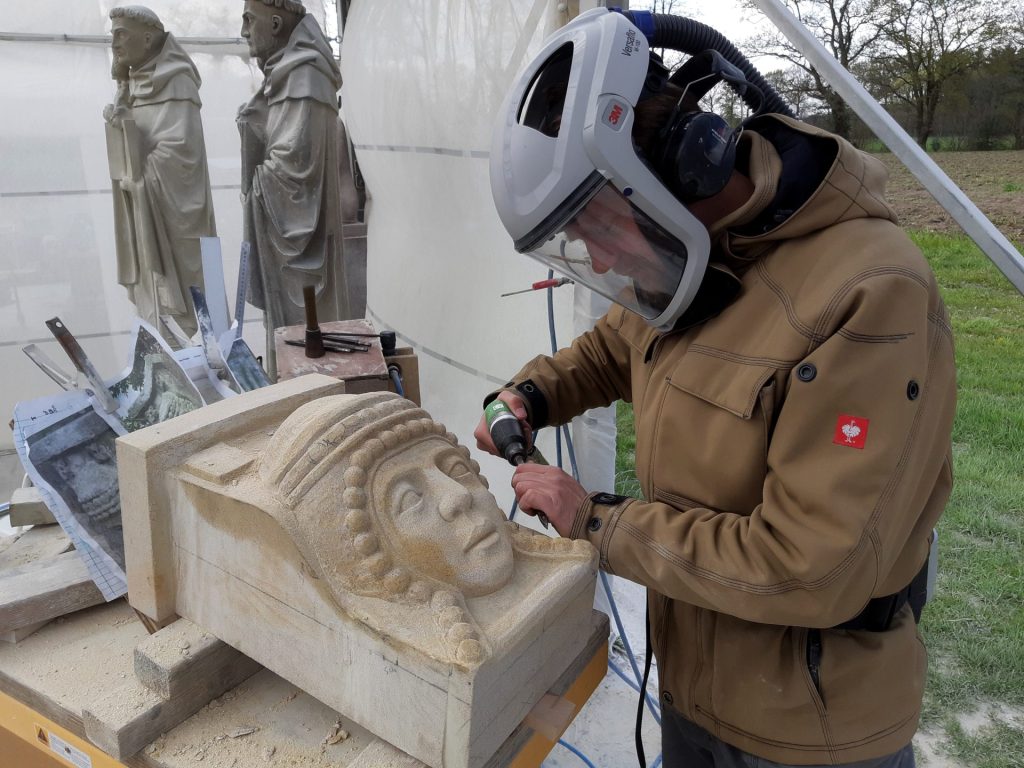
    We currently have a lot of work in progress at the same time. I just couldn't get it all finished on time alone, so I was glad Jelle took on the carving of the head (read his blog post about this here ↑) while I was sculpting a blue statue from sodalite in the meantime. Some time later I had time to tackle the carving of the spoonbill. We both followed the same procedure, so my approach below was the same for Jelle's sandstone head. I had ordered two blocks of Bentheimer sandstone to the right size, so we could get started right away.

    Modeling and copying
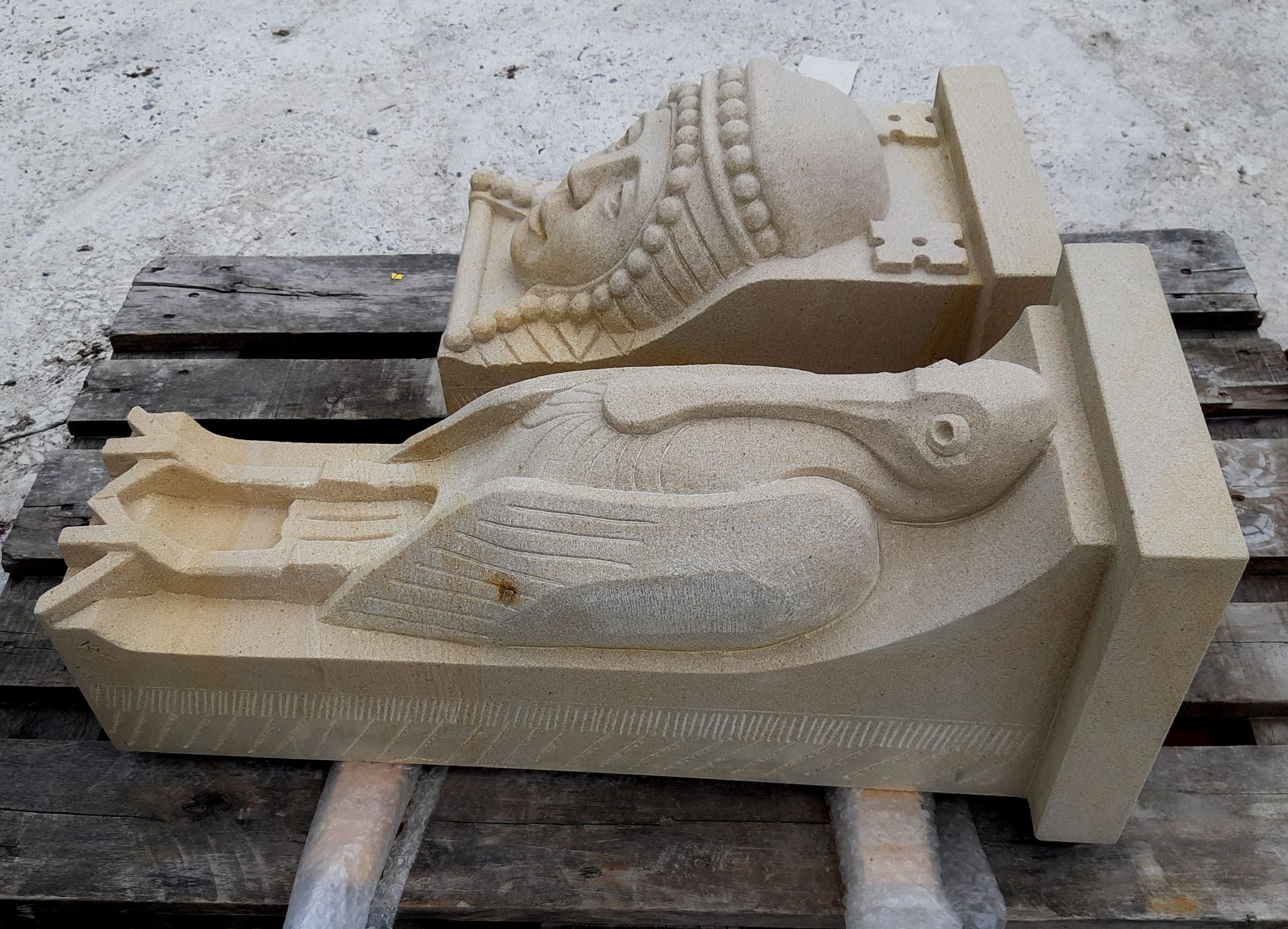
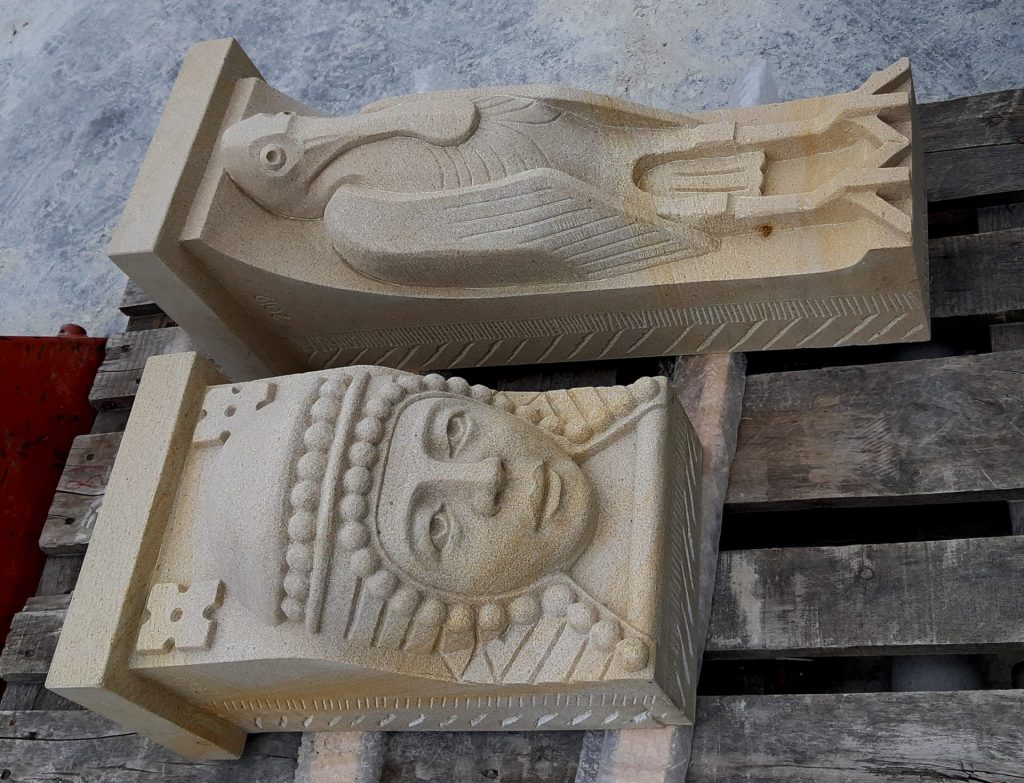
    Two new reliefs ready on the pallet

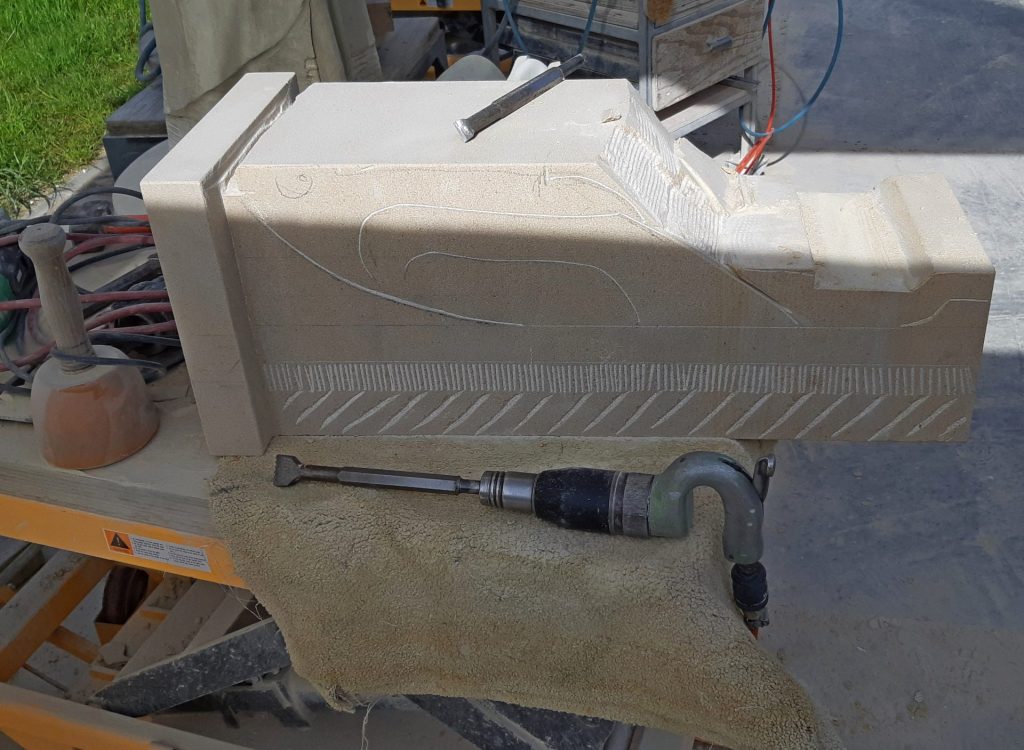
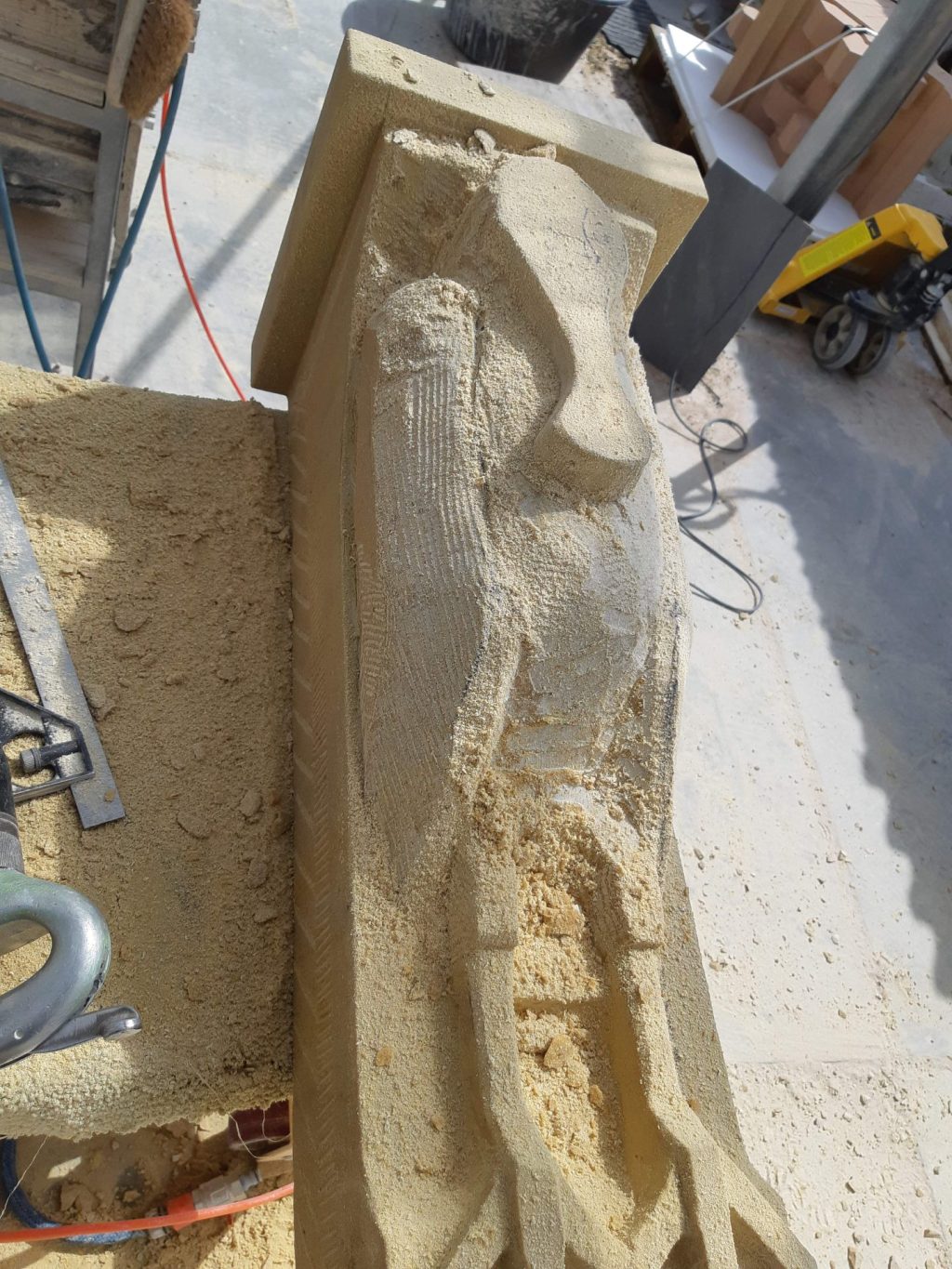
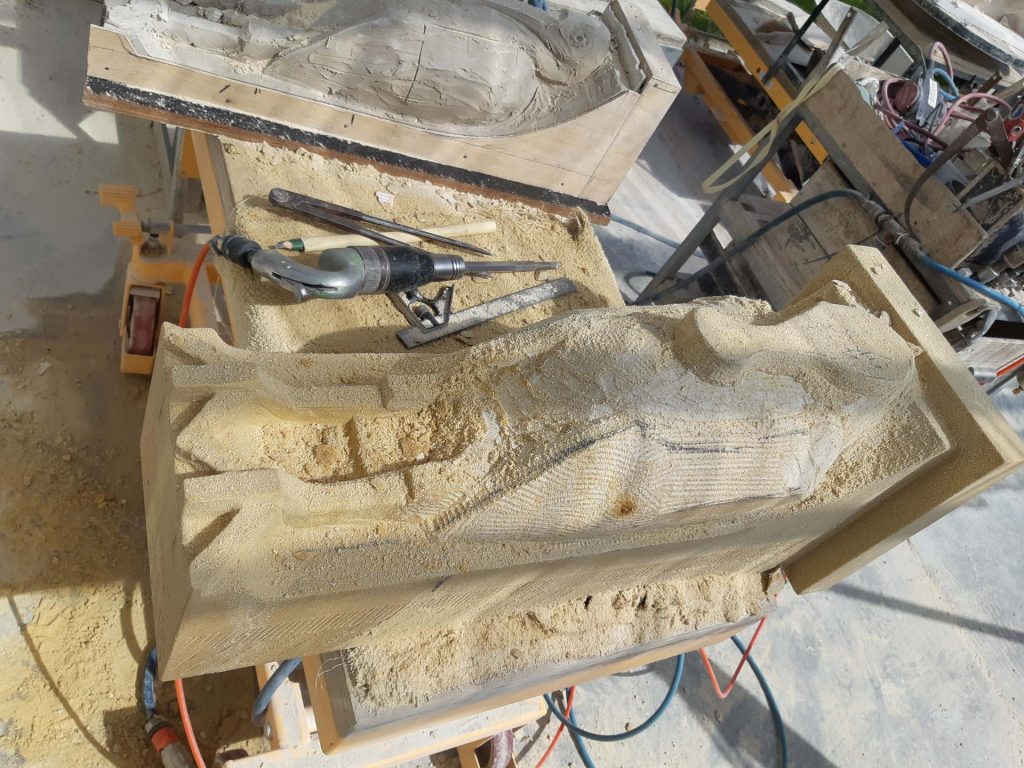
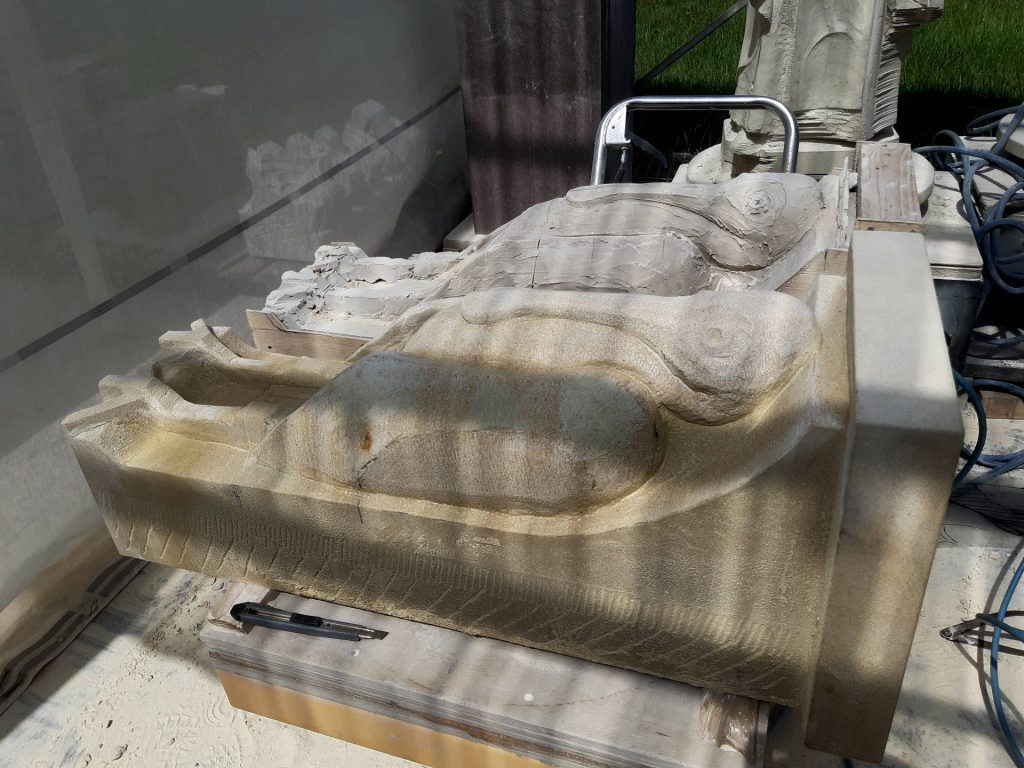
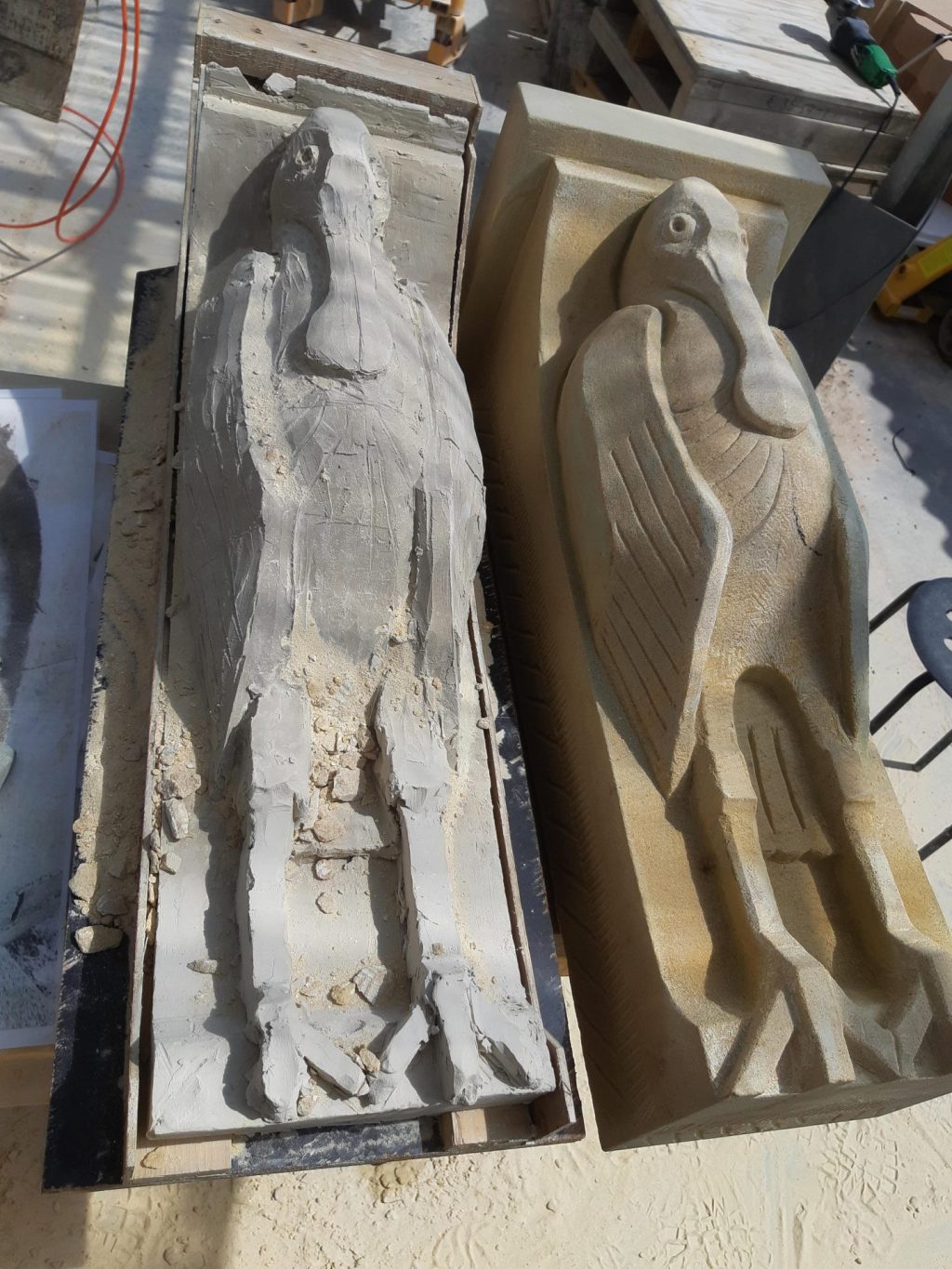
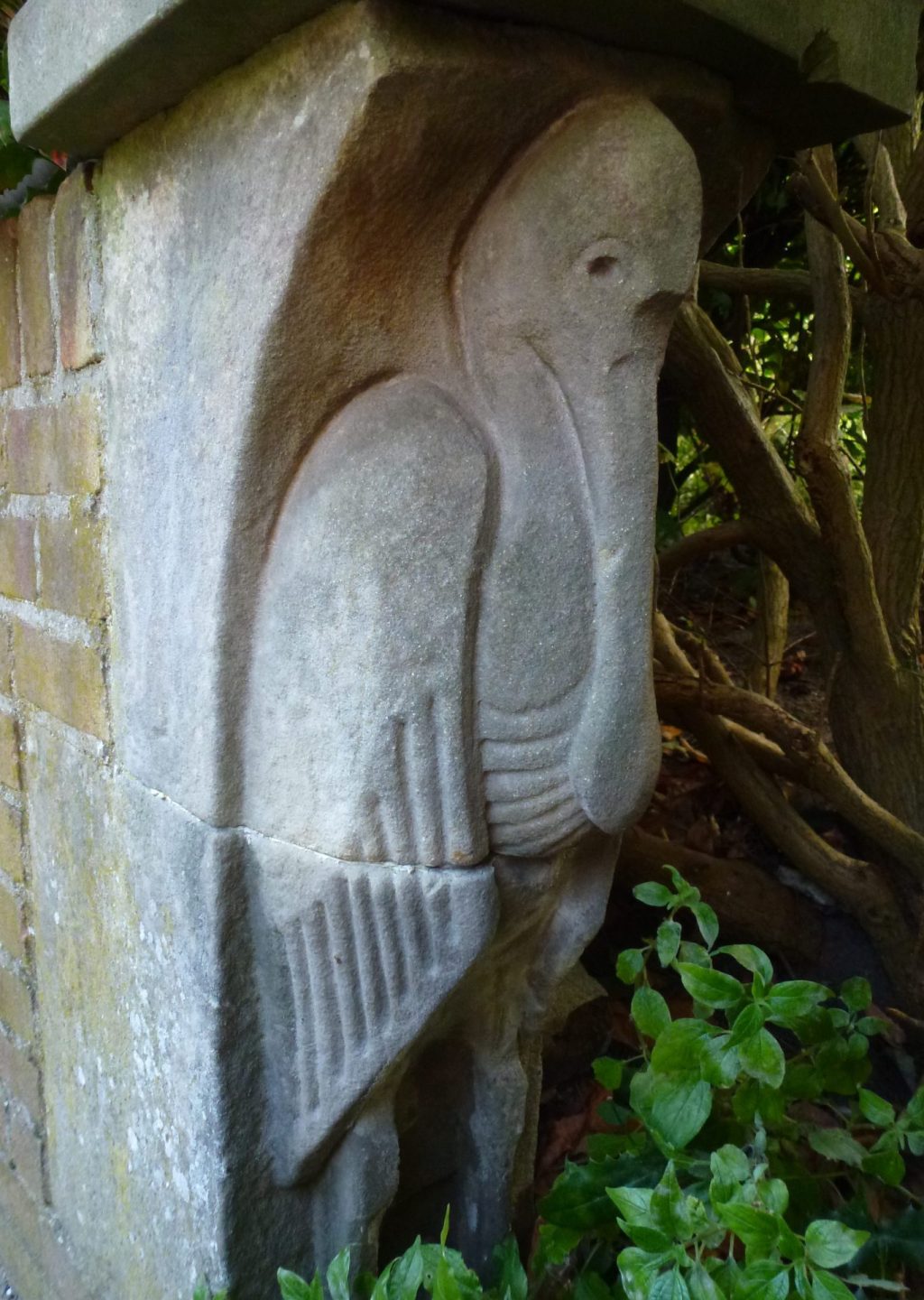
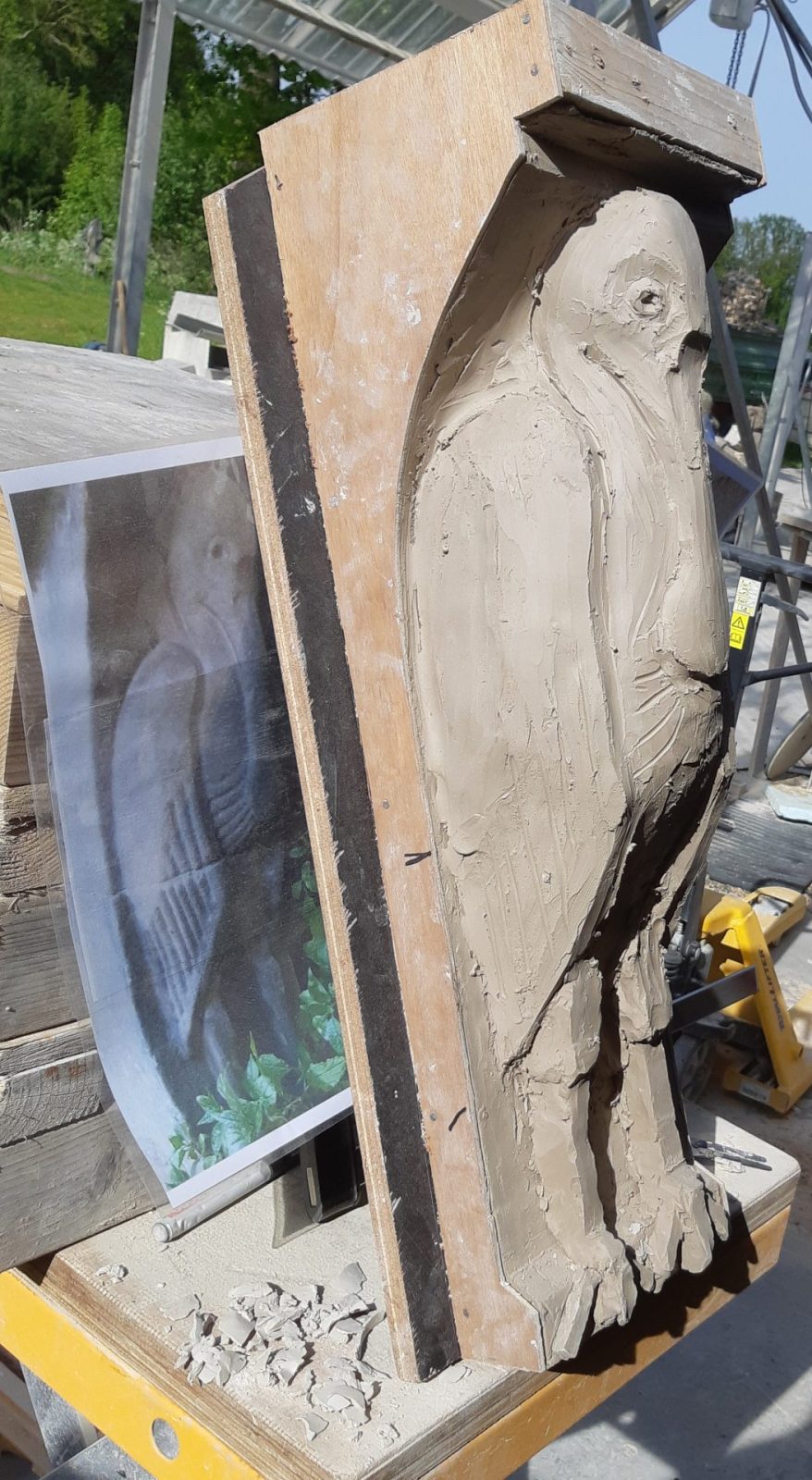
    I had thought about carving this spoonbill straight out of the block, but that is not the best way to address it if the customer wants an exact copy. I had received a lot of pictures of the old reliefs via email, along with a number of measurements that were carried out on the counterparts that were preserved. This proved essential in the reconstruction: from these measurements and the pictures I was able to model a similar looking spoonbill in clay. Fortunately, there were pictures from three sides, from when the bird was still in its last garden wall. Once the clay model was to my satisfaction, I could start carving a copy in stone. Small details like feathers in the wings I had left out for the time being.

    I traced the contours of the spoonbill onto a piece of cardboard, so I could transfer them onto the stone. After I'd carved away the stone outside the contours, I could transcribe the other sizes quite simply with a compass. In such a case, I usually put the two pieces tightly together. That way, I can transfer most of the width measurements one by one, without adjusting my compass. I've once made a video and a blog post about that. Once most measurements were in place and the rough shapes were carved, only the finish carving of the spoonbill needed to be done. The method of working from a clay model first is called the Indirect Carving Method. Read more about this method in this blog post.

    Gallery

    The facade reliefs can be seen in the garden of the Lutheran Church, Witte Herenstraat 22 in Haarlem.
  • Corbel for the Eusebius Tower: a bird-like beast?

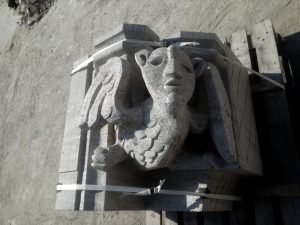
    Bird beast: a copy of a tufa stone corbel by John Grosman in new Muschelkalk limestone for the Eusebius Tower in Arnhem

    One of the last of the 10 corbels for the South- and North side of the tower of the Eusebius Church at 23 meters high was this winged bird-like beast. It sits somewhat cramped in its corner and there spreads its claws and wings. This piece was originally carved in 1954 by John Grosman, who also adorned a pair of flying buttresses with statuettes. I already copied his seven trumpet angels of the Apocalypse earlier; read the report here.

    Style characteristics

    Grosman at the time quickly carved these figurines out of the original tuff, and the chisel strokes can still be recognized from up close. I have not changed their style. Stide and I both agreed: if you'd think it necessary to leave your mark on this work and go about changing things, then you'd violate their original intention, it would detract from the atmosphere of an era and you'll either end up with something completely different, or something that makes no sense at all, ending up being neither this nor that. So with great pleasure I copied this figure pretty closely. A while ago I was able to inspect the whole group on site at the tower and it became clear that these five by Grosman form a coherent ensemble, even though I have no idea of their meaning. Most of the five figurines have a rather triangular, flat face which was carved close to the original surface, and are portrayed with wings.

    Legs and wings

    This bird beast was slightly damaged. It missed a claw on its right leg and there was some surface damage. Although it still looks okay, it's being replaced now because of this Ettringer Tuff is already showing signs of decay, such as tiny cracks, which will in the coming decades inevitably lead to danger of falling parts. Also, the original is still clearly readable now, so it will be easy to copy faithfully. There are sculptures on the Eusebius Church that are already falling apart now and have some parts missing. This would therefore require that a reconstruction is made before a copy can be cut.

    As I said, I copied this bird-like beast reasonably precise, except that I've carved the wings a bit thinner. Muschelkalk can be detailed a bit finer than tuff and is also stronger, so I can carve some things slightly slimmer than its original. In my opinion this doesn't detract from the original intention of the sculpture in any way.

    Carving by pointing machine, or CNC milling…

    presawing a flying buttress figurine on the copy saw
    presawing a flying buttress figurine on the copy saw

    There are of course methods to copy this sculpture much more precise. I could accurately copy it with a pointing machine to the millimeter and carve it into new stone. Or I could complete the bird beast with plastiline clay to a mint condition, then have it scanned with a 3D scanner, and then have it milled out of a new block of stone with a CNC five-axis milling machine.

    It may be clear that those methods, along with the advantage of accuracy, also have a number of disadvantages such as longer delivery time and a much higher price tag. A CNC milling will copy every little dent, so you'd need to prepare each model either to a mint condition or you'll need to keep a wide margin above the final processed surface. These are also costly machines, so this milling work does not come cheap. By the time the scan is processed and the robot and the stone are ready, I've already finished presawing. Besides, no further transport is required.

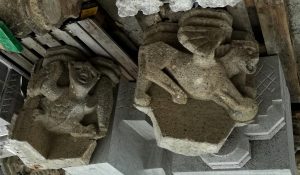
    Two winged cubistic creatures: old tufa stone corbels from 1954 by John Grosman from the Eusebius Tower in Arnhem

    Therefore my copy saw turns out to be for the flying buttress figurines a perfect compromise: I can accurately and quickly remove a l arge amount of stone, and at low costs. Yet little preparation of the original is needed and I keep just about as much margin as I have set in advance. Unfortunately I can not make good use of this machine for the corbels because these figures are embedded into crisp masonry .

    I cannot risk damaging this with an overshot saw kerf. For the flying buttres figurines, this risk is practically non-existent, since they need to be cut all around. Hence I carved this bird-like beast and all his other brothers by hand and measured them with the aid of compasses and profile templates.

    To the next corbel.

No more messages to show.

No more messages to show.