Patching up and replacing new blocks
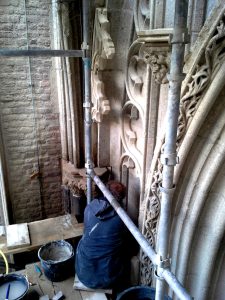
'Patching up’ was originally a fishing term for repairing fishing nets, from a time when these still had to be painfully repaired by manual labour with a spool of wire. Nowadays the term is used in all sorts of professions as designation for the re-filling of holes in work previously done.
I encountered the term before when I worked in parks maintenance, during the filling in of holes in hedges and other plantings, and this time around in the world of stonemasonry.
To the first post about this project.
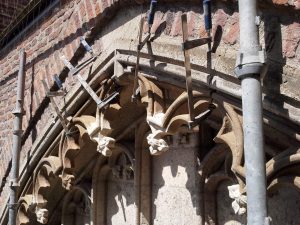
In this case, we are 'patching up' parts of stone sculpture’ in the South Portal of St. Stephen's Church in Nijmegen. We're putting in new pieces of stone in the existing facade, to replace weathered pieces. There is not that much to tell about; it is simply a matter of filling in the holes that we made previously (because we have removed the old blocks there) with new stone again.
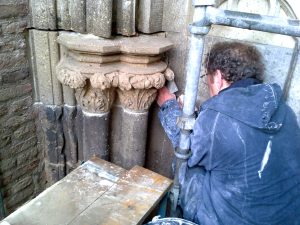
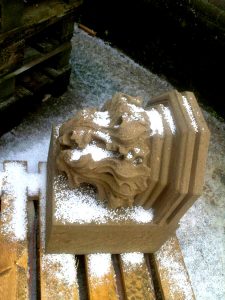
But of course it is no ordinary piece of stone, these are as I said before 20 trefoils (crets, my colleagues say, after the French word crête), 20 crockets (a form of reclining crockets), 7 consoles, two 'caps’ or upper parts of consoles and three capitals.
It is actually quite a tricky job. If we have made the drawings just right, then the pieces will fit into the holes and then we can add the mortar around the joints. But usually such a block has to come out once again for knocking off a piece of old grout somewhere, and when in very bad luck, a couple of times more, until it fits. Once the block is placed right and the grout has hardened, then through a hole at the top the liquid mortar can be poured behind the block , to fill the area below, next to it, behind it and above it.
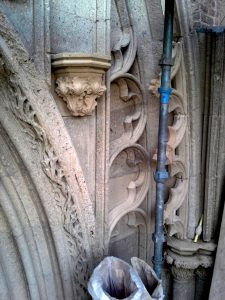
But those are the easy blocks: the capitals and the consoles. The hardest bits are the trefoils. These are very open pieces that will hang from the inside of the pointed arch, from a small contact area. For each trefoil there will be two anchors of stainless steel, which should provide for extra security.
Finally on the inner one of the pointed arches a whole range of side crockets will be placed. Side crockets are crockets on its side. There are ordinary crockets, water leaf crockets, finials, crockets, suspended flowers, and a few more types of flowers in the Gothic ornamentation, but these are all variations on a theme.
Next week we'll continue mounting the crêtes (trefoils), and when everything is done, we will accord. A new term to look forward to, but in any case it has nothing to do with accordion music.
Update 22 april 2015:
It's coming along nicely with the mounting of the blocks. Today we have suspended the last trefoils inside the arch. These 'crêtes’ have been carved by my colleague Jan Tolboom, so this is a three man's project: We divided the carving work into three parts , Stide and I take care of dismantling and placement and Jan supports us with his advice and insights. A good team, with a hundred years of experience put together.