• 70 percent debris

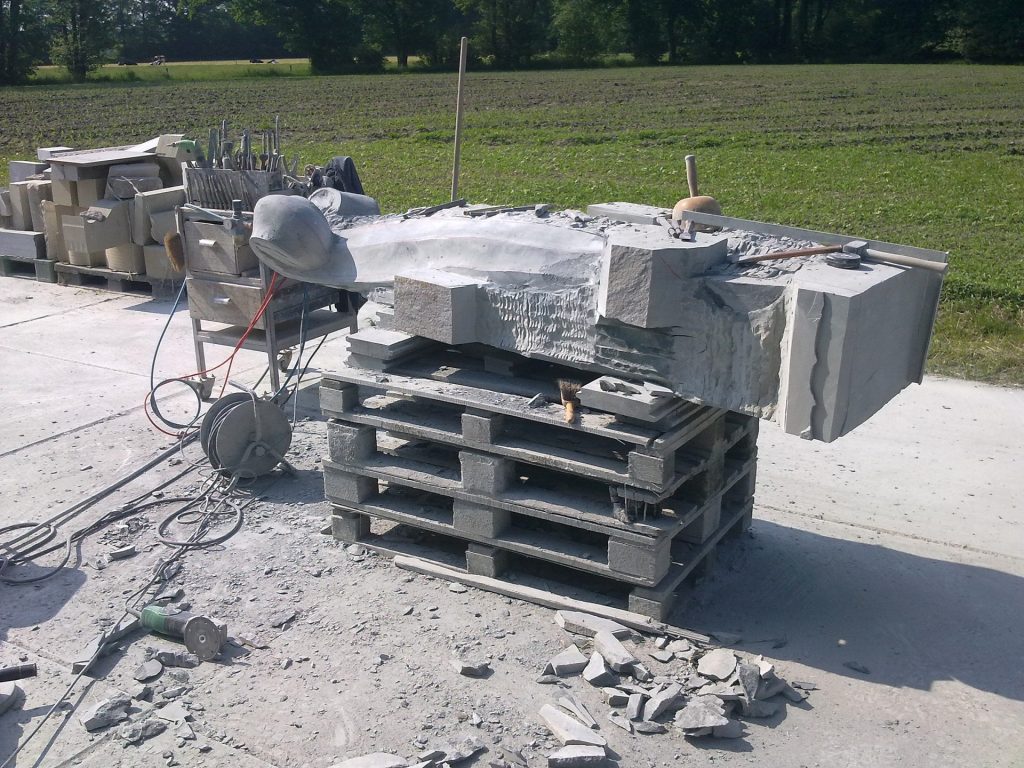
    One is often not aware, but when carving a statue from a block of stone, only a small part of it remains. I once calculated that very easily 70 percent of the block is thrown in the skip, and sometimes even more than that.

    In this case, the block of Anröchter Grünstein (they often call it dolomite) for the ferns weighed 3,5 tons, because I had taken a rough block. If I had taken a block that was cut to size, it would have been about 2200 kilos.

    I think I will end up with 600 kilos, so that's just a bit over 17 percent that remains. Normally one would take a block cut to size, So that means they already throw a lot of stones and debris at the quarry (The rough sides, non-right-angle pieces, bad pieces, and what was redundant after splitting the block).

    Most people find it a pity that you throw away so much of a resource. In a way that's true, but on the other hand that's just what makes it sculpting: Creating a form by taking away the excess. And that excess comes in the form of rubble, that's just the way it is. Using a computer-controlled wire saw you might still be able to retain greater residual pieces, but these still oddly formed and after a period of storage often still end up in the skip.

    Actually, this is quite a trivial topic; weight is obviously not the form of an image and nothing at all about beauty. At most, it says something about the process. That's what I like about sculpting: it is a process with many hours of handicraft between the creative parts. I do not constantly need to use creative side, I often enough may simply carve, and that gives a nice balance. How much noise all that cutting and that compressor will make, I notice that the purely physical aspect of the work to me forms a big part of the fun in the sculpting process.

    At the time when I had the stonemason's training, I noticed that all this hitting the chisel and stone brings a certain calm. With each blow you delete something from your unrest. Someone who has ever seen a stonemason doing his decorative chiselling will understand what I mean. I sometimes think that sculpting in stone could be a good form of therapy for burnt-up managers. Maybe something for the future.

    Nasty the first message about this project.
    Nasty the next post about this project.
  • Direct carving vs indirect carving

    Direct carving

    However much I like to find my way through the stone while carving, it's not always the most convenient way of working, especially when working a large piece. The advantage of the direct carving method is that your thoughts about the shape are growing along with the shape itself, and that you might work a little more directly.

    And, such as Bob Ross said: ‘We don’t make mistakes, we just have happy accidents’. Every now and then through a little 'mistake’ you'll be forced to change your mind a bit, and apart from teaching you to be flexible and inventive, it can actually sometimes produce something unexpectedly positive. The disadvantage is that it can be a very time-consuming way of working, especially in complex work. You're constantly trying to find solutions, and in stone that is not easy. Another disadvantage is that any real mistake in stone will be irreparable. When carving a sculpture of 2 metres 30 tall you don't want to end up there.

    Indirect carving

    auguste-rodin-in-atelier. Indirect carving
    the studio of Auguste Rodin

    Hence, already in antiquity, sculptors would make a model out of clay, and took their measurements from that in order to carve out the larger work. But having a a clay model right next to a sculpture that you're carving is just not practical. One shard splitting off wrongly and your clay model is unsusable. So they used to make a casting in plaster, which they used as a model for carving. This led to the point where other sculptors were able to perform the precarving work. This way Auguste Rodin for example had a whole studio full of assistants, who precarved his statues based on his models, after which the master himself put the finishing touches to it (sometimes just his initials). They used a full-size model and took the measurements with a pointing machine.

    Combining the two methods

    slose up van punteerapparaat, hulpmiddel voor taille indirecte in steen en hout

    In this sculpture, I tried to combine the best of both methods by carving a model out of Pir foam in the direct method, which I now use as a model for the large sculpture. And because I work with relatively few points, there always remains a very large part of the shaping process on the final stone sculpture.

    The dolomite in which I carve this is a nice stone to work with. I'm carving in it for the first time ever, and noticed that it is not too hard (slightly less hard than Belgian bluestone), but somewhat layered though. It still looks a bit greyish now, but once you have fine sanded it, or wet it, or put it in oil, the greenish colour comes out clearly. When it's finished, it's time to decide for the best treatment to get it soft green, with a few test pieces. If the sculpture would stand outside, it would become greener all by itself, but it's intended for indoors. And yes, as you can tell: it remains dusty work. Fortunately, I have a good dust protection.

    And yes, as you can tell: it remains dusty work. Fortunately, I have a good dust protection.

    Nasty the first message about this project.
    Nasty the next post about this project.

No more messages to show.

No more messages to show.