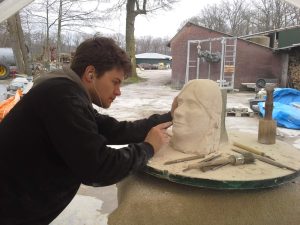
A relief in direct carving method
The holidays are over and so I started a next project last Wednesday: a relief in direct carving method. It's still far from finished, but it's starting to show just a bit by now. I'm carving it out of 'beats-me-stone ', a piece that I had lying around and of which I have no idea what exactly it is. It seems like a layered kind of sandstone, but it can also be a slate-like one. Anyway, it turned out te be a beautiful piece to work in, It can be sanded to a very fine grit and carves away very easily. Sometimes you just need a little luck.
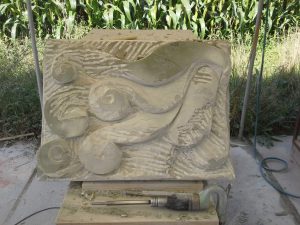
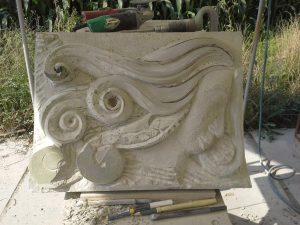
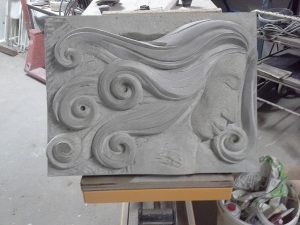
Update:
I've been wondering over the last few days what kind stone it should be. For a while, a colleague thought about Ölandsteen from Sweden, but by now, I found out that it should be a German sandstone in any case. But which one? Maybe Sander sandstone?
The point is that there are so very many German sandstones about, and I have no idea how I should recognize them.
I would very much like to carve more in this stone. At first I had some trouble with sanding it, because a small test with a rasp made it soon disappear and this also applied to other abrasives. I have been sanding with all kinds of materials, from sandpaper to small pieces of ceramic bonded abrasive disc. Until it turned out that it just goes perfectly with a shard of the same stone! The two stones wear each other off beautifully smooth.
Now it is known that sandstone is generally best sanded with the same material, but I simply hadn't noticed there was so much sand in this stone. It's a very dense stone, you see.
And sanding with a stone has another advantage: It's much easier to keep the shapes and forms smooth. A sandpaper follows all lumps and dimples, but a hard shape, such as a file or an abrasive irons these out. Now I can only hope I can find more of that stone.