Thomas Aquinas (sandstone) for St. John's Cathedral
St. John's cathedral
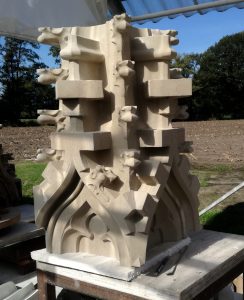
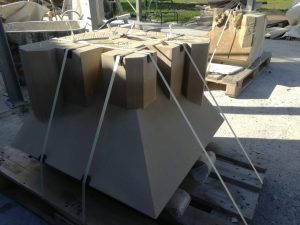
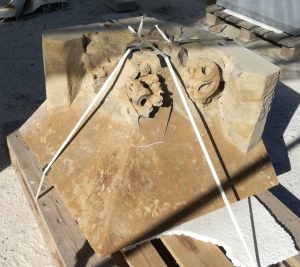
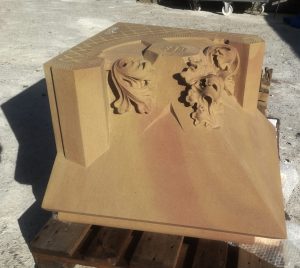
The major overhaul of St. John's Cathedral is steadily continuing. Each year or maybe every two years, I'm not quite sure, one bay of the church is restored: 1 buttress and 1 window facade. This year I already did some work on two finial bases, a slanted profile and some crockets, but this time no canopy.

Thomas Aquinas
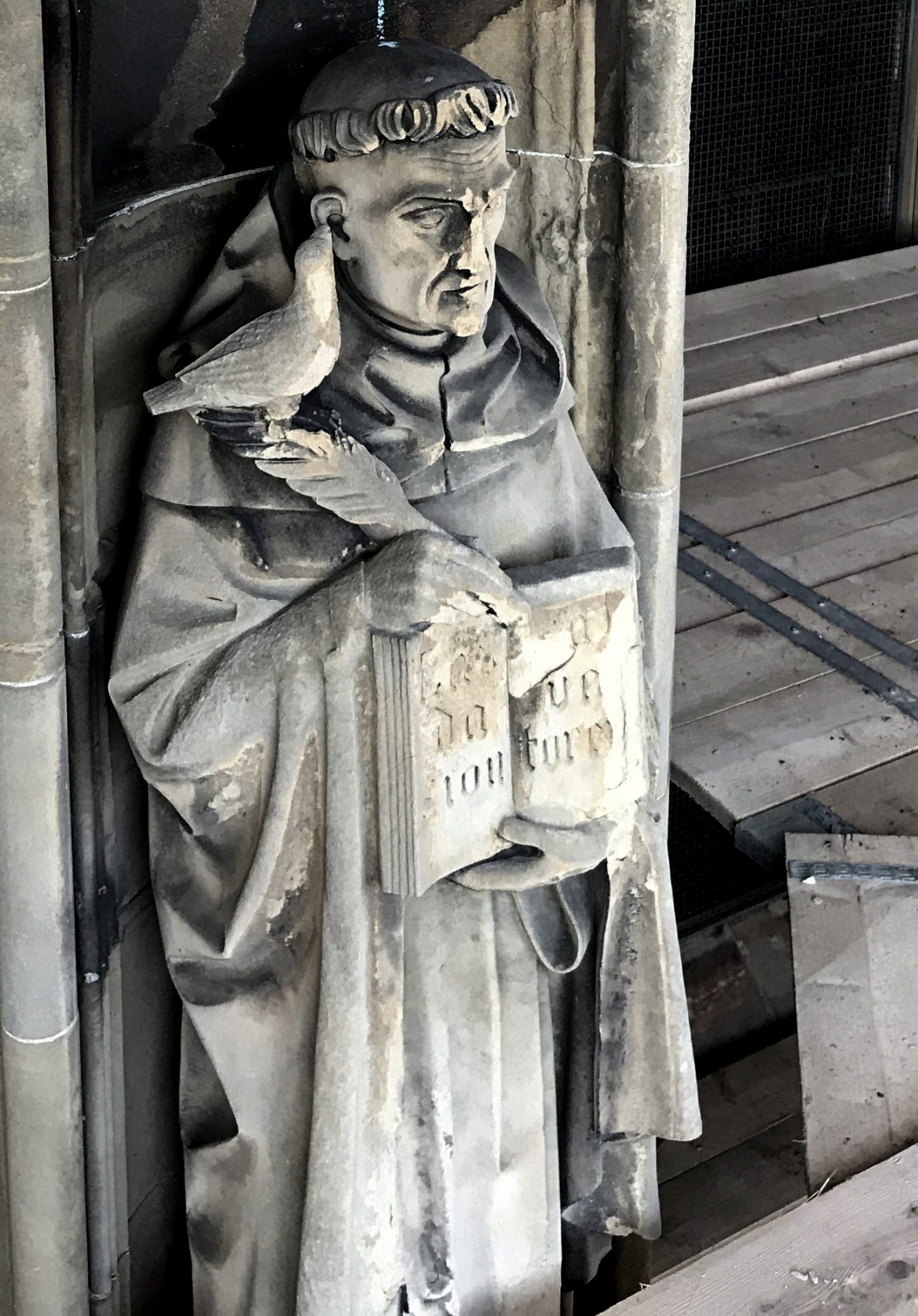
I received a request to bid for the carving of a copy of a statue from this church. To my pleasure I got the commission. But at the time it was not yet clear to me which saint was depicted. It is a statue in Udelfanger sandstone.
Stylistically I thought from the 1920, because it is so highly stylized, but it is about 40 years older: around 1880. It's a monk in a Dominican habit (as seen by his hood) with a book, a quill and a dove. The book and dove made clear that he is a "father of the church’ as it's called.
a father of the church (nowadays Teacher of the Church , because there are female teachers of the church as well, such as Teresa of Ávila, Catherine of Siena, Theresia of Lisieux and Hildegard of Bingen) is someone who has left important writings on faith and doctrinal matters and has led an exemplary life of holiness.
I thought his book to show something like 'Lausal da van Sion Tower', but a search yielded nothing. I wish I had read vertically!
Long live Whatsapp
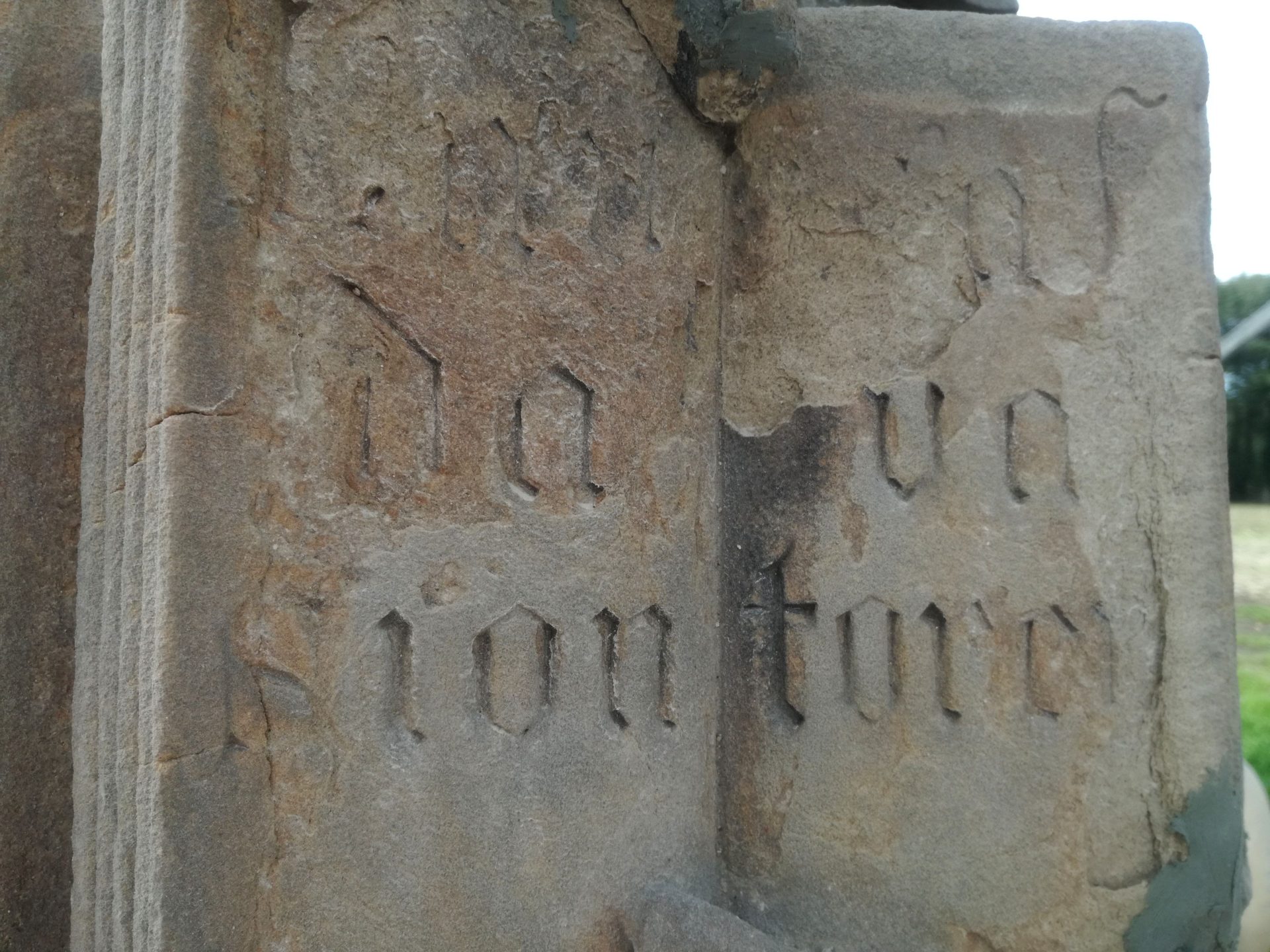
After a few questions via Whatsapp to the right person it became clear that this sculpture has been on the outside of the cathedral in front of a stained-glass window, and that he probably was depicted on the inside as well. And yes, he was, he turned out to be Thomas Aquinas. And so the text becomes immediately apparent: an opening sentence from a famous cantata written by him. 'Lau da Sion Sal va torem'. Praise, Sion, the Savior.
strange, For Aquinas was, according to tradition so enormously fat that he did not fit in a regular choir bench. They had to saw away one of the separation pieces, so he could sit at twice the normal width. Here he is pictured almost ascetic lean.
Vertical layering
Anyway, I was not hired for a hagiography or for art historical research, but to carve a copy. The first step is to reconstruct it, and then I need to carve a copy from that into a new block of sandstone. And just there's the catch. The old statue was carved in Udelfanger sandstone. But this stone is not available in this height. How is it that they were able to make a statue in one piece anyway? Simple. The stone they can retrieve from a bank of about one meter thick. So a statue of 152 cm is simply not possible. Unless you take a horizontal block of stone.
But this choice has its drawbacks. The sedimentary deposits of this block will then be in line with the statue. Vertical. You'd prefer that the layers run horizontally through the sculpture, because if something breaks, the fracture will run horizontally as well, So the chance that everything stays in place anyhow is quite large. But in a statue with vertical layers, after some weathering an entire slice at once could come loose and fall down.
The layer deposition in the quarry is called layering. Horizontal layering is desirable, upright layering is not. For this staue, they wanted a block with horizontal layering. That just is not possible, because the bank thickness in the quarry is not more than at most 110 cms wide.
Patching it up
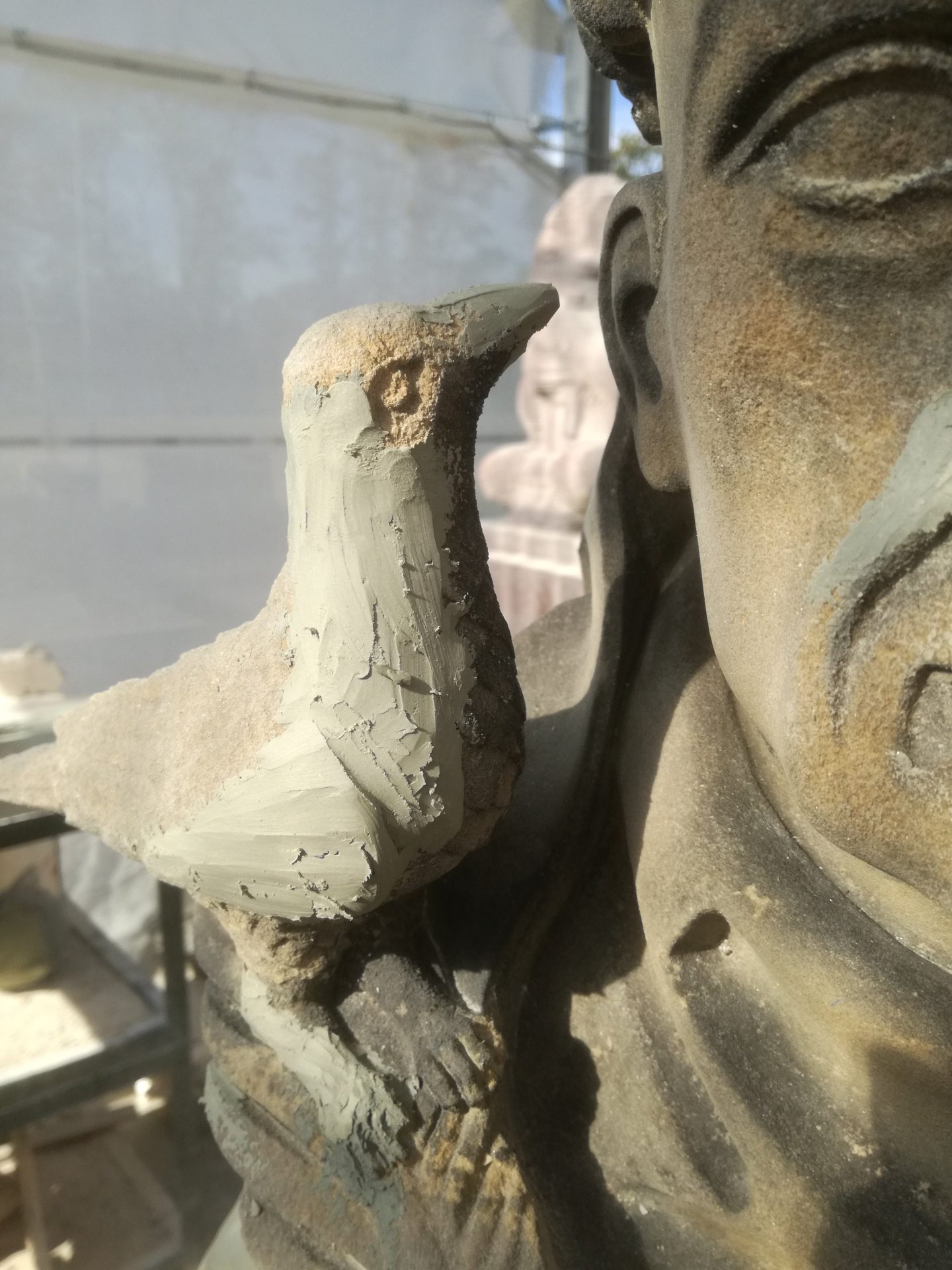
The pictures show clearly that this sculpture is missing entire parts at the bottom, which fell off after weathering. I had to remodel those first and make a reconstruction of how it must have been originally. Now I do prefer plaster for this, so I can presaw the statue more easily on my copying saw. But Thomas Aquinas must be preserved intact because he will be stored later in the museum The Bouwloods, at St. John's Cathedral. That's why I modeled the missing parts in plastiline clay, which never dries out. That can later be easily removed again.
In two parts
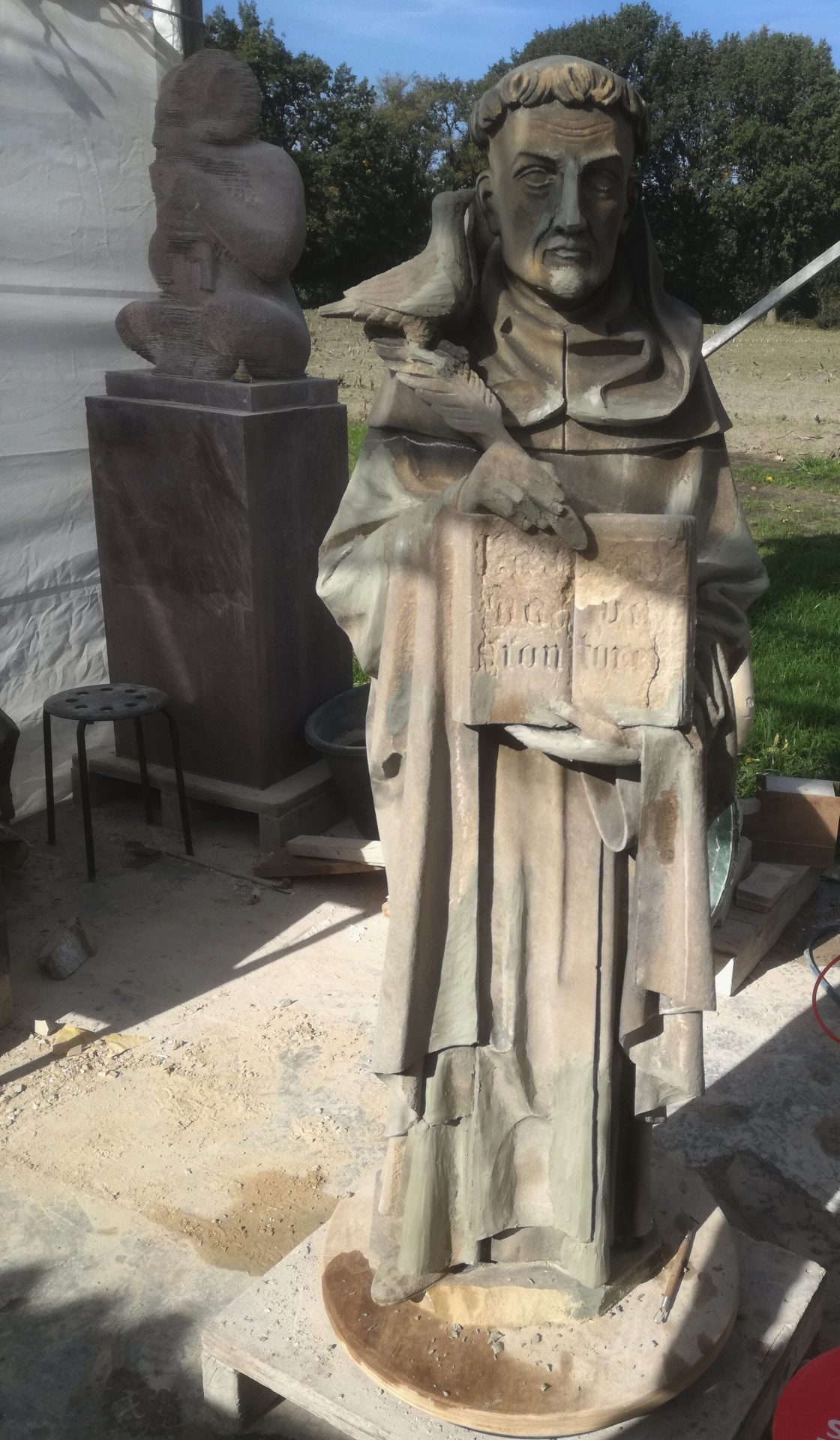
This week, the committee came to see me to review the results and discuss how we can make this statue in horizontal layering. Eventually it was decided to create a thin seam between the two new blocks. On the dividing line of the monk's hood will be a cutting surface. But this seam runs quite irregular. When I cut a straight line here it will firstly be very visible and secondly the seam runs through the knuckles of the right hand.
After some deliberation we decided: I'll make a separate top part and a separate bottom part. Exactly on the axis of the cap, I'll carve a parting plane toboth parts. Next, I'll put the two pieces together and insert two thick stainless steel pins. That will be an interesting puzzle!
Read more about this image in the next post.