• Two stolen facade reliefs: a head and a spoonbill

    My comeback on this blog!

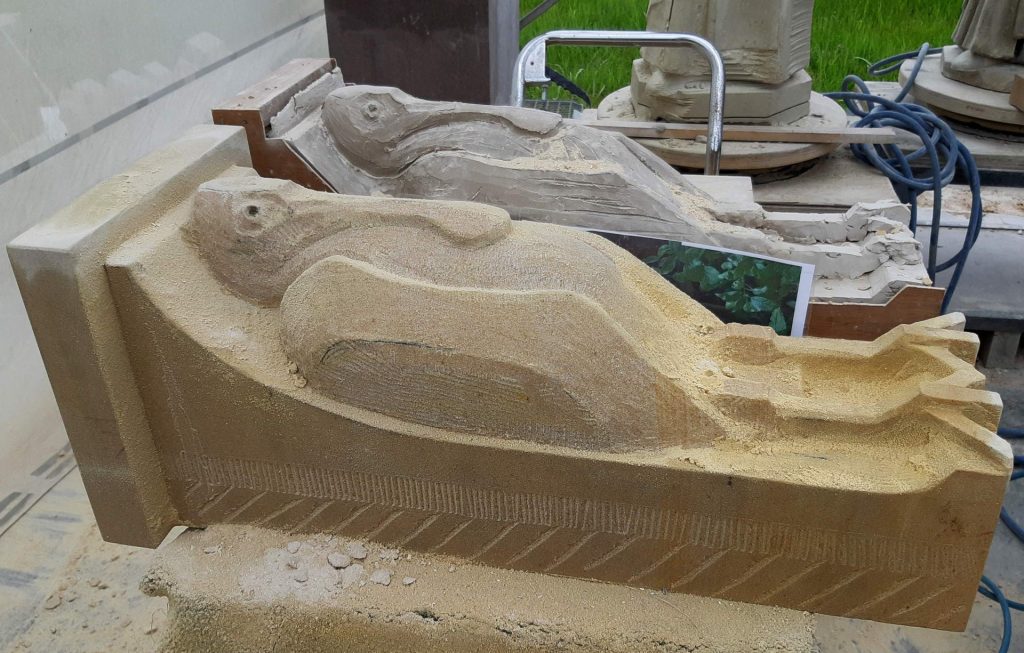
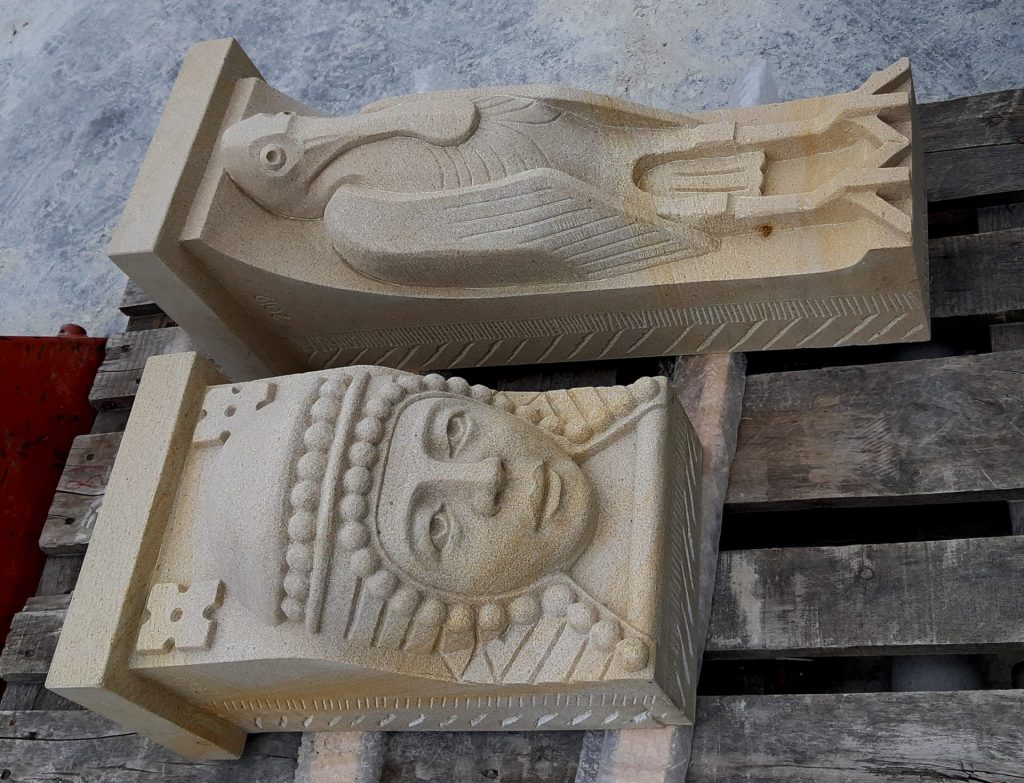
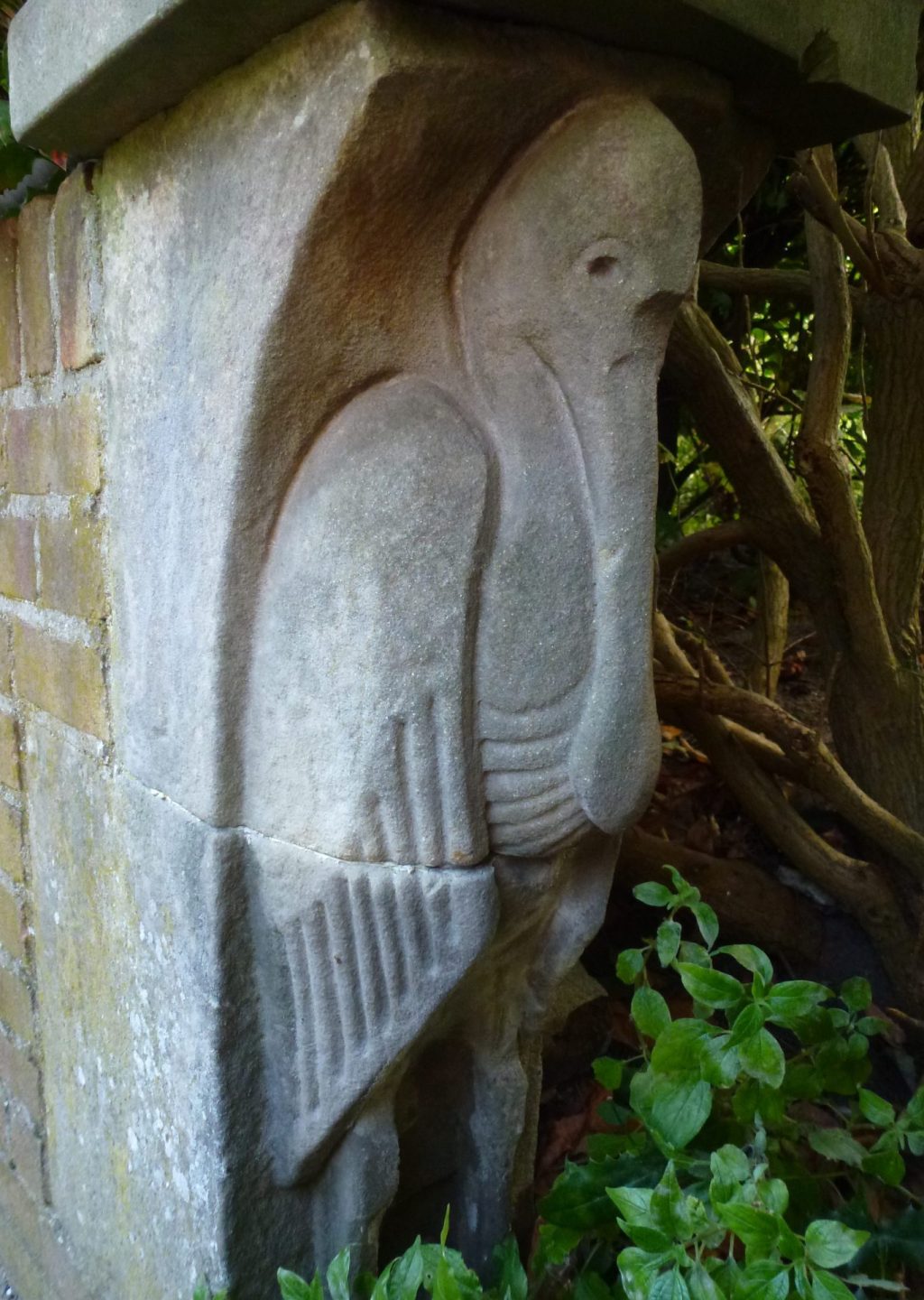
    I've recently had many different projects in progress and have just not gotten round to post any messages about them on this blog. But, fortunately we still have the pictures, as the businessman said when he saw his million dollar yacht sinking. This project has been an interesting challenge in between all the ornamental work. The job on hand was about two facade reliefs of a spoonbill and buddha head from Haarlem.

    The original stone ornaments came from the façade of the Lutheran Orphan's and Old Men's Home, which was built in 1906. After the demolition of this home, the stones were reused in the garden wall of the Vitae Vesper Elderly Nursing Home that in 2015 was demolished again itself. An apartment building was constructed on this site and the reliefs remained behind, discarded and orphaned. The Lutheran Church Council wanted to provide these ornaments a final resting place in their garden wall between Frans Loenenhofje and the Lutheran Church in Haarlem.

    A stolen spoonbill, pelican and buddha head
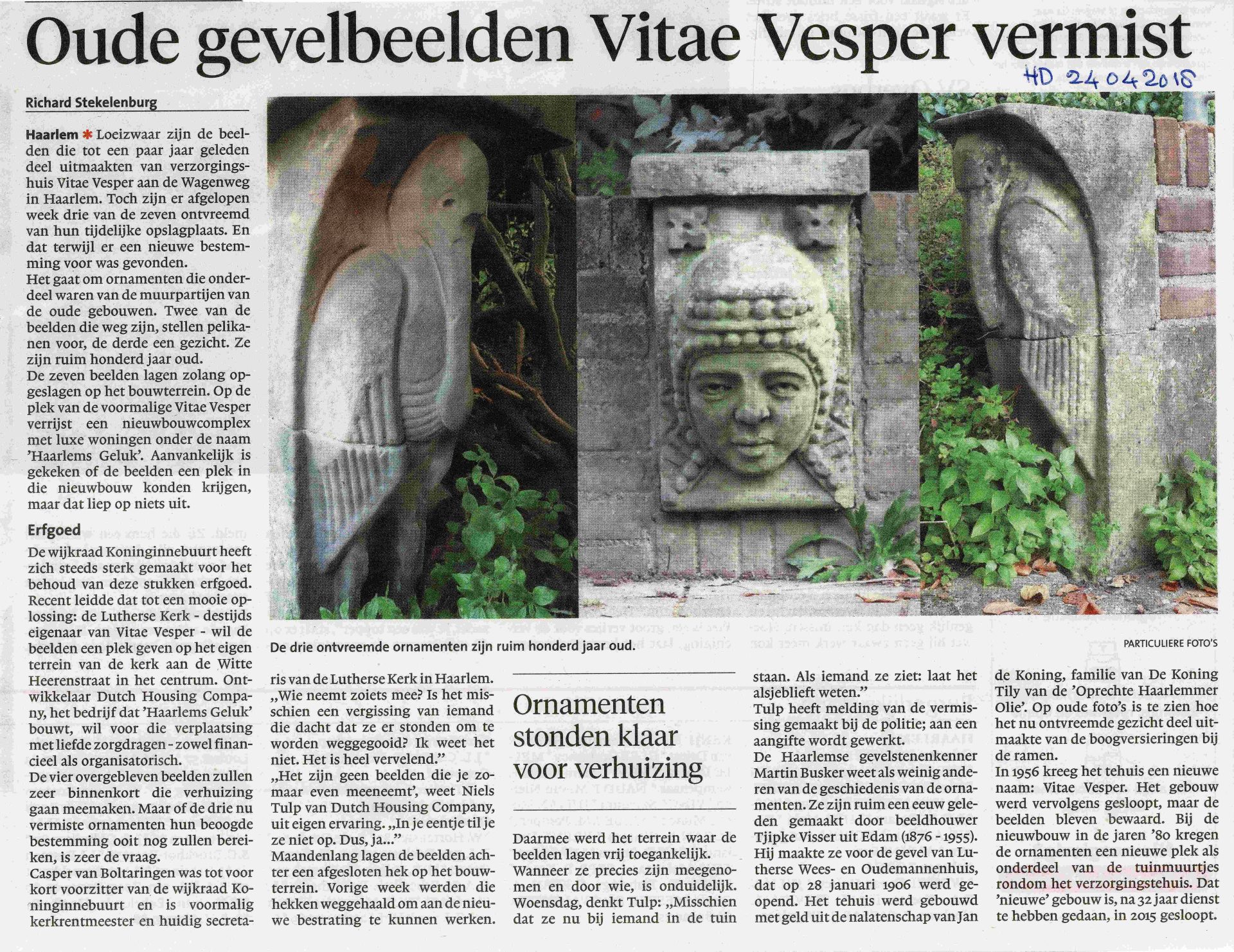
    -click on the photo for the article-

    The seven facade reliefs were removed from the original garden wall and kept separate. But three of those reliefs, of a pelican, a spoonbill and a Buddha head,  were stolen from the construction site. Fortunately, the pelican was found again three days later. Apparently there is a market for stolen ornaments.

    Stylized

    The carvings are quite stylized and I thought for a minute that they were made in the Art Deco-style. But Art Deco only started from the 1920s, so although around 1906 there was already a stylization going on, it was not yet Art Deco.
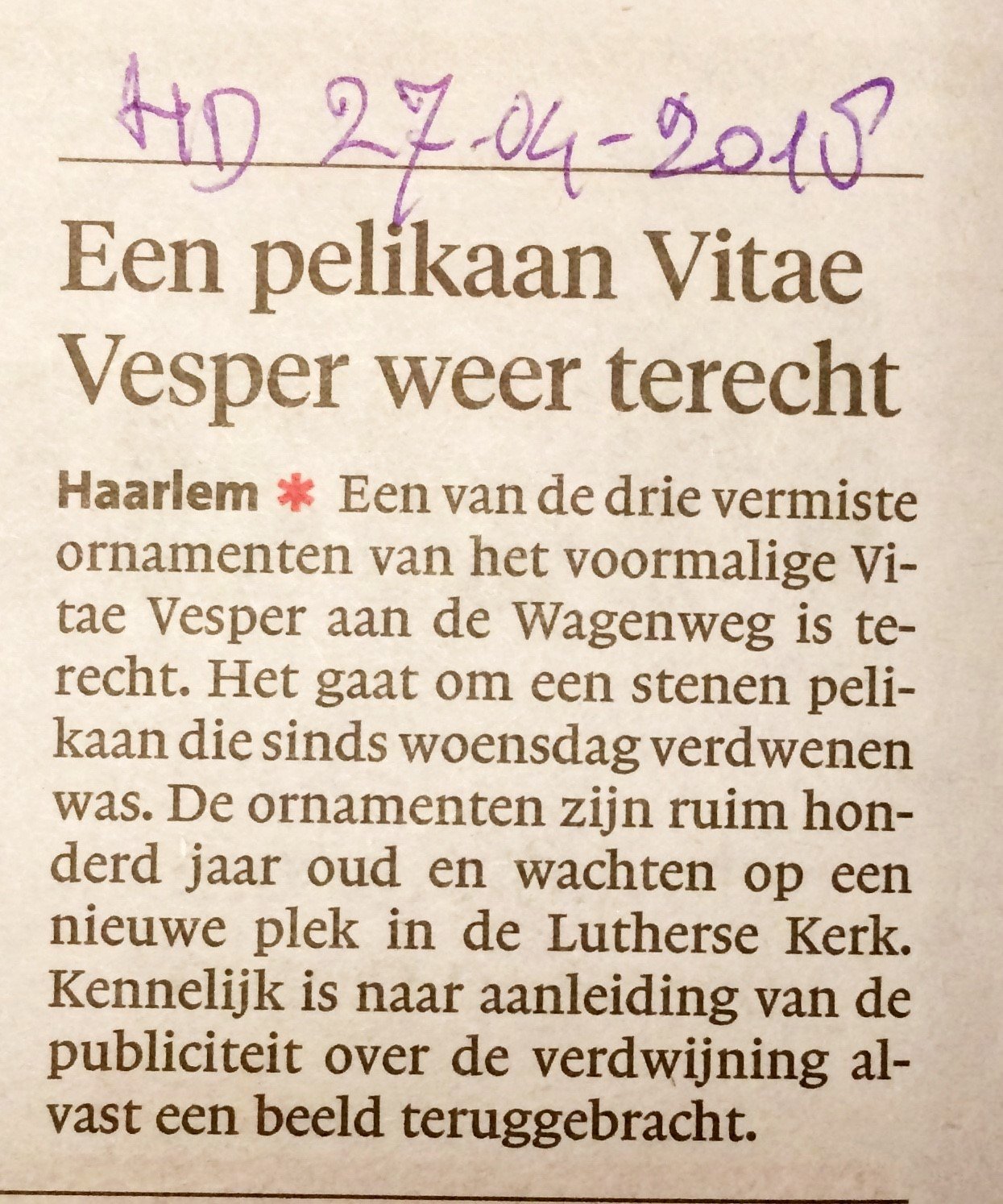
    The emphasis must have been on their decorative function, because I can't imagine what relation a heron and a Buddha head should have to a Lutheran orphanage. Or an Old Men's Home, for that matter. As the article mentions they were carved around 1905 by sculptor Tjipke Visser from Bergen, North-Holland. He made seven of those, a Buddha head, a head of a native American woman, two feline heads, an ibex, and a pelican and spoonbill. The spoonbill and the pelican are placed on opposite sides of an existing memorial in the garden wall of the Lutheran Church. The other reliefs got a place further down the wall.

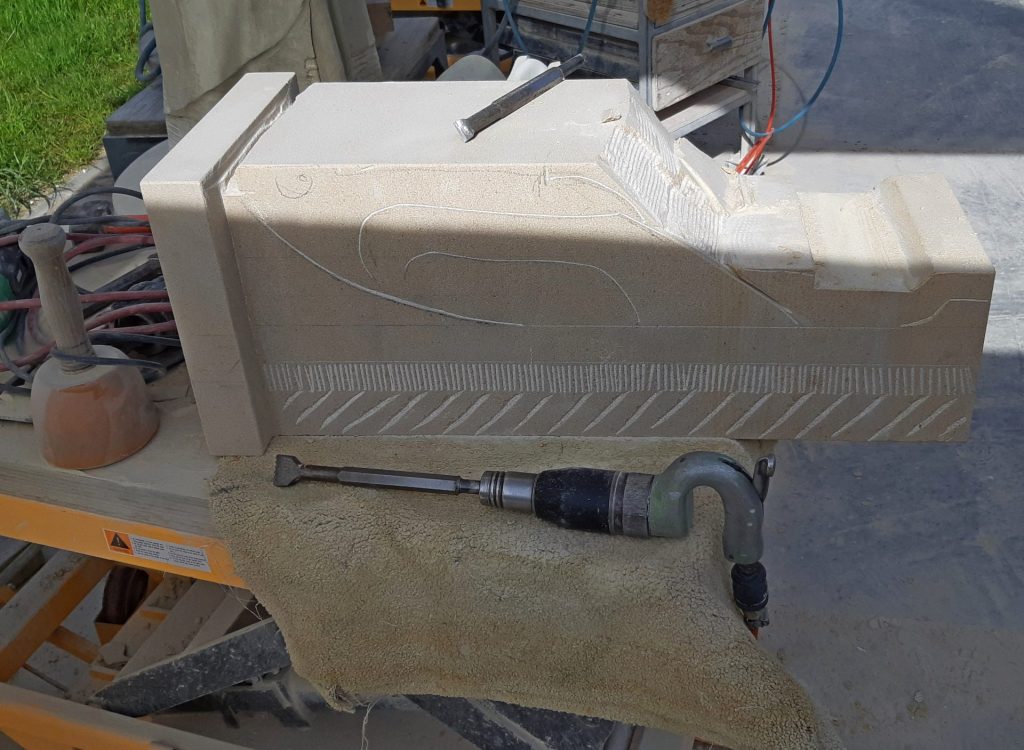
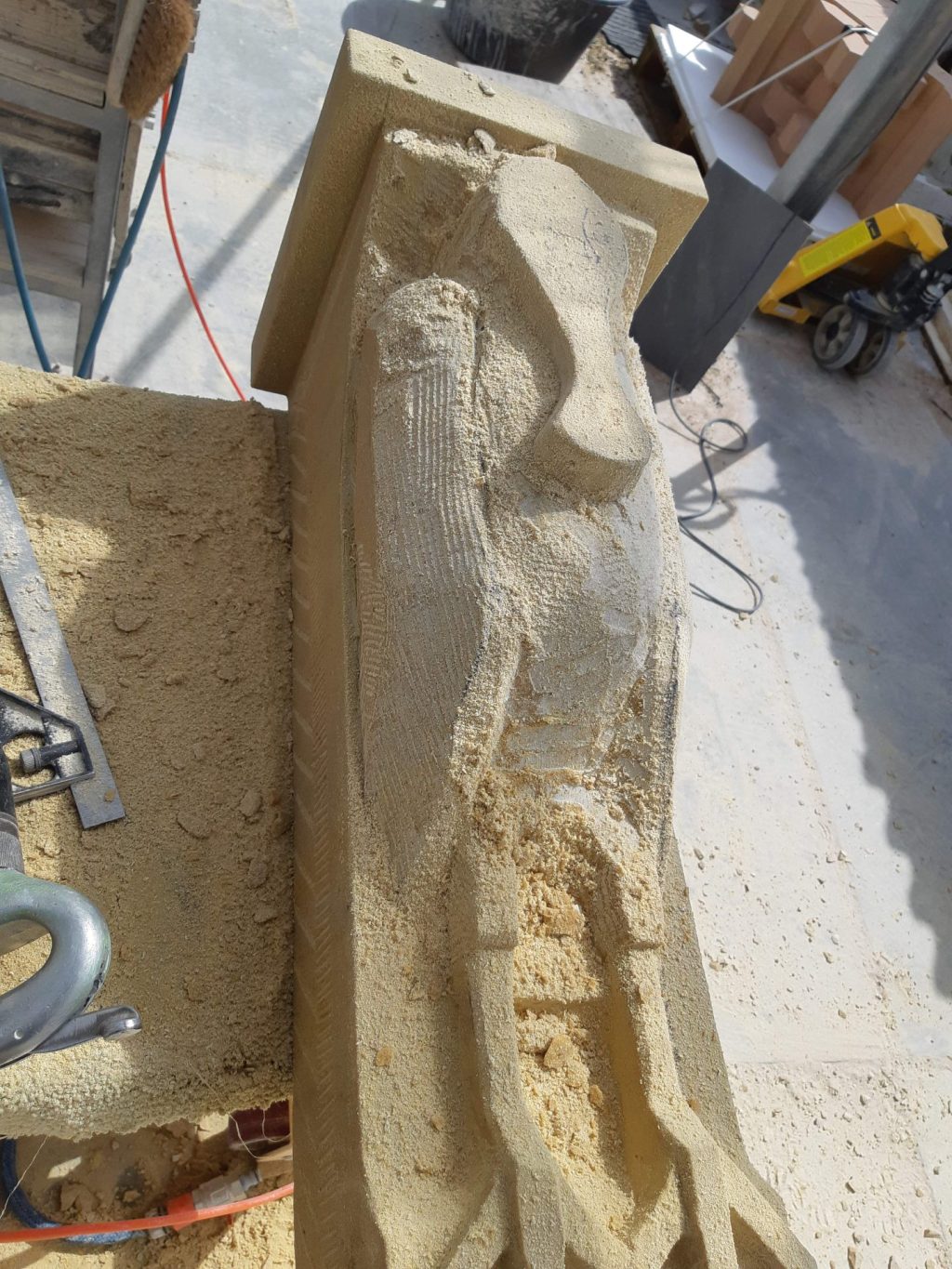
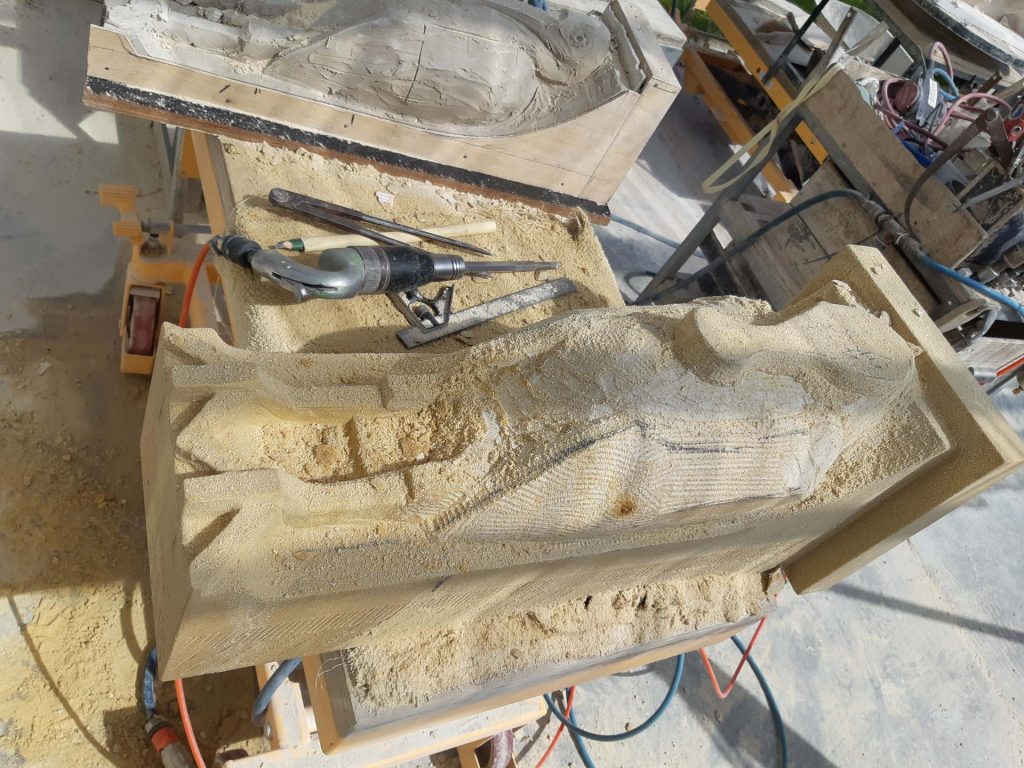
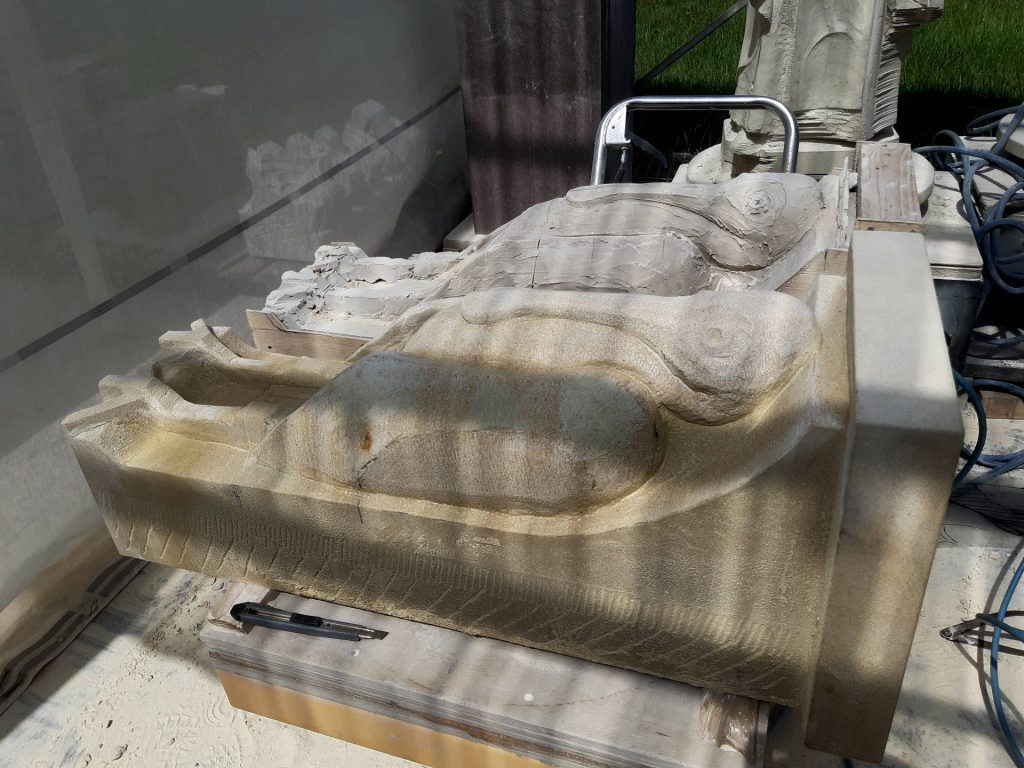
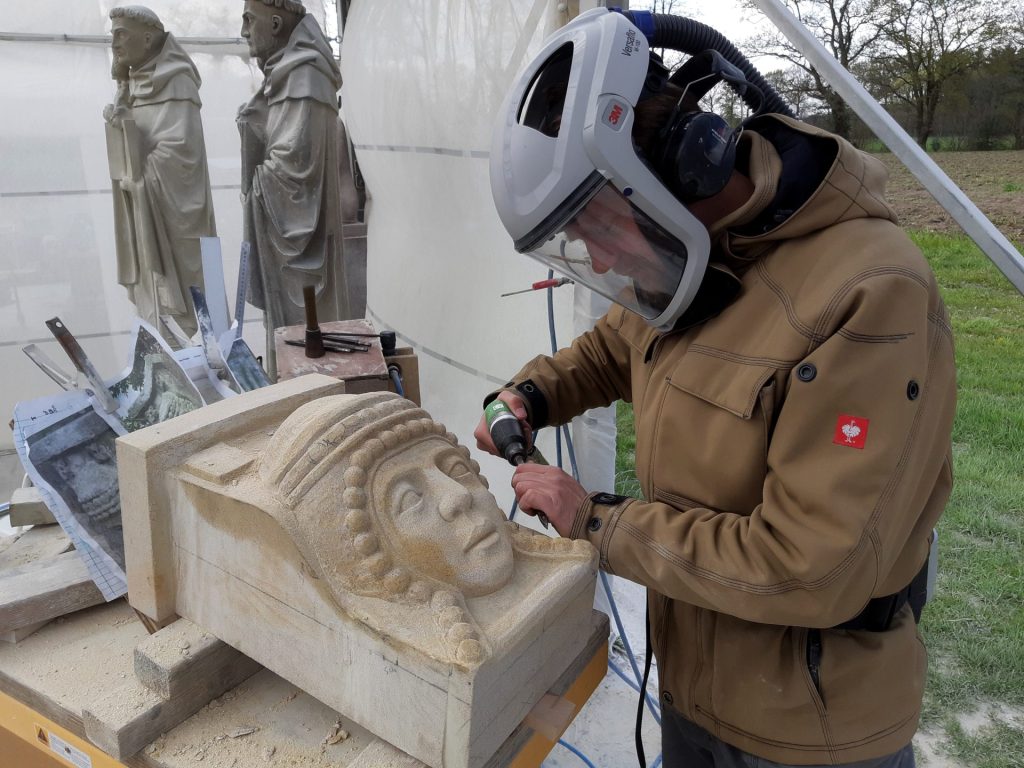
    We currently have a lot of work in progress at the same time. I just couldn't get it all finished on time alone, so I was glad Jelle took on the carving of the head (read his blog post about this here ↑) while I was sculpting a blue statue from sodalite in the meantime. Some time later I had time to tackle the carving of the spoonbill. We both followed the same procedure, so my approach below was the same for Jelle's sandstone head. I had ordered two blocks of Bentheimer sandstone to the right size, so we could get started right away.

    Modeling and copying
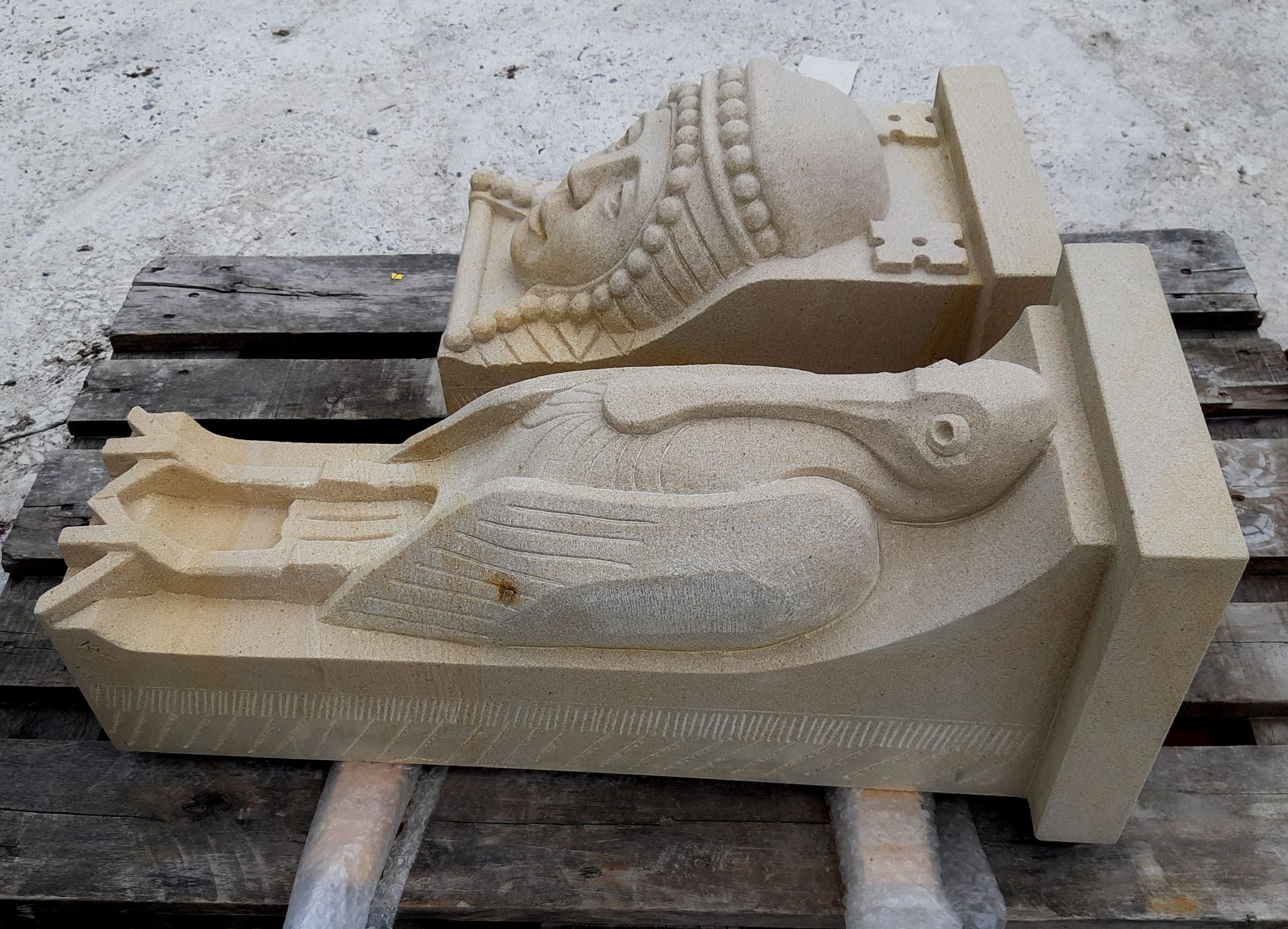
    Two new reliefs ready on the pallet

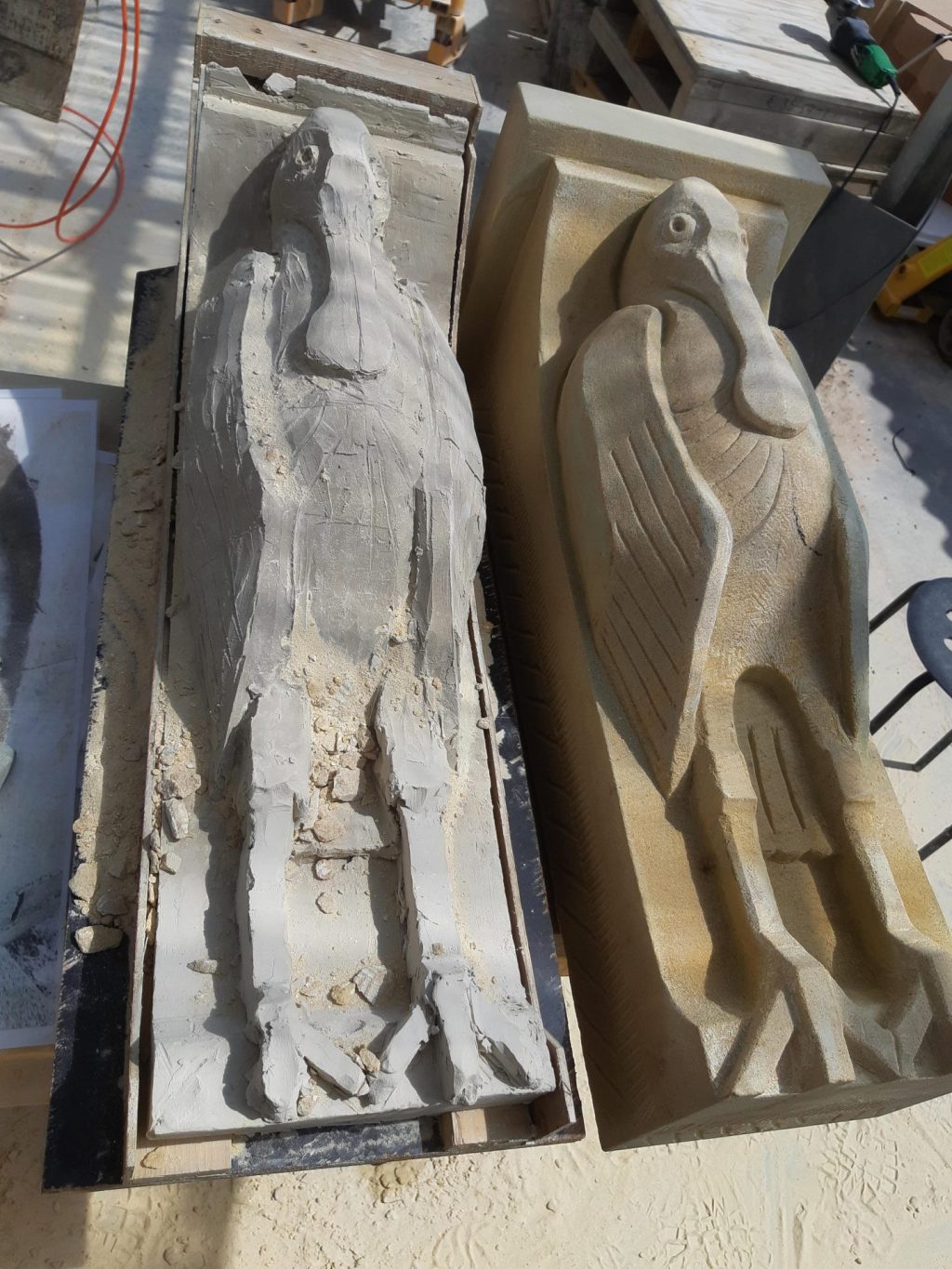
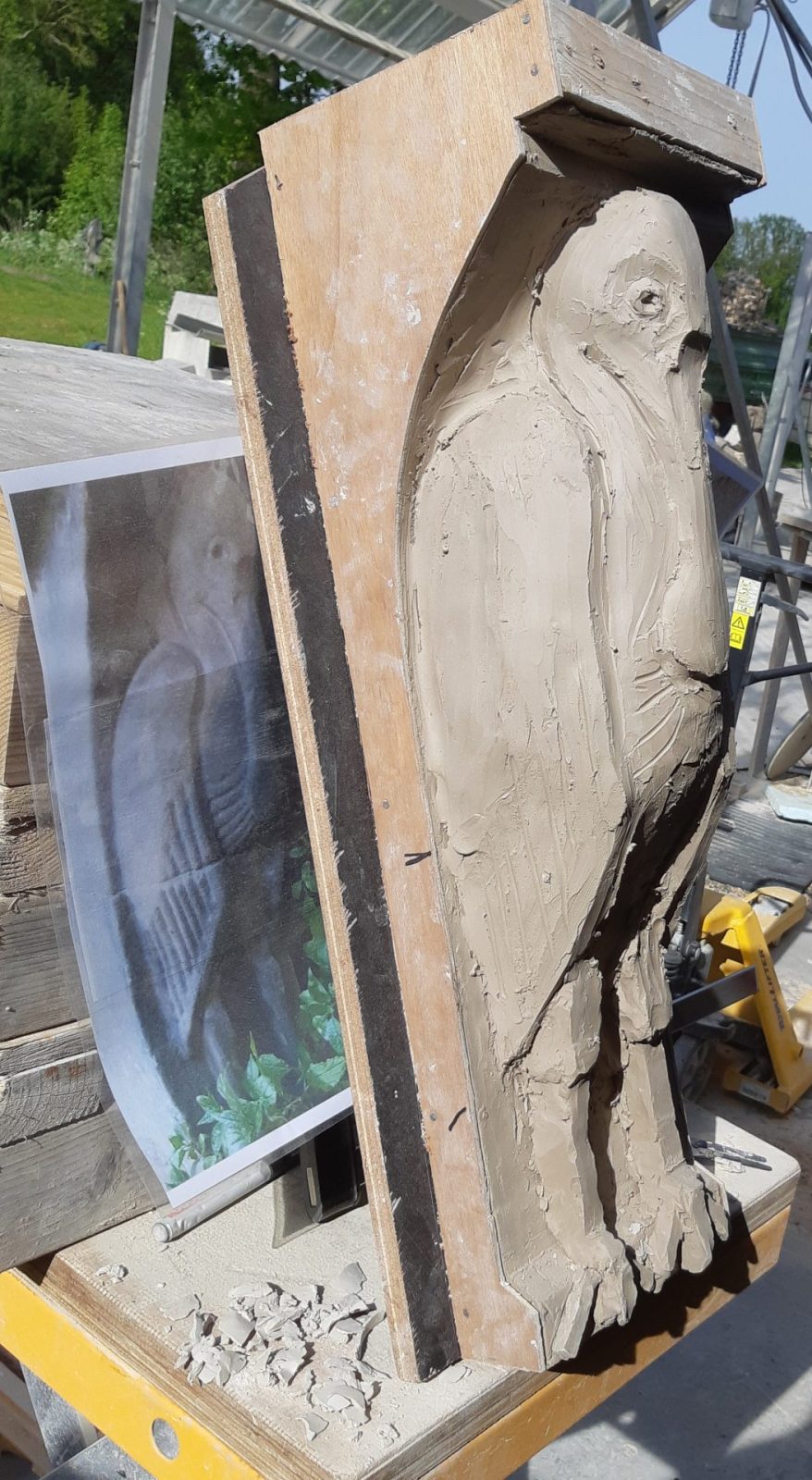
    I had thought about carving this spoonbill straight out of the block, but that is not the best way to address it if the customer wants an exact copy. I had received a lot of pictures of the old reliefs via email, along with a number of measurements that were carried out on the counterparts that were preserved. This proved essential in the reconstruction: from these measurements and the pictures I was able to model a similar looking spoonbill in clay. Fortunately, there were pictures from three sides, from when the bird was still in its last garden wall. Once the clay model was to my satisfaction, I could start carving a copy in stone. Small details like feathers in the wings I had left out for the time being.

    I traced the contours of the spoonbill onto a piece of cardboard, so I could transfer them onto the stone. After I'd carved away the stone outside the contours, I could transcribe the other sizes quite simply with a compass. In such a case, I usually put the two pieces tightly together. That way, I can transfer most of the width measurements one by one, without adjusting my compass. I've once made a video and a blog post about that. Once most measurements were in place and the rough shapes were carved, only the finish carving of the spoonbill needed to be done. The method of working from a clay model first is called the Indirect Carving Method. Read more about this method in this blog post.

    Gallery

    The facade reliefs can be seen in the garden of the Lutheran Church, Witte Herenstraat 22 in Haarlem.
  • Location, location, location

    Jan van Velzen

    One of the things I've always admired in the sculptures of my father is the spots he has chosen to put them. My dad is a sculptor from the village of Onderdijk, Jan van Velzen. With several of his sculptures he got the opportunity to personally pick their destined spot, something that is not always left to the artist. His first big sculpture was The Dijkwerker, a labourer building the Dutch dikes,

    a bronze statue of a man digging. Unlike most sculptures of dikers, this one is not of a man placing blocks of basalt, because in these areas the dykes were originally built from clay, that was moved with shovels and wheelbarrows.

    It was his first major assignment. He was noticed as a sculptor when he made a design for a statue of St. Gerard Majella some years before. The parish existed 70 years and as part of a cabaret with drum band and great fanfare at the end a 'new statue ’ of St. Gerard Maiella was unveiled, supposedly for in the church.

    Bulbs Rooi Ende horticulturist (St Gerard Majella) by Jan van Velzen

    I think my father cannot be dienied a certain quirkiness in those years. Apparently he had nothing with the traditional devout image of Gerardus, because he decided that Majella had been a simple man, and chose to portray him as the people around him: a small scale farmer, on his knees in the clay. Bare-chested.

    What happened was to be expected of course: Little Gerard on his knees was a step too far for the parishioners. Worth a smile in hindsight. So I don't think my father expected that this image would seriously get a place in the Church. That was never the intent. But the modelling had fueled his creativity again and was the incentive to get asked for making the Dike Worker.

    I was seventeen at the time, and thought I might perhaps be a little bit creative, but that I could never be a sculptor like my father. I had so little confidence in myself in that respect that I've never tried getting to an art academy.

    Jan van Velzen wax Mother and Child

    But I found the work on the Dike Worker fascinating. For my father working in this scale was all new, too, and while he learned, I learned along with him. Working with Styrofoam and wax, enlarging, modelling, Moving the wax model on location to discuss the best place. I wrote a paper about it when I did a training at the MTS of Graphic in Amsterdam.

    VanVelzen Dike worker 1981

    The image is now placed in a large open space, at the end of the village, approximately in between Onderdijk and Wervershoof. When around the end of 1980 while walking with my mother he had chosen this place, us children were horrified at first. It was still one big mud hole at the time, with a new pumping station and a few big canals, in a place where few people bothered to look with interest. Didn't such a sculpture fit better in the heart of the village?

    In hindsight, I can only say that he had been right all along. The statue immediately draws attention because of the lack of all kinds of disturbing elements, the mud gave way to grass and trees and blossoming Roxy, and the Dike Worker has become a landmark for the village .

    Dike worker Jan van Velzen

    It strikes me that an appealing statue has the ability to influence the environment. I am thinking, for example, of how 'The Best Navigators’ on the pier of Medemblik have made a prime spot out of a place with an end-of-the-world feel, because all of a sudden it became clear that the environment needed care. The mess gets cleaned up, The path is paved or updated, the shrubs and grass are kept and what was a forlorn place gets allure. Same way with the piece of land behind the Drommedaris in Enkhuizen, that because of‘Paulus Potter’ from an empty dog's field suddenly gets focus and turns into a photo location.

    Yet there was a man from Wervershoof who said he thought it was a Onderdijk oriented sculpture, and asked: 'Didn't you overdo it a little too much?’ How come, asked my father. ‘Weeeeellll’, was the West Frisian answer, 'It's a nice sculpture alright, no arguing, but he's turned his ass in the direction of Wervershoof, that's why!’

No more messages to show.

No more messages to show.