The five-taloned Falcon
'Idleness is the beginning of all vices’ and 'There's never enough time to do all the nothing you want', which is why, after a period of six days a week carving ornaments I went right on to the next project.
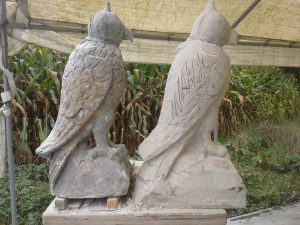
Meanwhile I am quite busy carvingthe Falcon for the Valckeniershuis in Franeker.
After having reconstructed the weathered original in plastiline clay, I'm carving a copy in a new piece of Bentheimer sandstone. I'm now busy carving all those feathers.
To the first post about this project.
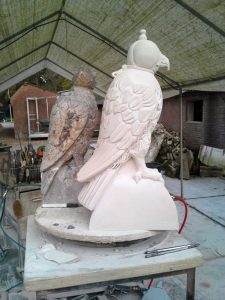
I really have to force myself to work in the old style, because normally I carve these kind of feathers very differently. These are almost squared off: very flat and with hard lines. It probably works fairly well at a distance. A disadvantage is that there's a lot more work to do in finishing.
In the old days, I would have to go to the library or buy a book about birds of prey. And then hope that the picture I needed was inside. Now with the internet and searching for images it all has become a lot easier! I noticed that the original sculptor didn't have such a database close at hand.
Toes
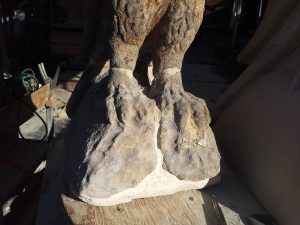
My youngest daughter (14) was looking for a internship and came along to perform a set of chores for me. So while I was busy carving ornaments for St. John's cathedral, she started modelling the talons of the Falcon. 'Dad', she said, 'I can clearly see that he has carved the leg on the right side first.’
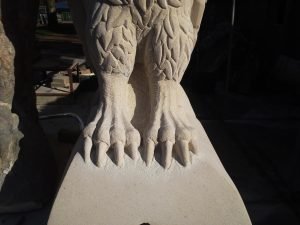
'How so??’ I asked. ‘Well, that foot is a whole lot wider than the other, so he did that one first and then noticed that he didn't have so much space anymore, so that other one became smaller.’ Obviously, she kept her head clear.
Her work went so well that she could model the other parts as well. When I wanted to adjust and redo some of the work a while later, I noticed just how well she had done her job. Where I thought I would have to take away some of the clay, the original stone was just below the surface and in the end I didn't have to adjust much to get it to my liking. So this father was quite proud of his daughter!
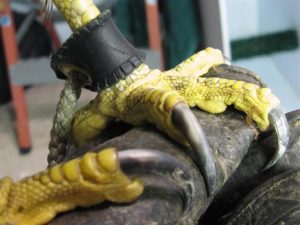
But later, during the carving, I looked a bit better at the photos of Falcons talons I'd found. And what became apparent? A bird of prey has three talons on the front, and one on the rear. An ostrich has two, a cockerel has a spur that you might consider as a fifth toe, but a Falcon is supposed to only have four . Our Falcon from Franeker had four toes on the front and one behind. So five toes in all! I was wondering why it looked so strange, like a mammal's.
Hood
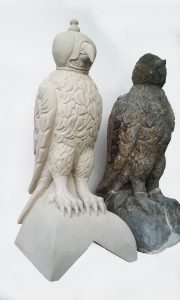
Those five talons will all come back again on the copy, and those typical flat feathers, too. But on the missing parts I did follow my own ideas: the animal wears a falconer's hood, (which the original very likely had also) and a pair of leather straps. Too bad that on the legs can be seen that it never had any straps to one of the legs, that would have been nice. This week the carving will be finished and later on it will be gold plated. More about corbels later.