• 70 percent debris

    One is often not aware, but when carving a statue from a block of stone, only a small part of it remains. I once calculated that very easily 70 percent of the block is thrown in the skip, and sometimes even more than that.

    In this case, the block of Anröchter Grünstein (they often call it dolomite) for the ferns weighed 3,5 tons, because I had taken a rough block. If I had taken a block that was cut to size, it would have been about 2200 kilos.

    I think I will end up with 600 kilos, so that's just a bit over 17 percent that remains. Normally one would take a block cut to size, So that means they already throw a lot of stones and debris at the quarry (The rough sides, non-right-angle pieces, bad pieces, and what was redundant after splitting the block).

    Most people find it a pity that you throw away so much of a resource. In a way that's true, but on the other hand that's just what makes it sculpting: Creating a form by taking away the excess. And that excess comes in the form of rubble, that's just the way it is. Using a computer-controlled wire saw you might still be able to retain greater residual pieces, but these still oddly formed and after a period of storage often still end up in the skip.

    Actually, this is quite a trivial topic; weight is obviously not the form of an image and nothing at all about beauty. At most, it says something about the process. That's what I like about sculpting: it is a process with many hours of handicraft between the creative parts. I do not constantly need to use creative side, I often enough may simply carve, and that gives a nice balance. How much noise all that cutting and that compressor will make, I notice that the purely physical aspect of the work to me forms a big part of the fun in the sculpting process.

    At the time when I had the stonemason's training, I noticed that all this hitting the chisel and stone brings a certain calm. With each blow you delete something from your unrest. Someone who has ever seen a stonemason doing his decorative chiselling will understand what I mean. I sometimes think that sculpting in stone could be a good form of therapy for burnt-up managers. Maybe something for the future.

    Nasty the first message about this project.
    Nasty the next post about this project.
  • 'Never hit that nose off?'…?

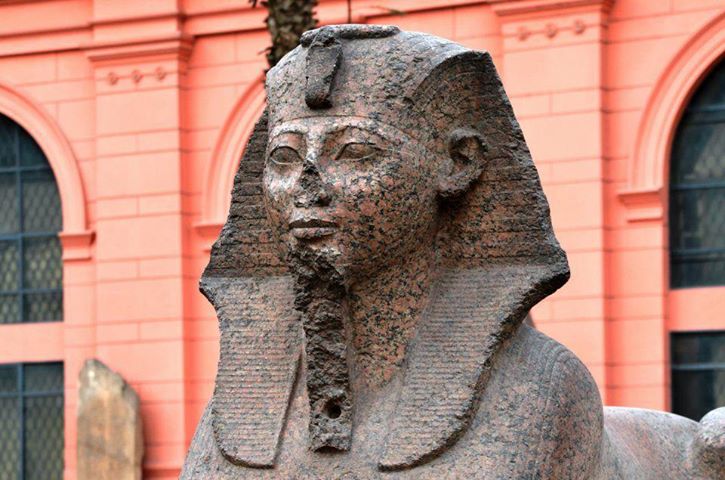
    The most asked question by visitors to a sculptor's workshop is the next: 'And what if you're nearly finished, and you accidentally hit that nose and it comes off…?’  (or that hand, or finger, or little protruding part, and so on). My colleagues and I have heard that question so many times, that sometimes we got a bit fed up with that. Then we said with a dead serious face: 'Yes, that's always the problem, right, that you hit the nose and it comes off. That used to be so in the old days. Just look at all these ancient Egyptian statues, these also have always the noses broken off.’

    You do not always want to explain that in many cultures a temple sculpture had to be absolutely intact, and that otherwise it would be unfit for worship. That the Egyptian images originally would have been crisp and whole. That Islam was introduced later in Egypt, and that in that faith it is an abomination to venerate an image of human or animal. That conquerors not always had the time to quietly smash the statues to bits, especially if those were twenty meters high or out of rock hard diorite. Makes sense that they then settled with the nose. 'Who violates his nose, violates his face, they say in Dutch.’

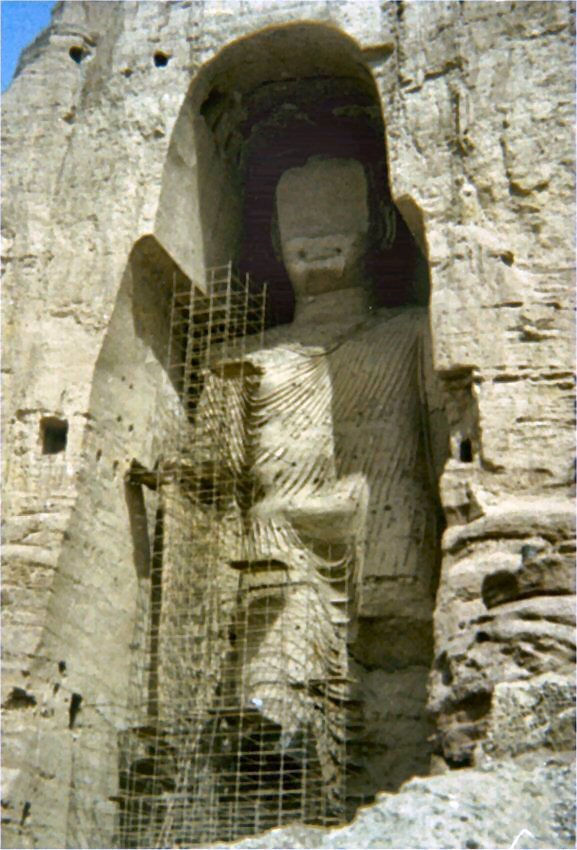
    Bamyan Buddha statues. that nose off...?

    We have quite recently been able to see how the Taliban blew the two enormous Buddha statues of Bamiyan to smithereens. The faces had been removed already at an earlier stage. Islam points out to man that God can not be caught in an image. I myself always think as well that our attempts to even describe creation fall laughably short of their aim, let alone our descriptions of God him (or her, or it)self. On the other hand, God is for man often so elusive and big, that in other cultures an image is used to find access to God through tender devotion. For both of these two views there is a place, and therefore it is very unfortunate that the Taliban in this way were trying to impose their views on others. I'll just leave it at that.

    Not so much different than our own iconoclasm anyways…

    But how come sculptors generally don't smash a hand or a nose at the last minute? The answer is only a mystery to the layman. Sculptors know that this type of hard knocks occur only in the early stages, when the sculpture is still quite solid, and the risk is small. You still have to take care though, because else in the early stages you'd hit it so hard that you'll cause fractures in the underlying rock, where you will get problems with it later. But at that point there are no hands jutting out yet, or noses that can break. When the whole sculpture is roughly carved, you'll go on refining further. From that point you will work with increasingly lighter tools and remove smaller pieces, until you get to the stage where you're finishing the details. By that time, it is absurd to still attack the statue with hard knocks. Only quite at the end you will remove the suppports you had left to support the vulnerable parts. You just need to be careful when grating, to not accidentally move your grater like a lever when you're grating somewhere in between parts.

    We pulled a joke on visitors at other times as well. If we saw that they were going to ask questions about the stone dust, like if it wasn't unhealthy, we secretly took a hand full of grit and dust. And when they looked our way,  we would ostentatiously cough in our fists, making it seem like a great cloud of dust came out of our lungs.

No more messages to show.

No more messages to show.