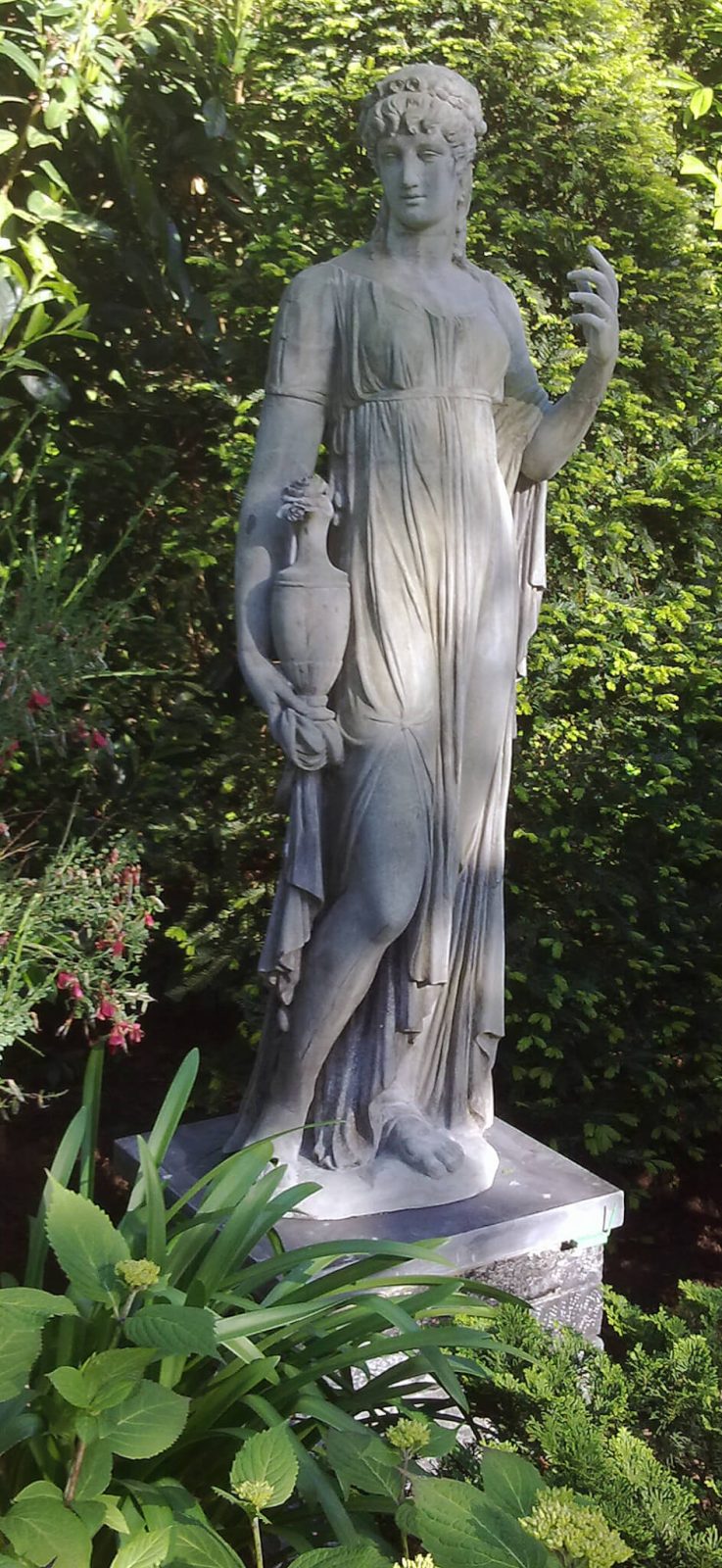
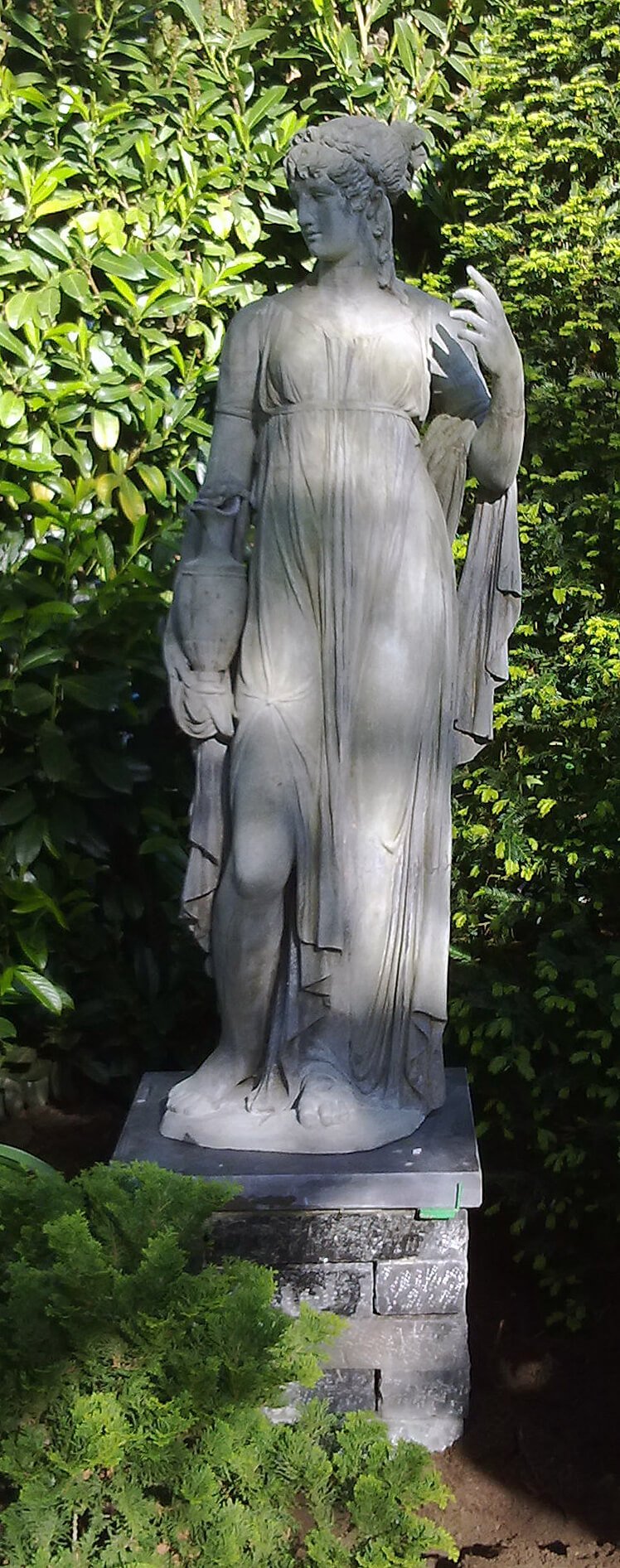
Yesterday I The garden image of Flora from Lead Antimoon put back into the wild. At this site it comes into its own, a very classic and graceful garden statue of the goddess of spring and flowers.
I made a base for her out of blocks of gray stone and a thick stone tile, to which she's anchored with three thick stainless steel threaded bars of 14 mm. This way it all has become one quiet gray coloured whole, so the base draws no more attention than the sculpture itself.
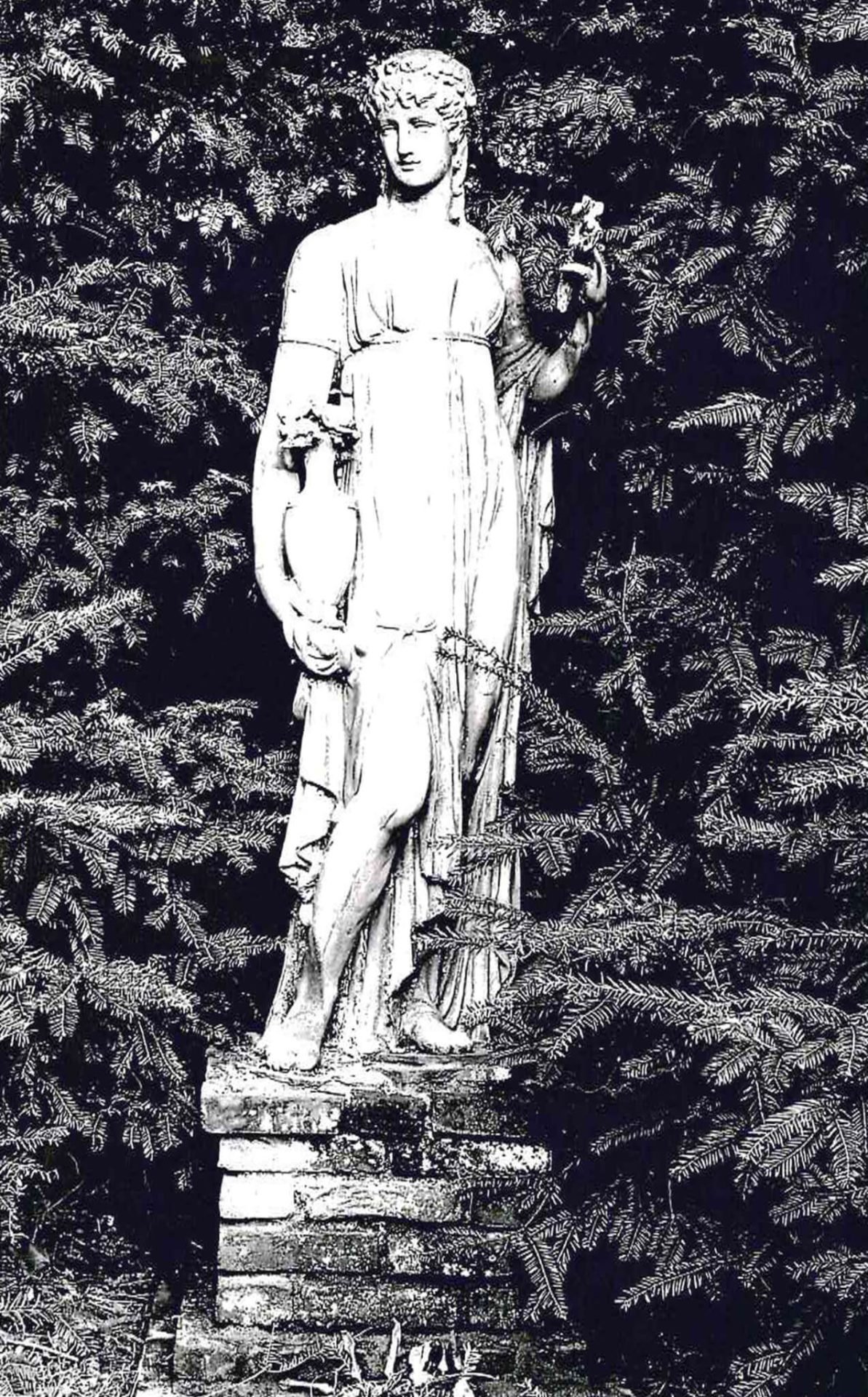
A picture from the 20th century shows that Flora used to have flowers in her left hand and in the vase. From the strange position of the fingers, I think I can deduce that the statue already had been restored at the time.
The statue is now restored with restoration mortar. I made the mortar in the same grayish colour as the lead alloy; the greenish colour comes from some chlorophyll that I rubbed in. Should the owner in the future choose to remove the algae, the repair will have the same colour as the original, and not a misplaced greenish tint. With the chlorophyll the repair now also resembles the rest, which already had a slight layer of algae .
The repairs will be getting their real patina after a time in all weathers, so the difference will soon no longer be visible.
The loose parts have been fastened and missing mass is added to with restoration mortar. Later follows the shaping and colouring.
In the meantime I am busy with the restoration of a classicistic little garden statue of Flora, the godess of spring and flowers. Very fitting given the beautiful warm spring. The image was drained at the time in an alloy of lead and antimony, but since then it fell over and got repaired a few times. In her last fall she broke her left hand, in a place where it had been repaired once before, and a foot got damaged, and a piece of the footplate and her vase.
I estimate that the sculpture is from around 1820. It was not unusual in those days to make cheaper casts of statues in lead, zinc or an alloy thereof. In the close-up you can see that it was cast in parts, which were then soldered to each other. At the back it's evident that the statue was painted after completion, to cover the seams and probably also because of the material. Incidentally stone statues were usually painted as well. In the deep folds, I could still find many traces of white paint.
Because the image has long been outside the material is quite brittle. Some parts are somewhat bent, but it's risky to bend them back, because it breaks immediately. Therefore, and for cost reasons, I decided in consultation with the client to restore the statue with mortar , and not with solder and the creation of newly cast additions.
First I welded a support frame for the hand and fingers out of stainless steel. The hand is anchored with colorless, strong epoxy adhesive to the supporting frame and the lower arm. Soldering would in this case have yielded a lead seam, which would have needed reworking, affecting the patina. In consultation it was decided to maintain the patina as is.
Up close his earlier soldered joints can be seen. The last break was quite rudely restored at an earlier time.
I can bend the fingers some more to the correct position, after which I can model them in mortar. I first reinforced the feet as well with a stainless steel frame. It soon became clear that the sculpture had sagged quite a bit in the course of years, making it leaning over much too far. Therefore, I first found up the correct position (the contraposte) Before I started to add material to the base and feet.
To avoid repetition of falling over an anchor is added to the statue out of three stainless steel pins of M14 threaded rod, so that it can be fixed to the lintel. The vase is glued as well, and for extra support reinforced with an invisible extra pin.
The color of the first repairs is still much too dark, but that will be, after additional work (shaping, sanding) much lighter. During curing, a part of the coloring matter is concentrated in the top layer. There will be an additional step to make the color totally complementary, and the green algae patina will have to form in the garden.
The next step is shaping the hands and feet. Originally, she had a bunch of flowers in her left hand and in her vase, but these two will not return, for monetary reasons. However, the gesture of her hand will be fully recovered.