• Flying Buttress figurines for St. Eusebius' Church Arnhem

    Restoration St. Eusebius' Church gets going again

    Good news! There is a budget again for the restoration of the St. Eusebius's Church in Arnhem (the Netherlands). Today a press release came out that the municipality and province have provided funding for a transitional period of a few months, and the expectation is that the rest of the restoration project will in time be provided for as well. As a result, I can now report that the next few months I will be busy carving a whole batch of new statuettes for the flying buttresses of this church. Below is an account of the first two that Stide and I made.

    Read the first message about this restoration here.

    Flying buttress sculptures for St. Eusebius's

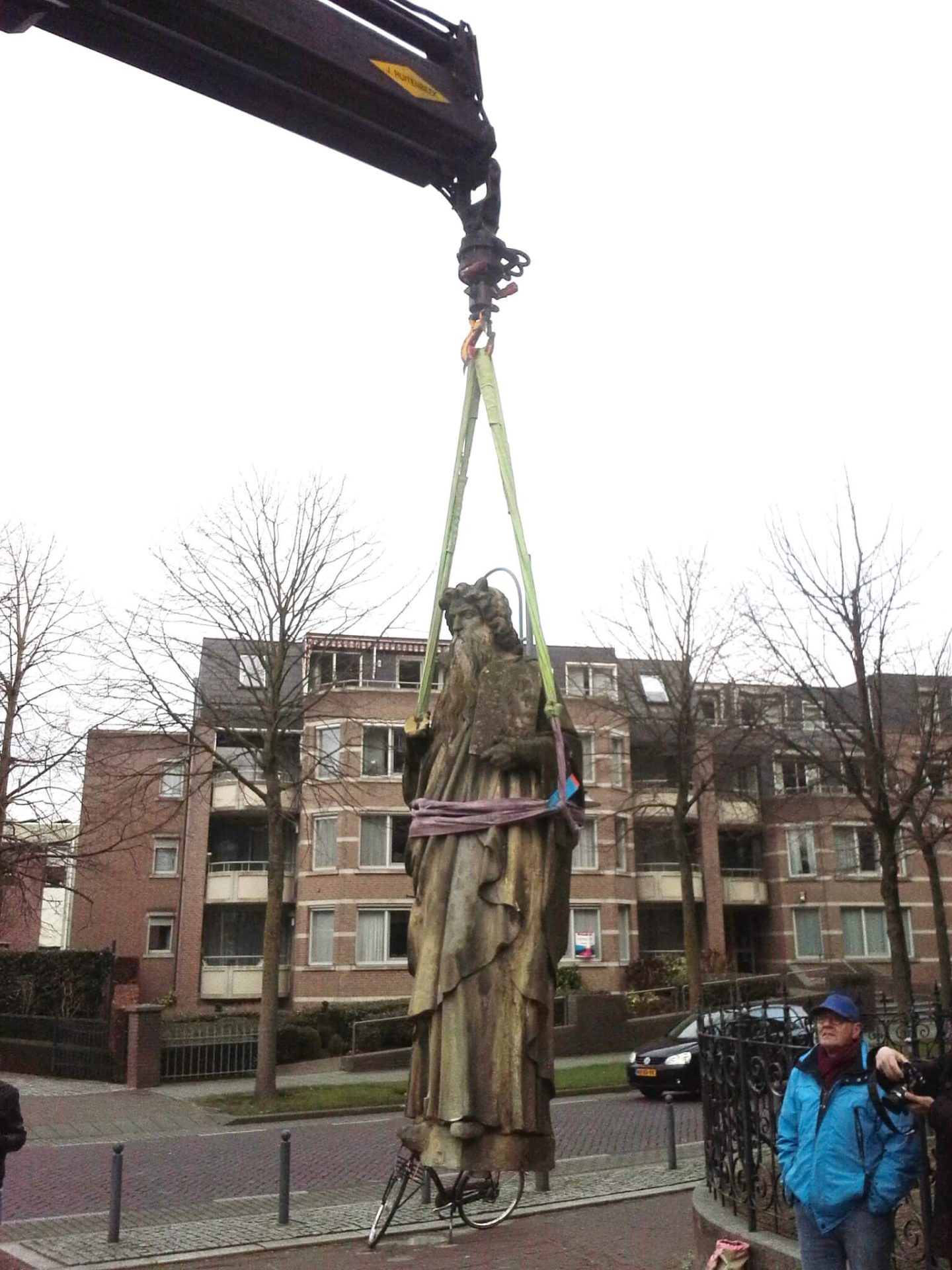
    precutting flying buttres figurine1
    the precutting of a flying buttress statuette

    The St. John's Cathedral in 's-Hertogenbosch is known to many people in the Netherlands. Quite recently, that church has also received a lot of attention flying buttress figurines as well: on account of the Jerome Bosch year, a scaffolding was built into the roof gutter, providing access so that everyone can view the famous flying buttress figurines with their own eyes, under the title ‘a Wonderful Climb‘.
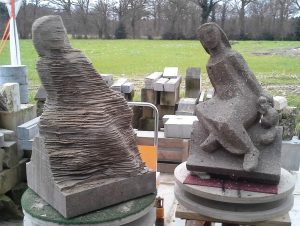
    Flying buttres figurine ES1

    However, less known is that there is another church in the Netherlands whose flying buttresses used to be covered in flying buttress figurines: the St. Eusebius's Church in Arnhem (the Netherlands). This church currently is mainly in the news because its restoration has met with financial difficulties. But I am hopeful of a positive course of the further restoration.

    Much of the church and tower was heavily damaged by bombing and shelling in World War II, so after the war an enormous amount of new work had to be carved.

    copying flying buttress figurine1
    Stide Vos copying a flying buttress statuette

    There have always been figurines on the flying buttresses of Eusebius, but after the war there was so little left to be found and so much had to be made in a short time, that the sculptors were given a lot of freedom to invent and carve new figures in their own style. So now the spirit of the fifties and sixties can easily be read from the figurines.

    Weathered tuff replaced by Muschelkalk
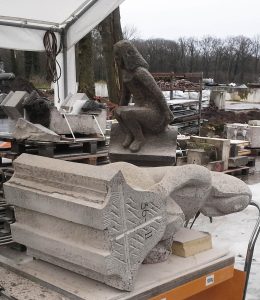
    stonemasonry Eusebius Church
    the work also includes the stonemasonry work on the profiles

    As I already explained in described previously in this article on my blog, Ettringer tuff was the material of choice in the after-war reconstruction period . Regrettably, this proved to be an unfortunate choice over the years: the Ettringer tuff responds poorly to changes in humidity and temperature and begins to fall apart a few decades.

    To preserve the unique character of the Church it was decided to copy the figurines in new stone. In the past it was tried to preserve the sculptures by means of conservation, but that too has unfortunately not worked out well: the tuff continued to disintegrate. That would endanger bystanders. So they'd rather replace them altogether.

    Copying
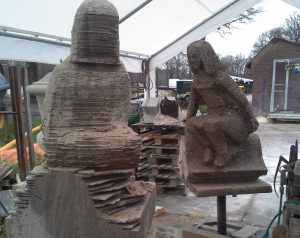
    precut flying buttress figurine2

    Now my colleague Stide Vos and I started carving the first figurines in Muschelkalksteen, a coarse limestone that matches the design and finish of the old sculptures. The figurines we started with were still in fairly good condition; only the big yellow sandy spots had washed out. Should funding for more statues arrive in the future, then there will also be some among these that will need complete repairs and reconstructing before we can copy them, and there are even a few that have disappeared altogether.
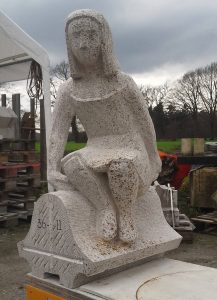
    flying buttress figurine 2
    the flying buttresses extend at an angle towards the church, hence the sculptures are portrayed leaning forward a bit

    With the copying saw machine I own we can precut the figurines and then carve them, detailing and adding toolmarks after that. On the pictures the original in Tuff can be seen, next to the emerging copy in the new Muschelkalk limestone. By adressing it this way, we can work quickly and efficiently, and even a lot cheaper than a computer scan in conjunction with a CNC milling cutter.

    I've already had the opportunity to make some sculptural works in connection with the restoration of this church: Read here the archives of articles about this on this blog.

    To the next one 7 flying buttress figurines as well.

  • Moses and Aaron-Veghel

    Lambertus Veghel façade with statues of Moses and Aaron

    Today I once again started on an interesting restoration job. I went to St. Lambert's church in Veghel to collect two statues: Moses and Aaron, carved in Udelfanger sandstone. The statues date back to about the construction time of the church, round 1860.

    There are many statues above and around the portal of the church, that were nearly all replaced in the 1990s because they were weathered down so much. Only four original statues remained, and two of those are now in need of restoration. I was asked to clean and repair them, after which they'll go to Germany to be impregnated with acrylic resin. That should ensure they can be preserved for a very long time to come.

    picture of Moses from 1860. Udelfanger sandstone

    But first the statues had to be hoisted away. Luckily, they were not too high up, on a pedestal of about a metre. I'd brought along my chainsaw and would cut them loose and hoist them out. But it all went rather more difficult than I thought. I was sure I had cut Moses loose from its anchors, but he wouldn't budge even for one millimetre! When we finally got him hoisted away, it became clear why: somewhere in the not-too-distant past, he had been bonded to the wall with a strong adhesive. That caused problems during cutting and taking away, but also caused decaying stone to the rear.

    statue of Aaron from 1860

    In the coming weeks I will be working on repairing damage and replacing old repairs with proper repairs using restoration mortar.. Aaron's condition was not too bad, but Moses still needs some work. When I removed the rod a bad previous repair broke off. The hand was repaired with cement and cemented to the staff; which could also be seen in its anatomy. He will get a new hand.

    Moses is often depicted with horns. That is the result of a translation error in the Vulgata, the Latin translation of the Bible from the 4th century. The Hebrew word keren was translated as usual as 'horns’ instead of interpreted as 'beaming', so that the text now stated: 'his face was horned by the conversation with the Lord', instead of that Moses was radiant.

    sculptor Koen van Velzen cutting the statue of Moses from Lambertus church in Veghel with a concrete chainsaw
    the dismantling of the statues with a concrete chainsaw. photo: Stadskrant Veghel

    In any case, it makes it easy to see who is depicted, even if you couldn't tell by the stone tablets. And Aaron is shown with the bronze plate to the chest in which the twelve precious stones are put, that help the priest in the contact with the Lord, and the sacrificial loaves of bread in his hands. On the edge of his robe Aaron carries all kinds of decorations, that are described in the book of Exodus: 'The lower edge of the mantle should be decorated with pomegranates — made of blue purple, red purple and scarlet — and golden bells, to and to.'

    Picture of Moses in the hoist. Lambertuskerk Veghel
    The Moses statue hangs in the block

    Links to newspaper articles

    • Brabants Dagblad: Natural stones Moses and Aäron from Lambertuskerk Veghel are going to stay
    • Stadskrant Veghel: Aäron en Mozes na 152 jaar tijdelijk in retraite (lots of pictures)
    • Krantenartikel Brabants Dagblad 30-1-2016:
      P1: Moses taken from Veghel church with a power saw
      P4: New hand for Moses and Aaron gets a little finger

    Read more…

No more messages to show.

No more messages to show.