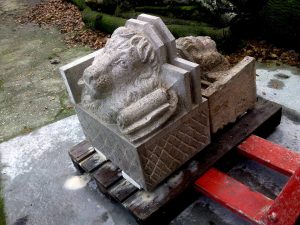
The old corbel with the lion in Ettringer Tuff stone
In order to finish all of the work in time, I am currently carving six days a week, and because I can work in my own studio I am not bound to fixed times. That way I can make some nice progress, and that's how the copy of the corbel with Marcus was finished this week. Where Lucas got a bull as his symbol, Mark got the winged lion.
Just as in the bull, this lion hasn't changed much: feathers in the wings, a little more detail in the hair and eyes, and everything a bit sharper. Because the four 'creatures full of eyes’ look up to the throne of God, all the reliefs are gazing upwards, and I've kept it that way in the copy as well. After this, it's the eagle of John's turn. Below the copy on a pallet; the roughened piece is recessed into the wall, and only the chiselled and the carved pieces remain visible.
The small reliefs that I am carving now generally don't have too many details. To a large extent this is because theEttringer tuff stone in which it was originally carved, isn't very suited for detailed carving: it contains fairly large, sandy bimsspots, that later often wash out, leaving large holes in the stone surface. You might try to carve something in that spot, but your chisel will sink in, unless you have a very wide chisel. You can see those yellow soft spots very well in the picture above.
The replacement stone is Muschelkalk limestone, a fairly coarse limestone from Germany that matches the character of the tufa around it very well, but is a lot easier to carve and detail in, and apparently is more weather-resistant as well. Because the grain of the Muschelkalk is finer, I also got the opportunity to add a little more detail, but without deviating too much from the original. The idea is that the sculptors at the time would certainly have added more detail if the tuff had allowed it.
This ark was really something to enhance a bit. With a few windows and the planks of the ship's hull (the waves were already there, but they were very weathered) it's immediately a lot more attractive.
Anchor, new and old
And then you'll be right on the old debate: what is restoration? Are you going to copy exactly what was there, without adding anything, or is there some room for that little bit extra? These are things I don't think up all on my own. But I am happy with the outcome, it's quite a bit more interesting for me this way, because I don't have to just slavishly copy what was already there, but can put something of myself in it.
The old work has something very playful, what must be a result of carving in the direct carving method, and only after a round on the scaffolding around the tower, I began to see it. That's why the new work should preferably also have that directness, with traces of the chiseling still visible, and carved not quite super crisp and clean. And therefore the Muschelkalk is such a good choice: that coarseness of the tuff partly returns in the new stone, but something more can be made of it.
But there are also little reliefs that are absolutley unclear as to what they portray. On the left a picture: it is a couple of spiky protrusions, perhaps with a band surrounding it. If you know what it is, you can say it. After a brief discussion, it was decided to leave the mystery intact, and I copied it without much changes.