The weathering of tuff
The increased usage of Ettringer tuff
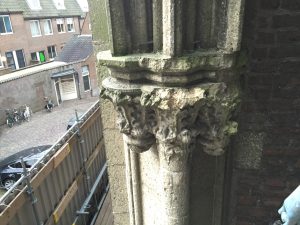
In the years I worked as a restoration sculptor I have often had to deal with statues and ornaments that originally were hewn in tufa and have weathered down over the years. In most cases, it was the so-called Ettringer tuff stone, which was used all over the Netherlands in the post-war years.
At that time there was a huge reconstruction going on, and the traditionally applied tuf was hard to get or unaffordable. Even in Germany itself, where the tuff mainly comes from, there was a great need for good construction- and sculpture stone. The quarries could not keep up with demand.

Therefore, the choice for Ettringer tuff seemed an excellent solution: it was cheaper, it was available and in very large sizes to boot. The stone was somewhat coarser and had greater bimsspots (yellowish, sand-like inclusions), but it was easy to carve. For centuries sculptures and- stonemasonry had been made out of tuff and the rustic character of the stone fit well with the concepts of restoration at that time and thoughts about sculpture. Added to that, tuff is quite easy and quick to carve; it's not too tough when it's still fresh from the quarry.
No dynamite, but moisture and temperature
Unfortunately, over the years it turned out that in many places in the Netherlands Ettringer tuff deteriorated very quickly, so much so that entire parts were falling down. For a time it was said that this was due to the mining in the quarries, without much factual knowledge. It was claimed that in the 1930s to 1950s the stone was removed from the quarry with dynamite and that this had caused hairline cracks that were now causing all the misery. However, that was not the case. It turned out that precisely this kind of tuff was particularly sensitive to changes in temperature and moisture.
Volcanic ash
Tuff is actually a rock formed from the ashes of a volcano. The volcano emits a heap of ashes- and grit particles, that eventually have to come down somewhere again. The coarse particles land closest to the volcano, the finer parts are blown further away. Thus, in a few days time a pack of ash and pumice and other parts can be deposited of even a few metres thick, just think of Pompei. Once the volcano has finally calmed down, the package is gradually condensed, and under the influence of seeping (rain)water, it hardens into rock. If the tufa is cut, the hard parts of basalt, the matrix of volcanic ash and the sandy yellow bims spots can easily be recognized .
As with all types of stone there are types that are very suitable for finer work, parts or banks of inferior quality and unsuitable stone. The knowledge about this is often built up over centuries by quarry exploiters and stonemasons. As it turns out this Ettringer tuff is less suitable. Replacement tufa species such as good quality Römer- and Weiberner tuff are expected to last much longer.
Shrinkage and growth
Basically tuff is a bit like wood. If it gets wet, it expands a fraction. When it is dry, it shrinks again. Actually that applies to all stones a bit. But these tuff can absorb a lot of water and give it off again slowly. Added to that, the various components of the stone respond different to moisture, and that generates internal stress. All that expanding and contracting over time leads to fracturing, causing the moisture to penetrate deeper into the stone.
Then there is the effect of temperature. Under the influence of heat the stone expands as well, and in cold weather it shrinks. That too gives tension differences and fracturing. The moisture penetrates deeper and deeper into the stone. If a frost period comes over it, that water freezes to ice, and ice of course expands, accelerating the whole process remarkably. Especially the slender protruding portions react to that first. Thus, it may happen that a church needs to place a fence to protect visitors from falling gargoyles.
Solutions
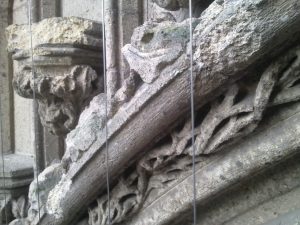
The solution in this case is very clear: patching will only help temporarily. For a while was tried to slow down the process by impregnating these sculptures in their entirety with acrylic resin under high pressure. Of these, there are by now many examples that show that this doesn't always turn out as desired, in tuff at least. You'll have to choose between letting the decline continue, whether or not delayed by fixing with mortar or something like that, protecting the original, or replacing.
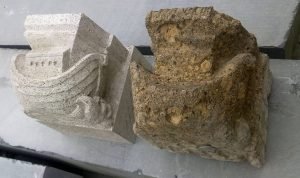
You can protect the statue by building a shelter or putting it inside, but usually it loses its accessibility or function in that location. For sculpture, frequently has been chosen for replacing. If the original is still somewhat presentable, you can for example display it inside, or put it into storage. That nearly stops the weathering process almost immediately . In that case, you'll have two statues: the original that's now inside, and a copy outside. Then the question remains how you want to replace it. Are you going to make a cast of the weathered image or carve a new one?

I myself would of course (that's how biased I am) choose for carving a good copy in new stone. A casting is accurate, but it remains a cast of the already damaged statue, with missing parts and lost definition and all. A good restoration sculptor can fairly accurately recognize the various carving techniques and details and reproduce them, and thus do justice to the original intention of the sculptor who made it. I see it as the reperformance of a classical piece of music by a well-trained musician. Obviously you will hear something of the personality of the musician coming through, but in a good performance it will get to touch the audience. But in the case of a degraded casting, I'm not always sure about that.
In the course of the years I have been carving copies of (originally tufa) sculptures in various types of stone. I have worked on copies in new tuff, in English portland stone, sandstone, basaltic lava and even granite. It all depends on the statue, the location, the speed of deterioration, colour, appearance and yes, also personal taste.
Weathering of a gargoyle
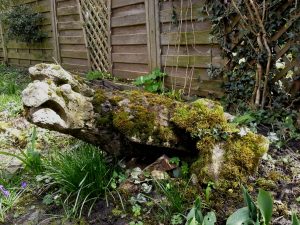
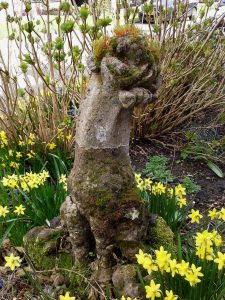
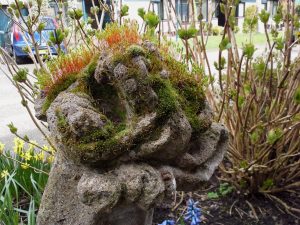
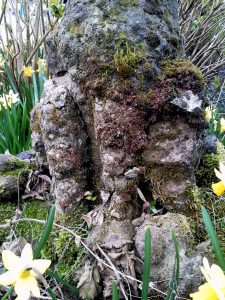
In the photos of this post you'll see how quickly the weathering of a tufa gargoyle can happen at a high moisture load. There continues to be moisture in it, allowing moss to grow on it (volcanic ash is very fertile), and already within a few years pieces come down. The upper gargoyle consists of two parts. The bottom piece is probably from 1880
or even earlier. The (too large) head dates back to the early eighties of the twentieth century. You can see how the legs begin to fall apart, how the moss thrives on the head, how the neck is still relatively intact, and where the joint between the two parts is. This gargoyle was replaced by a sandstone copy earlier. Sandstone is very porous, but the moisture can very easily flow away again, and thus, it lasts for centuries. It is also insensitive to acid. Some types of sandstone are stronger than others; some kinds for example can't withstand wind erosion, or leaching of water, or contain too much clay, which again causes problems. There is almost always a good kind and a wrong.
A work of art in Berlin
Last week I came across an interesting article about a work of art in Berlin which uses precisely the properties of tuff: to react to moisture and temperature. With the accelerated decline of four huge stone blocks on four courtyards, this process of weathering of tuff is brought closer to the city dweller in an art project in East Berlin. These blocks are a kind of wells, which are fed with the rainwater from the roof. The article and the accompanying photos are well worth reading:
- Vincent Kompier on tuff art in the Oberbaum City
- Tuffstone in the Berlin Oberbaum-City (German)
- Nature as art: Tuffstone in the Berlin Oberbaum-City (German)
- The website of the stonemason where this project was realized