• The Eusebius-copying and more

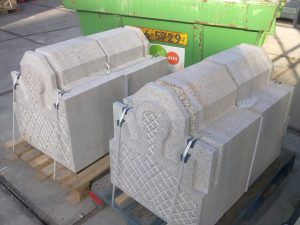
    Noah's ark: new in Muschelkalk limestone, old in Ettringer tuff stone. Tower of St. Eusebius' Church
    Noah's ark: new in Muschelkalk limestone, old in Ettringer tuff stone

    As I already explained in reported yesterday I am currently carving corbels for the tower of the St. Eusebius's Church in Arnhem (the Netherlands).

    The small reliefs that I am carving now generally don't have too many details. To a large extent this is because theEttringer tuff stone in which it was originally carved, isn't very suited for detailed carving: it contains fairly large, sandy bimsspots, that later often wash out, leaving large holes in the stone surface. You might try to carve something in that spot, but your chisel will sink in, unless you have a very wide chisel. You can see those yellow soft spots very well in the picture above.

    The replacement stone is Muschelkalk limestone, a fairly coarse limestone from Germany that matches the character of the tufa around it very well, but is a lot easier to carve and detail in, and apparently is more weather-resistant as well. Because the grain of the Muschelkalk is finer, I also got the opportunity to add a little more detail, but without deviating too much from the original. The idea is that the sculptors at the time would certainly have added more detail if the tuff had allowed it.

    This ark was really something to enhance a bit. With a few windows and the planks of the ship's hull (the waves were already there, but they were very weathered) it's immediately a lot more attractive.

    a corbel with anchor, tower of  St. Eusebius's Church (Arnhem)
    Anchor, new and old

    And then you'll be right on the old debate: what is restoration? Are you going to copy exactly what was there, without adding anything, or is there some room for that little bit extra? These are things I don't think up all on my own. But I am happy with the outcome, it's quite a bit more interesting for me this way, because I don't have to just slavishly copy what was already there, but can put something of myself in it.

    spikes new and old

    The old work has something very playful, what must be a result of carving in the direct carving method, and only after a round on the scaffolding around the tower, I began to see it. That's why the new work should preferably also have that directness, with traces of the chiseling still visible, and carved not quite super crisp and clean. And therefore the Muschelkalk is such a good choice: that coarseness of the tuff partly returns in the new stone, but something more can be made of it.

    But there are also little reliefs that are absolutley unclear as to what they portray. On the left a picture: it is a couple of spiky protrusions, perhaps with a band surrounding it. If you know what it is, you can say it. After a brief discussion, it was decided to leave the mystery intact, and I copied it without much changes.

    Read more…

    To the first message about this restoration project.

  • A set of corbels for the Eusebius Church

    The St. Eusebius's Church in Arnhem (the Netherlands) has been clad in scaffolding for a number of years now, and now the time has come to tackle the sculptured parts.

    corbels for the tower of St. Eusebius' Church

    I was asked to copy the first tuff stone pieces from the fifties in new Muschelkalk limestone.

    At first I didn't have much enthusiasm about the quality of the sculpture, because the first cocorbels looked very coarse (I would almost say crude) at first sight. But in the beginning of that first week I went up the scaffold to 46 meters high and there I was particularly impressed by the large corbels in Ettringer tuff stone that were still to be found there . The Eusebius was greatly damaged after all the bombing and a fire at the end of WWII, but it was carefully restored and because there was so much missing (and even in the first years after the war, a lot was stolen from the rubble, I read) the sculptors were given quite a lot of artistic space when filling the gaps.

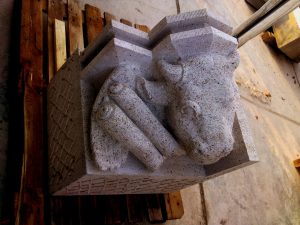
    Collar Stone Bison with young, Eusebiustoren

    The first thing I encountered when I stepped out of the elevator on the 20th floor were corbels with animals, and I was touched by the expression and skill with which a large bison with her calf and two Indian rhinos were hewn. The sculptor (A.M. Bruggeman from The Hague) had made brilliant use of the properties of the tuff (and those of his tools) to portray the shaggy coat.

    Several sculptors have worked on the Eusebius church in the post-war years, and the story of the sculptor Eduard van Kuilenburg was the most striking of them. He died young, but before his death at the age of 37 he carved, incredibly driven, his vision through the direct carving method into the church's reliefs

    If you want to read more about the sculptors and sculpture of the Eusebius Church and tower, then fairly recently a voluminous book was published about the sculptures of the church. Highly recommended!

    The sculptures that could be at risk in the coming years will l be replaced by a copy in a more weather-resistant material. In the following weeks I will occasionally write about the corbels that I am carving now.

    Read more…

No more messages to show.

No more messages to show.