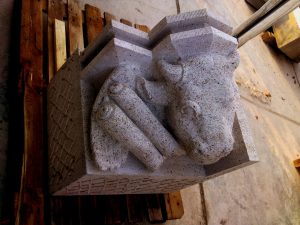
• Saint Luke's bull

    Lucas bull tower Eusebiuskerk

    As I mentioned earlier, these weeks I'm still busy carving corbels for St Eusebius' Church in Arnhem, for its tower to be exact. Last week the (large) blocks for the four evangelists arrived, and now the relief with the bull is finished.

    This symbolism comes from the Book of Revelation, in which St. John writes that in a vision he sees four beings standing before the throne of God:  “Right before the throne and surrounding it were four creatures, that from the front and the rear were all eyes .  The first being looked like a lion and the second like a young bull; the third had a face like a human and the fourth looked like a flying eagle.“(Revelation 4:6+7)

    These four creatures have since long ago been interpreted as the four Gospels or the writers of the four Gospels: Matthew, Mark, Luke and John. That's why these four also appear on the Eusebius church: The lion stands for St. Mark, the bull for Luke, the angel or man is Matthew and John himself is the eagle.
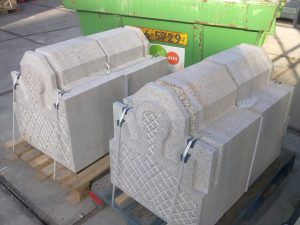
    blocks for the four evangelists
    Bull- Lucas old

    These are quite large blocks of stone; I've not actually measured them but I estimate that they are about sixty centimeters wide. Because the bull was in front, that was the one I took first, and that is now finished. Aside from a little more detail in the wings and sharper details I didn't change much on this one. And now St. Mark is placed on the block, and from that too I will take a snapshot later.

    Strangely enough, all these eyes are never shown. I suspect even in the early days they already realized that it's all meant symbolic or allegorical.

    Just as the previous one, smaller corbels, the original is in tuff stone and is starting to crumble away (with the danger of falling debris in coming years), and the copy is from the same course Muschelkalk. First I started with cutting away some unnecessary bulk mass, then with the pointing machine I transferred a number of points , and from there I carved the rest of it mostly by eyeballing, in order to preserve the directness of the original.

    Read more…

    To the first message about this restoration project.

  • The Eusebius-copying and more

    Noah's ark: new in Muschelkalk limestone, old in Ettringer tuff stone. Tower of St. Eusebius' Church
    Noah's ark: new in Muschelkalk limestone, old in Ettringer tuff stone

    As I already explained in reported yesterday I am currently carving corbels for the tower of the St. Eusebius's Church in Arnhem (the Netherlands).

    The small reliefs that I am carving now generally don't have too many details. To a large extent this is because theEttringer tuff stone in which it was originally carved, isn't very suited for detailed carving: it contains fairly large, sandy bimsspots, that later often wash out, leaving large holes in the stone surface. You might try to carve something in that spot, but your chisel will sink in, unless you have a very wide chisel. You can see those yellow soft spots very well in the picture above.

    The replacement stone is Muschelkalk limestone, a fairly coarse limestone from Germany that matches the character of the tufa around it very well, but is a lot easier to carve and detail in, and apparently is more weather-resistant as well. Because the grain of the Muschelkalk is finer, I also got the opportunity to add a little more detail, but without deviating too much from the original. The idea is that the sculptors at the time would certainly have added more detail if the tuff had allowed it.

    This ark was really something to enhance a bit. With a few windows and the planks of the ship's hull (the waves were already there, but they were very weathered) it's immediately a lot more attractive.

    a corbel with anchor, tower of  St. Eusebius's Church (Arnhem)
    Anchor, new and old

    And then you'll be right on the old debate: what is restoration? Are you going to copy exactly what was there, without adding anything, or is there some room for that little bit extra? These are things I don't think up all on my own. But I am happy with the outcome, it's quite a bit more interesting for me this way, because I don't have to just slavishly copy what was already there, but can put something of myself in it.

    spikes new and old

    The old work has something very playful, what must be a result of carving in the direct carving method, and only after a round on the scaffolding around the tower, I began to see it. That's why the new work should preferably also have that directness, with traces of the chiseling still visible, and carved not quite super crisp and clean. And therefore the Muschelkalk is such a good choice: that coarseness of the tuff partly returns in the new stone, but something more can be made of it.

    But there are also little reliefs that are absolutley unclear as to what they portray. On the left a picture: it is a couple of spiky protrusions, perhaps with a band surrounding it. If you know what it is, you can say it. After a brief discussion, it was decided to leave the mystery intact, and I copied it without much changes.

    Read more…

    To the first message about this restoration project.

No more messages to show.

No more messages to show.