• A Desperate Monk, Reading (flying buttress figurine)
    A Desperate Monk, Reading, Copying the statues
    copying the Monk

    Weather-beaten

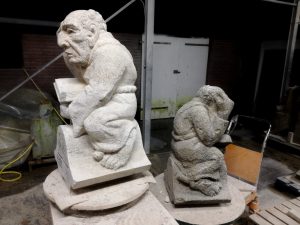
    The next flying buttress statue in the series for St. Eusebius's Church was a man in a monk's habit, reading a book and desperately grasping his forehead. The old tuffstone sculpture was pretty heavily weathered at the surface, but the stone underneath was still fairly sound. However, no warranty can be given that this is about 20 more years and that before that time no parts will come tumbling down. That's why all these sculptures are being replaced now. They all sit on the flying buttresses of the church, with most of them looking upwards, and under strong influence of all weathers.

    What on earth is a monk doing on Noah's Ark?

    I was wondering what a monk would be doing among all those animal figures, because in all likelihood monks didn't exist yet in the days of Noah.
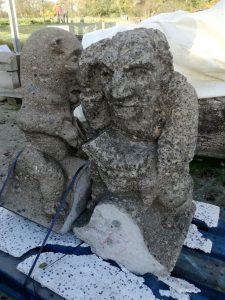
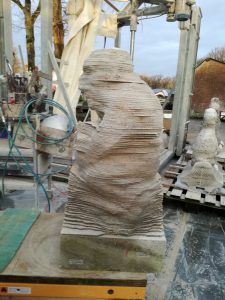
    A Desperate Monk, Reading, old weathered tuffstone statue
    old tuffstone statuette
    A Desperate Monk, Reading, Presawn image
    Monk has been presawn

    Speculating, I think there are two reasons for including this character in the series: either it represents the priests of those days who foresaw the disaster in their prophecies but saw no way out, or it stands for all those people, mainly priests and monks, who read the Bible in the past centuries and pondered about the reason for this disaster, the nature of man and the reason why God intervened.

    Finishing
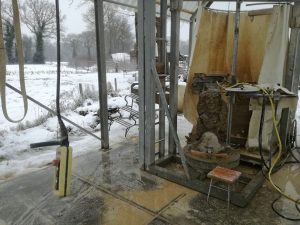
    presawing stone sculptures in the snow
    presawing in the snow

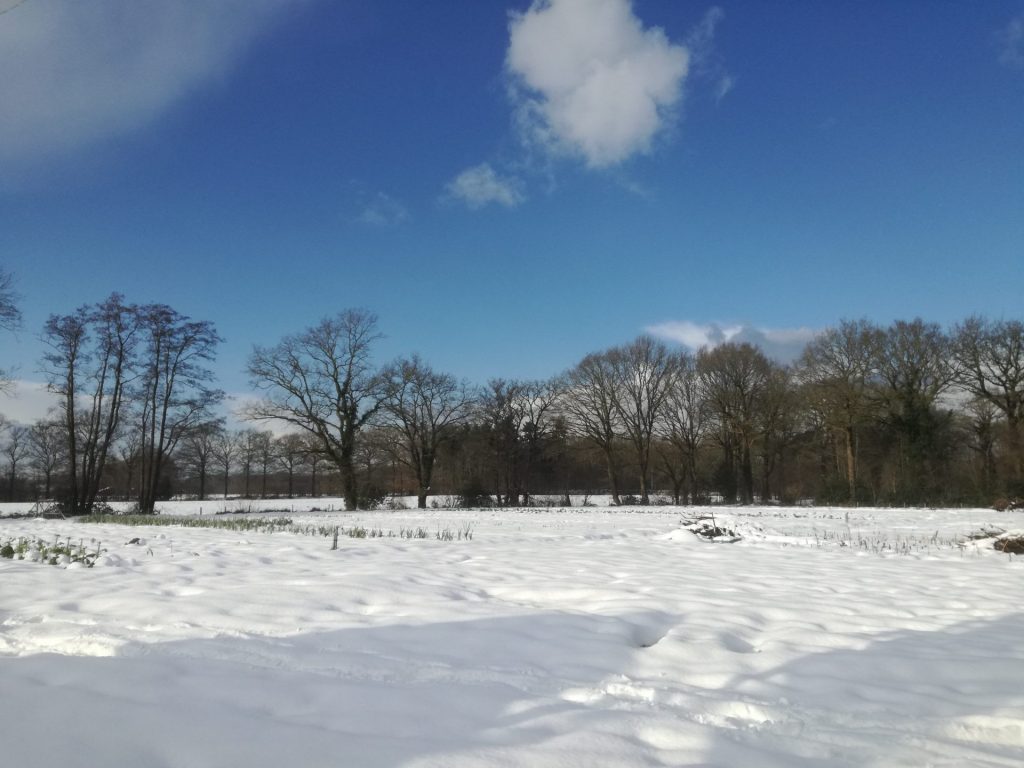
    As you can read in in a previous message I had presawn all the figurines of flying buttress no. 4 in the cold and snow, so I could quickly proceed with the next one.

    This figure is due to its shape a bit more work than for instance a Razorbill, a Capercaillie or an Elephant, but the details make it a nice topic to carve. I finished the habit with a toothed chisel stroke, and the hands, feet and head with a flat chisel.
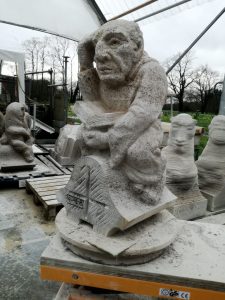
    A Desperate Monk, Reading, new limestone statue
    the copy in new Muschelkalksteen

    I tried to retrieve as many details as possible and copy them exactly, except that I've added some lines for pages in the book and carved a hint of nails on fingers and toes. Because of the lighter stone it's now much clearer what it represents.

    Nasty the following flying buttress image.
  • A Razorbill without a head (flying buttress figurine)

    Presawing in the snow

    Van Velzen sculptor overlooks snowy fields this winter

    The next flying buttress figurine for St. Eusebius's Church in Arnhem is finished too. I've been busy presawing all the blocks that I had lying around for flying buttress 4 and 5 (read here more), before maybe a real frost period got in the way. Because my saw sits outside, I cannot use it during frost, because then everything freezes immediately, if I even can get the water to the machine. As it was now it was only freezing by half a degree, and although a lot of snow fell and elsewhere on the terrain an old barn half collapsed by sheer weight, it had no consequences for me.

    barn roof collapsed because of snow
    barn roof collapsed
    presawing stone sculptures in the snow
    presawing in the snow
    seven presawn flying buttress figurines and seven old flying buttress figurines in the workshop
    seven presawn flying buttress figurines

    Reconstructing after an old photograph

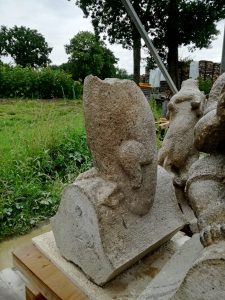
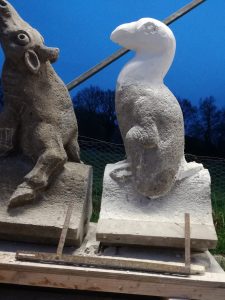
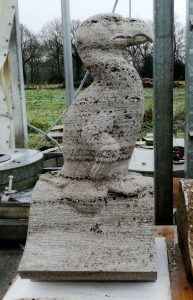
    What proved more difficult, was that the bird that I was going to copy into new stone was missing its head. A Penguin, so we thought. Must have been with its beak straight up, otherwise it could originally never have fit inside the block. But then it would have had very strange wings -doesn't a Penguin have straight wings?

    flying buttress figurine Razorbill without a head
    old headless Razorbill
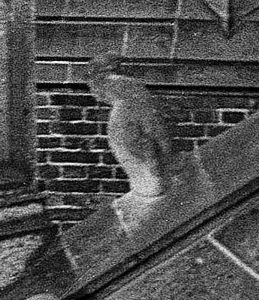
    grainy picture of flying buttresses figurine Razorbill on the Eusebius Church in original condition
    an old photo of the Razorbill in its original condition

    After some emails back and forth an old picture brought some clarity: the bird had its head bent backwards. It looked more like a Dodo. However, a Dodo does not have the legs of a seabird… then maybe a Razorbill? Although the bird in the old picture still didn't really look like a Razorbill, out of all options (Dodo, Penguin, Puffin…) that came the closest. So that was it going to be, and preferably a bit like in the picture.

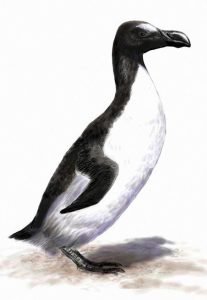
    Old drawing of a Razorbill with the same wing position
    old drawing of a Razorbill: the same wings.
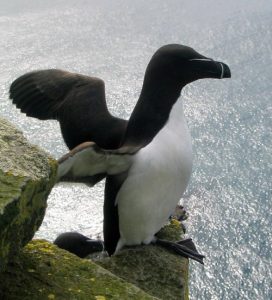
    Razorbill on a rock in Iceland
    a Razorbill somewhere in Iceland: the same feet.

    Soon I also found photographs and drawings of Razorbills that came a bit closer. I made a new head of plaster and after approval copied the bird into new Muschelkalk limestone.

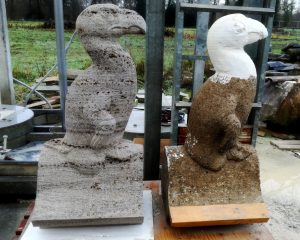
    This stone can be very dense or contain some fairly large holes. This block was quite open. That should not matter constructively. The brown layers wash out, but the stone remains strong enough. These are simply characteristics of the stone.

    reconstruction of the head
    the copy in new, rather coarse, Muschelkalk limestone
    the copy of the Razorbill in rather coarse new Muschelkalk limestone and the old bird with a plaster head

    To the next flying buttress statue.

No more messages to show.

No more messages to show.