• 70 percent debris

    One is often not aware, but when carving a statue from a block of stone, only a small part of it remains. I once calculated that very easily 70 percent of the block is thrown in the skip, and sometimes even more than that.

    In this case, the block of Anröchter Grünstein (they often call it dolomite) for the ferns weighed 3,5 tons, because I had taken a rough block. If I had taken a block that was cut to size, it would have been about 2200 kilos.

    I think I will end up with 600 kilos, so that's just a bit over 17 percent that remains. Normally one would take a block cut to size, So that means they already throw a lot of stones and debris at the quarry (The rough sides, non-right-angle pieces, bad pieces, and what was redundant after splitting the block).

    Most people find it a pity that you throw away so much of a resource. In a way that's true, but on the other hand that's just what makes it sculpting: Creating a form by taking away the excess. And that excess comes in the form of rubble, that's just the way it is. Using a computer-controlled wire saw you might still be able to retain greater residual pieces, but these still oddly formed and after a period of storage often still end up in the skip.

    Actually, this is quite a trivial topic; weight is obviously not the form of an image and nothing at all about beauty. At most, it says something about the process. That's what I like about sculpting: it is a process with many hours of handicraft between the creative parts. I do not constantly need to use creative side, I often enough may simply carve, and that gives a nice balance. How much noise all that cutting and that compressor will make, I notice that the purely physical aspect of the work to me forms a big part of the fun in the sculpting process.

    At the time when I had the stonemason's training, I noticed that all this hitting the chisel and stone brings a certain calm. With each blow you delete something from your unrest. Someone who has ever seen a stonemason doing his decorative chiselling will understand what I mean. I sometimes think that sculpting in stone could be a good form of therapy for burnt-up managers. Maybe something for the future.

    Nasty the first message about this project.
    Nasty the next post about this project.
  • Woodcarving in Ecuador

    In 1987/1988 I traveled for three months in Ecuador. It was a journey that would change my life, because after having experienced all kinds of difficulties I came into contact with woodcarving.

    I found myself in particularly difficult circumstances, without money and passport, and because of that wasn't allowed to leave the capital Quito. But with borrowed money, I learned Spanish, and started to travel. That way, I arrived in the village of San Antonio de Ibarra, of which I had heard there lived and worked lots of wood carvers. For me it was the land of plenty!

    From my thirteenth I spent time at home in the barn rummaging in wood. I carved a barge from a block of pine,  a maple leaf from rock hard AzobĂ© and further I made gt some little things that never reached a final stage. I had exactly one gouge, that I had to do everything with, and realized that I had to have lessons. But where?

    In San Antonio, I saw my chance. I walked into a shop and asked if I could learn the job somewhere. With my limited Spanish for three weeks, I realized that there was a crafts school in the village , where they were trained to be an accomplished carver in six years. Wonderful, but I did not have that much time. The man advised me to ask elsewhere in the village if I could learn to carve some time in a workshop.

    Already at the next workshop it was approved: if I just paid for the timber that I used I could learn woodcarving!

    The boss of the workshop, Hugo Garrido, was a young guy. He was very talented, ambitious, hearty, and had an open character. It turned out that he had worked in Germany several years before as a woodcarver for a year, to make tourist carvings in Lime wood after it had been precarved by machine, and finish it by hand. So he even knew some German, but I noticed that he hadn't been treated too well, as a sort of third rate worker.

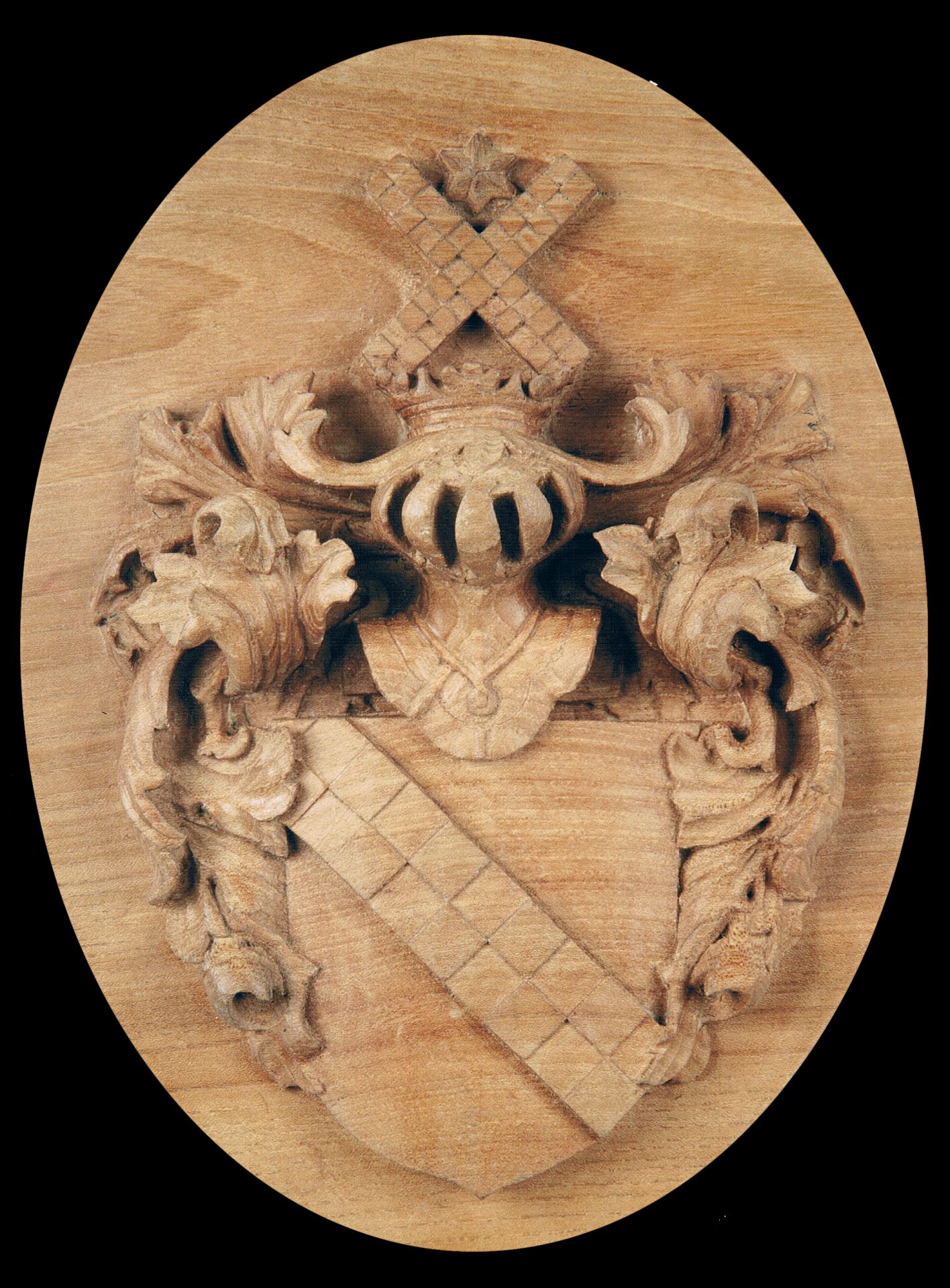
    wapen1

    So I could carve for five weeks there, and although that's far too short, I learned a lot. I went home with a twenty piece set of gouges for a bargain price, which were forged to size especially for me , and a wood turner made a series of matching handles.

    The gouges I still use occasionally, when I work in wood. They are much thinner than the gouges you can buy here in the Netherlands, and also go through the wood much easier. It's been years since I worked with it, for a couple of coats of arms, but lately I have been carving wood again, for fun. With an air hammer, that is, for the time hasn't stood still!

No more messages to show.

No more messages to show.