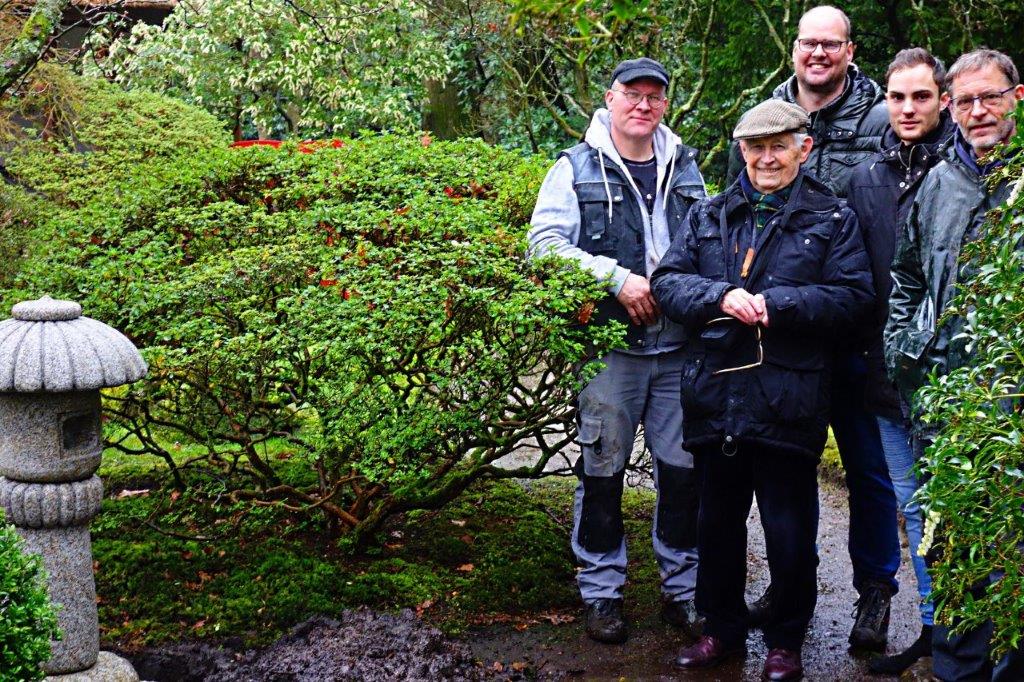
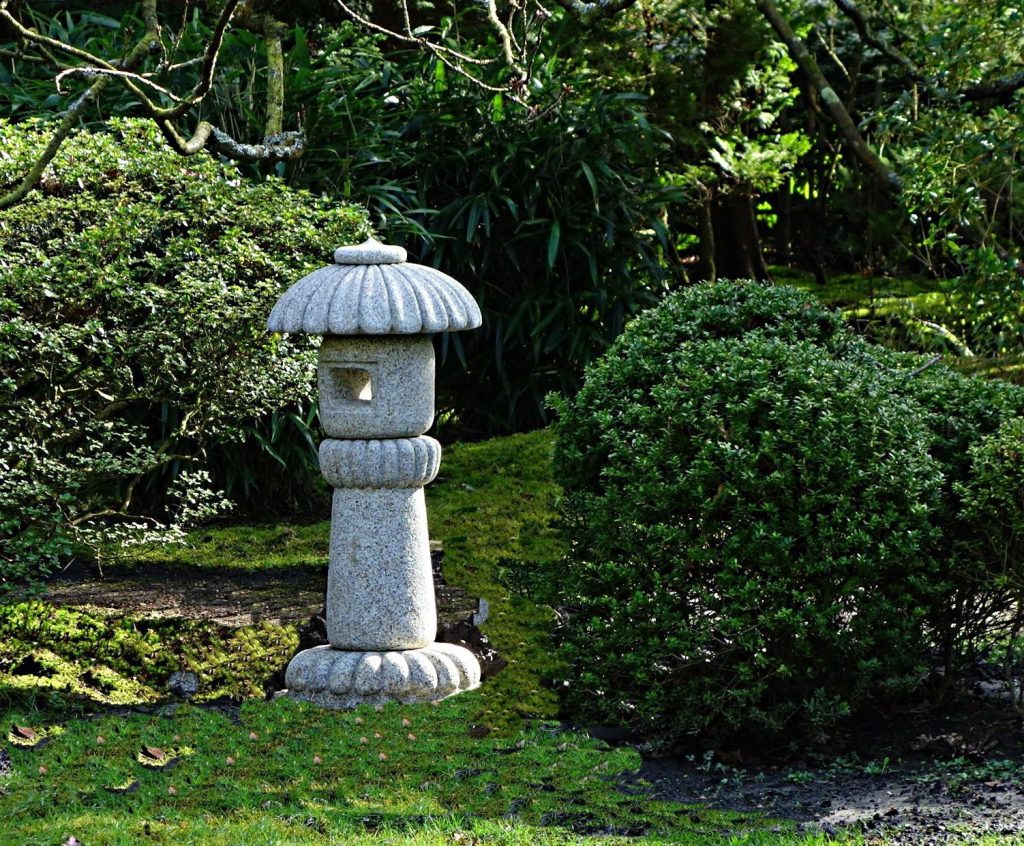
Japanese Garden of Park Clingendael. Photo by Takeaway – own work, CC BY-SA 4.0
You'll probably know them: the granite lanterns adorning Japanese gardens. I didn't know this, but even in the Netherlands, we have wonderful Japanese-styled gardens. Actually you can't really call them Japanese Gardens, because the criteria for these are apparently very strict. Rule no. 1 is as I believe that it should be located in Japan, and that just won't fit inside The Netherlands. Anyway, in The Hague, specifically in the grounds of Clingendael Estate in Wassenaar, there is also a Japanese garden. A very beautiful one, that was created around 1915 and only opens for 8 weeks per year. To save the moss.
Copying in Bavarian granite
Around the time of the construction of the garden, its owner imported a number of granite lanterns for her garden. Among them was also one
somewhat primitive Japanese lantern made of Shirakawa granite. It weathered rather quickly however, and was restored a number of times over the years. And then in May 2017 I was approached by Raymund Bervoets of Restauratie Breda, who asked me what it would cost to have a copy carved in Bavarian granite.
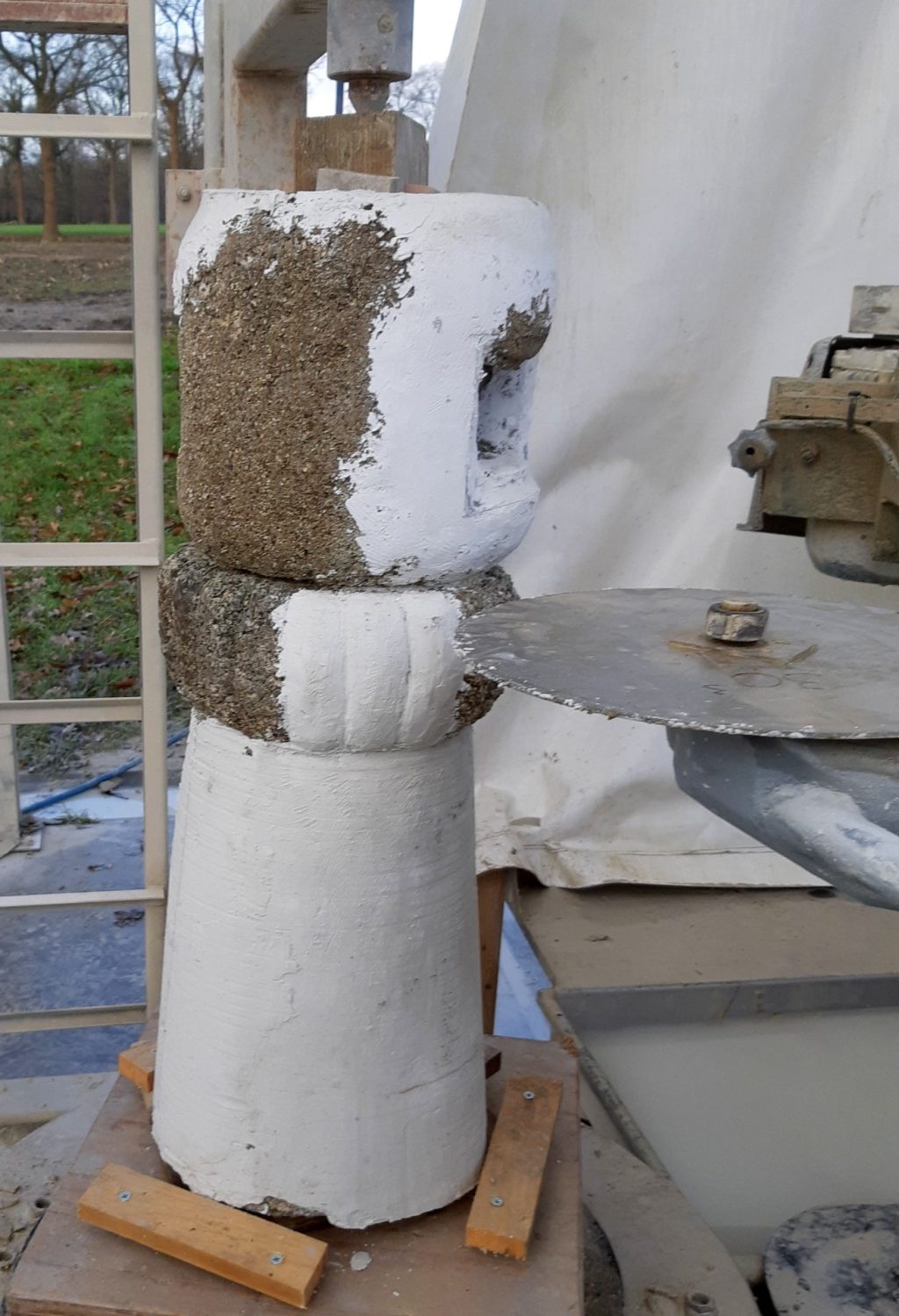
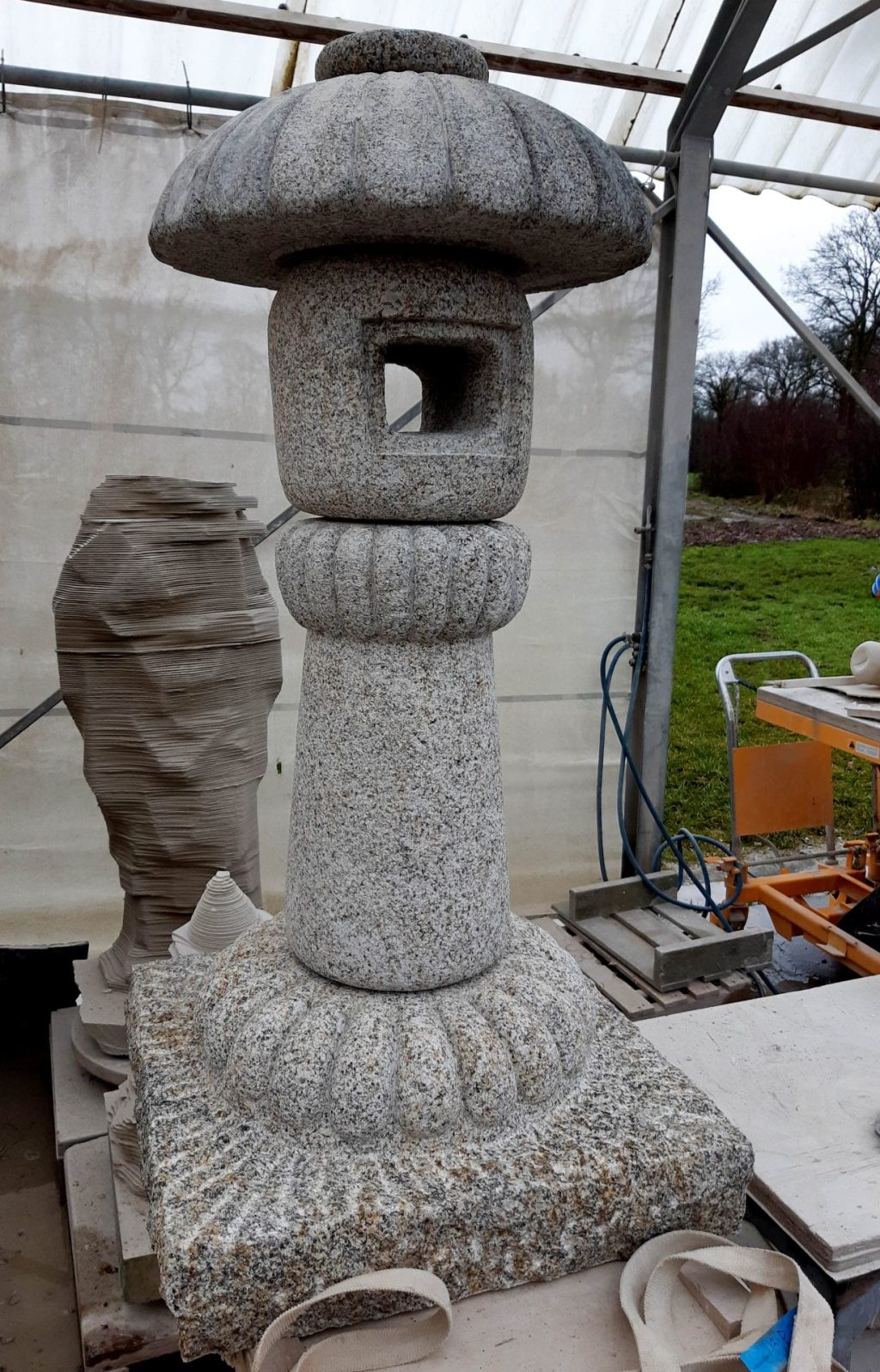
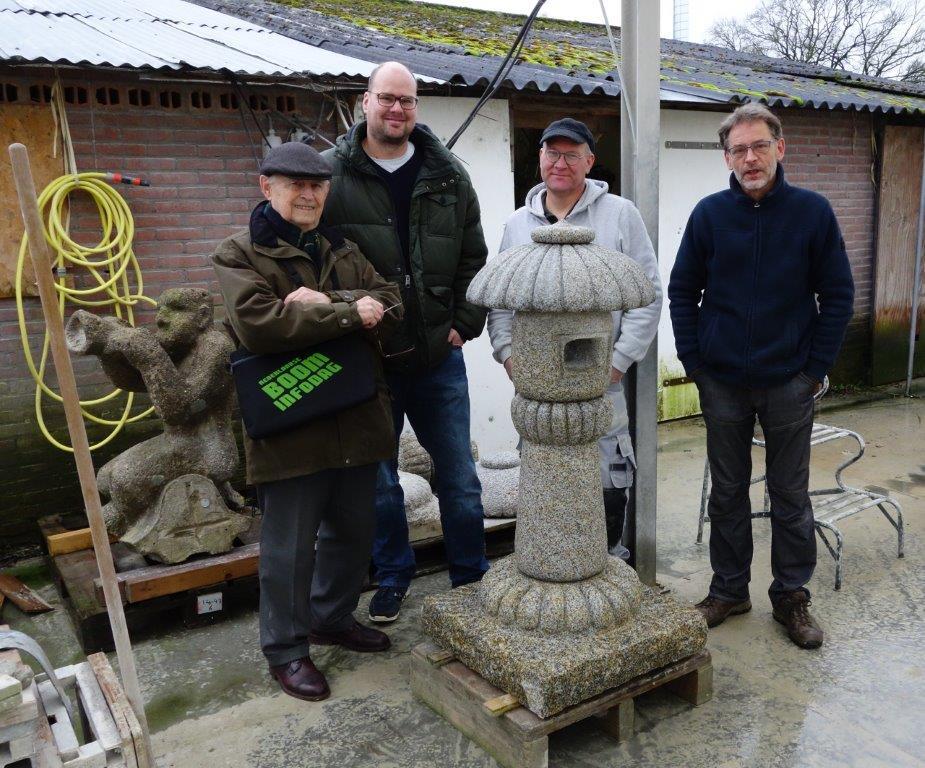
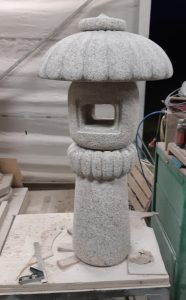
The lantern consists of five parts: the base, the shank, the fire chamber, the roof, and the cap. Typically, all the parts are loosely stacked onto each other, but in this one, because of all the repairs, several parts were glued together. Its base had gotten lost over time, perhaps it had weathered and been done away with, so at one time a composite cast piece was made.
Chrysanthemum themed
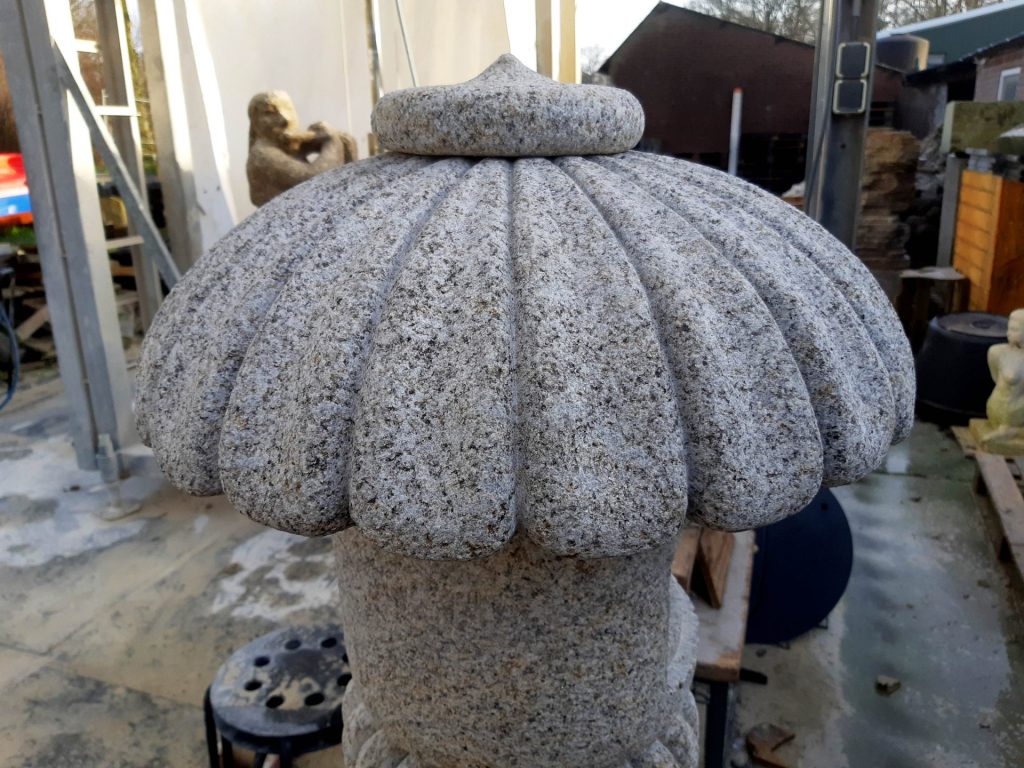
Usually Japanese lanterns look very different. For starters they haven't got 20 but 16 lobes, and thus get to bear the title 'Imperial'. Also, base and shank will be carved much more clearly. But the common element was that the roof of the lantern consisted of chrysanthemum petals. Perhaps this was a somewhat more rustic version of an official lantern?
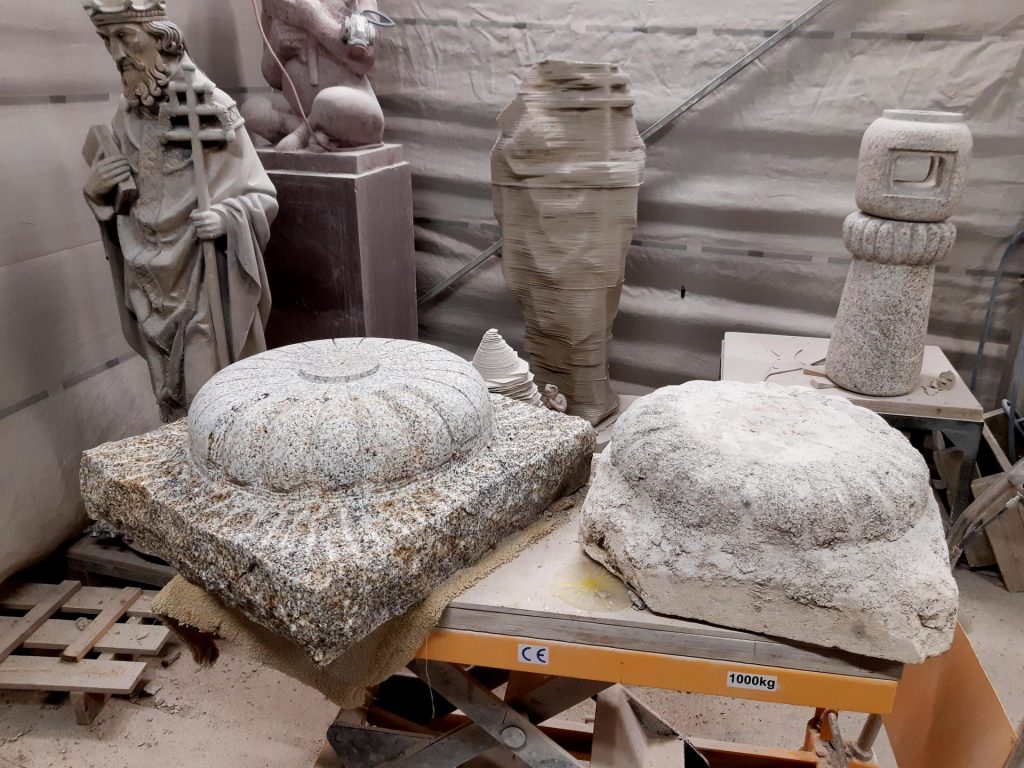
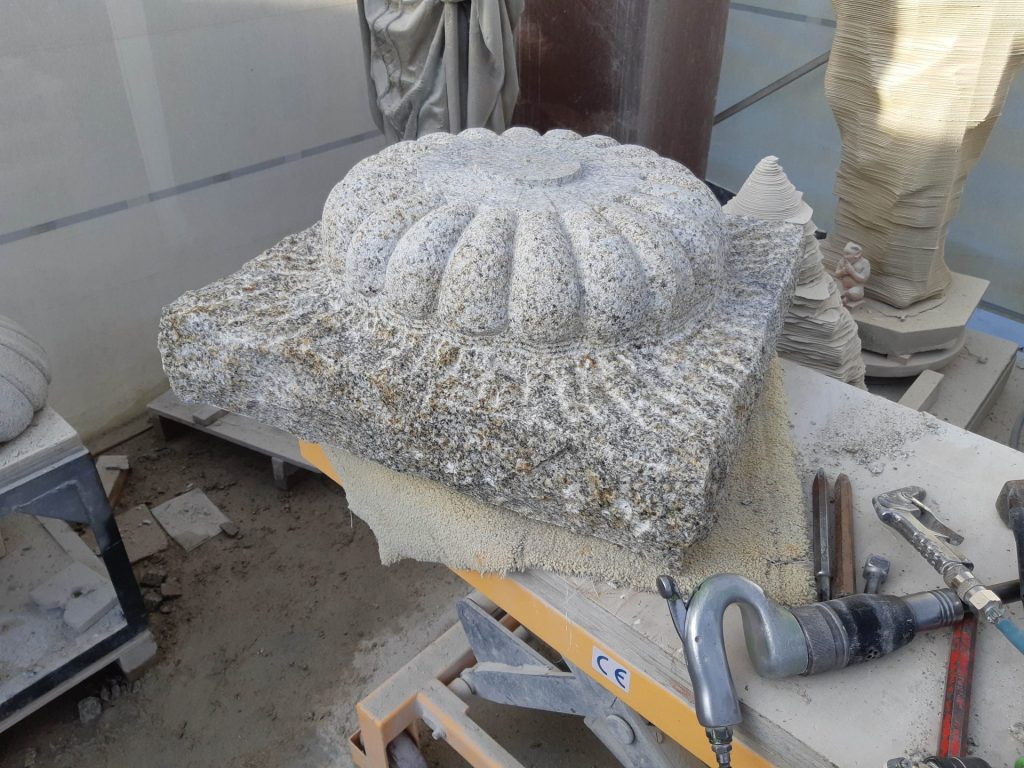
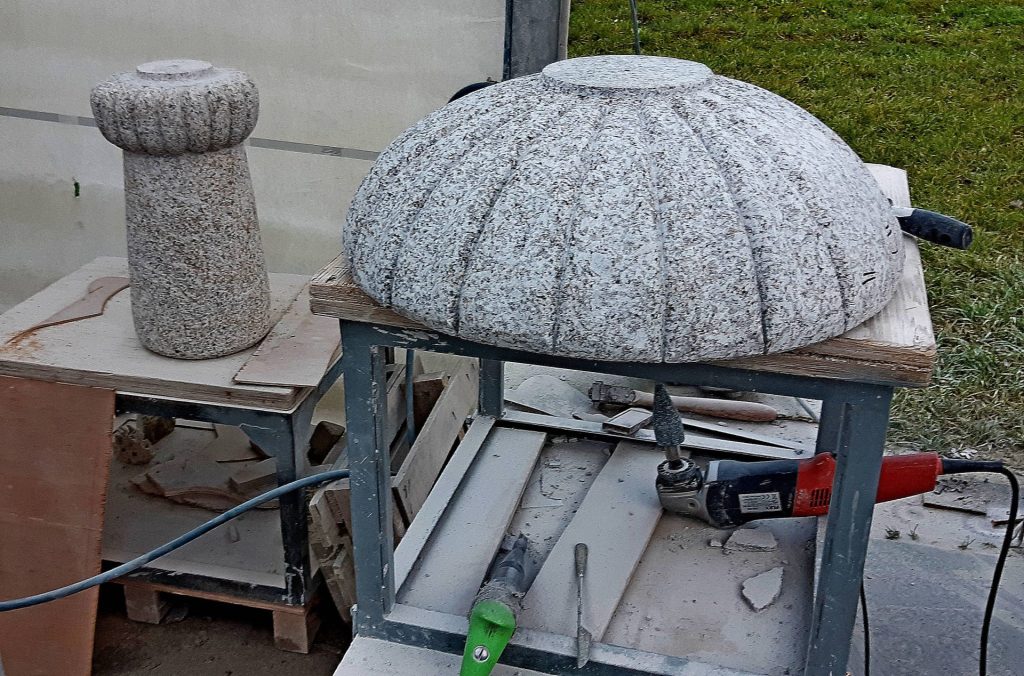
Raymund had done a lot of research into the right shapes for this lantern. On this basis, a plan was drawn up for copying. We needed a new design for the base, with, just as the roof and the shank, has 20 lobes. The shank was supposed to get a bit of a tummy. The fire chamber had deepened 'edges’ so that a small window frame with rice paper could be put in. The roof had to get 20 chrysanthemum leaves just as the original had, but sharper and fuller, and the cap had to go get a tip. And everything was supposed to get a hand-carved character.
Of course, no problem! You ask, we run.
Getting to work
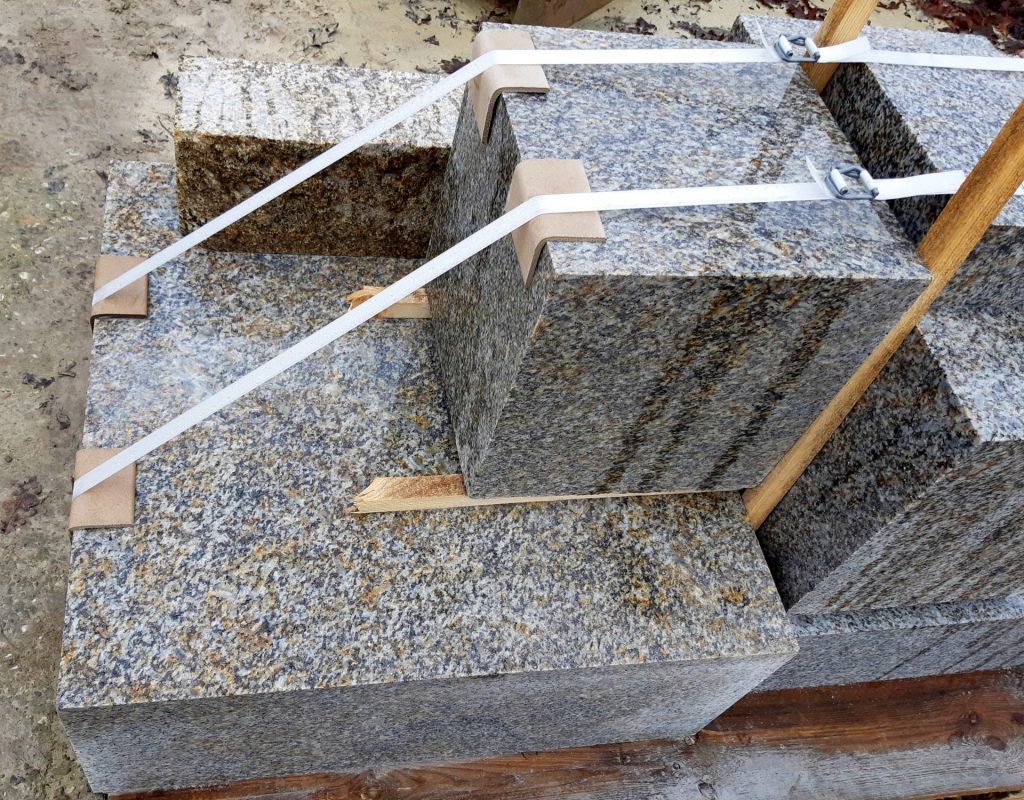
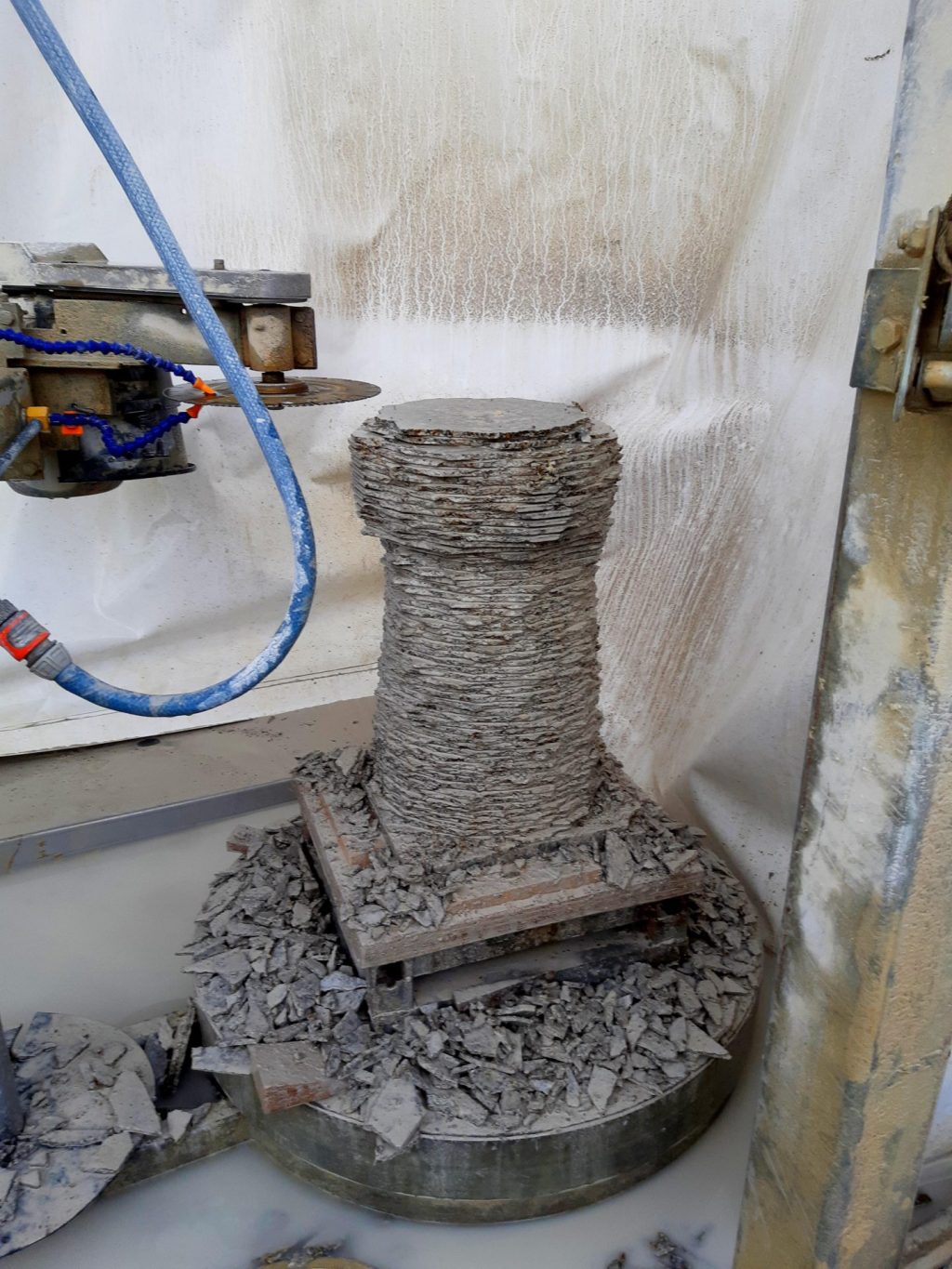
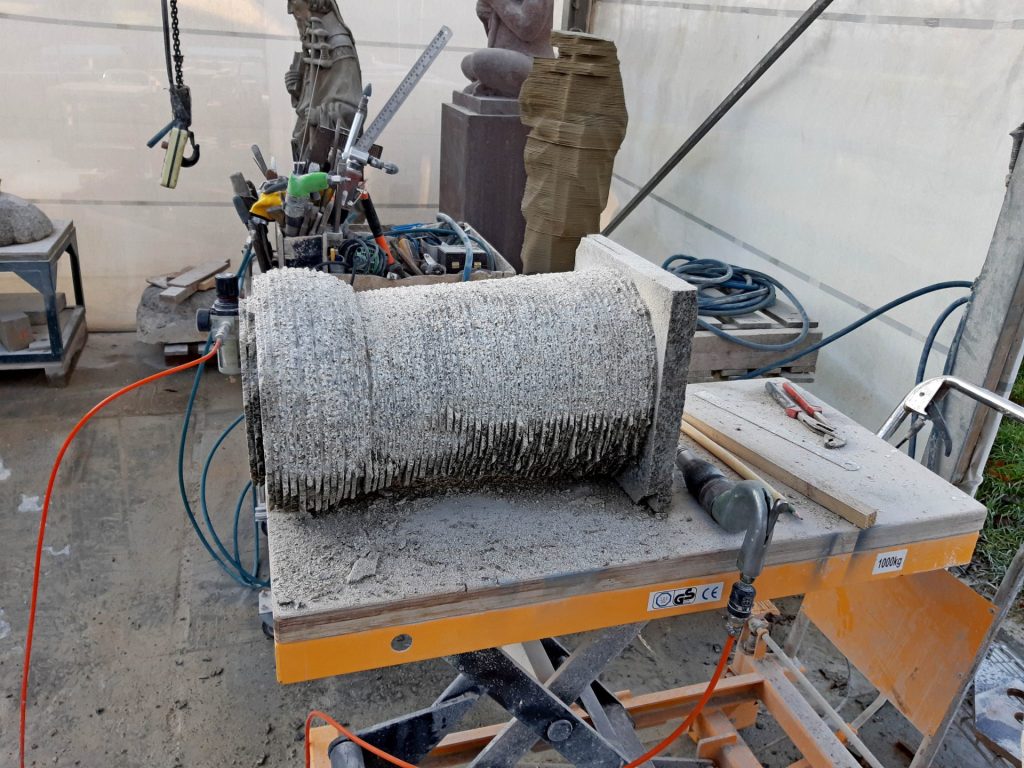
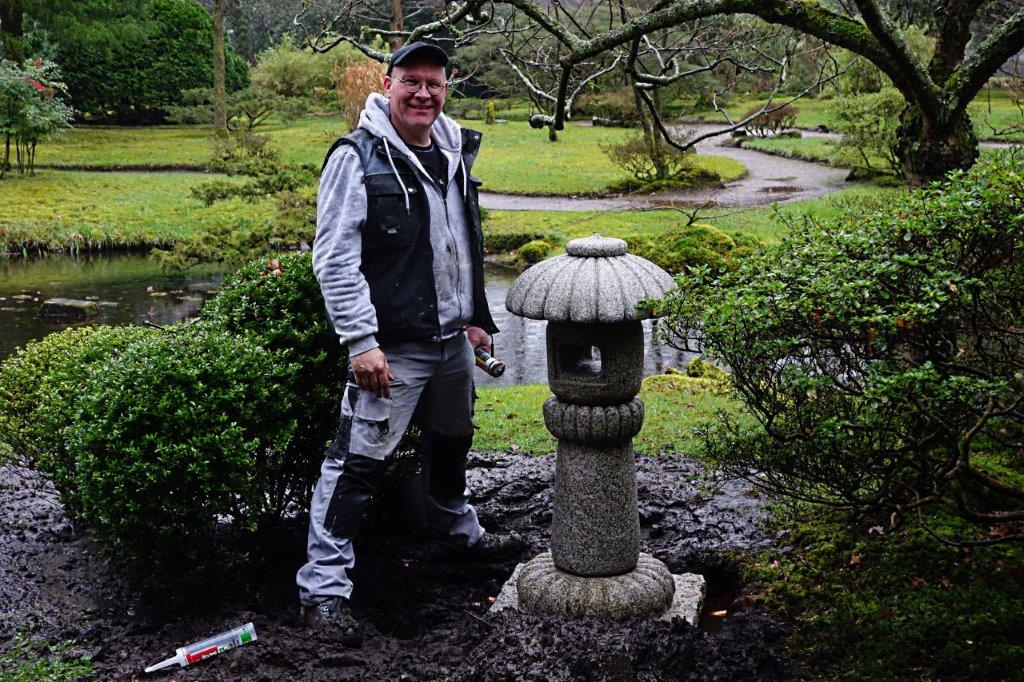
Bureaucratic mills never grind very quickly and certainly not in The Hague, but at the end of 2019 I got the green light and I could start reconstructing the lantern and then copying it in Flossenburger yellow-gray granite. With plaster I completed the five components, cut out the major shapes on my presawing machine, and carved the copy just as irregular as its original. Many details were deteriorated quite badly, so I had to bring them back a lot sharper in the copy.
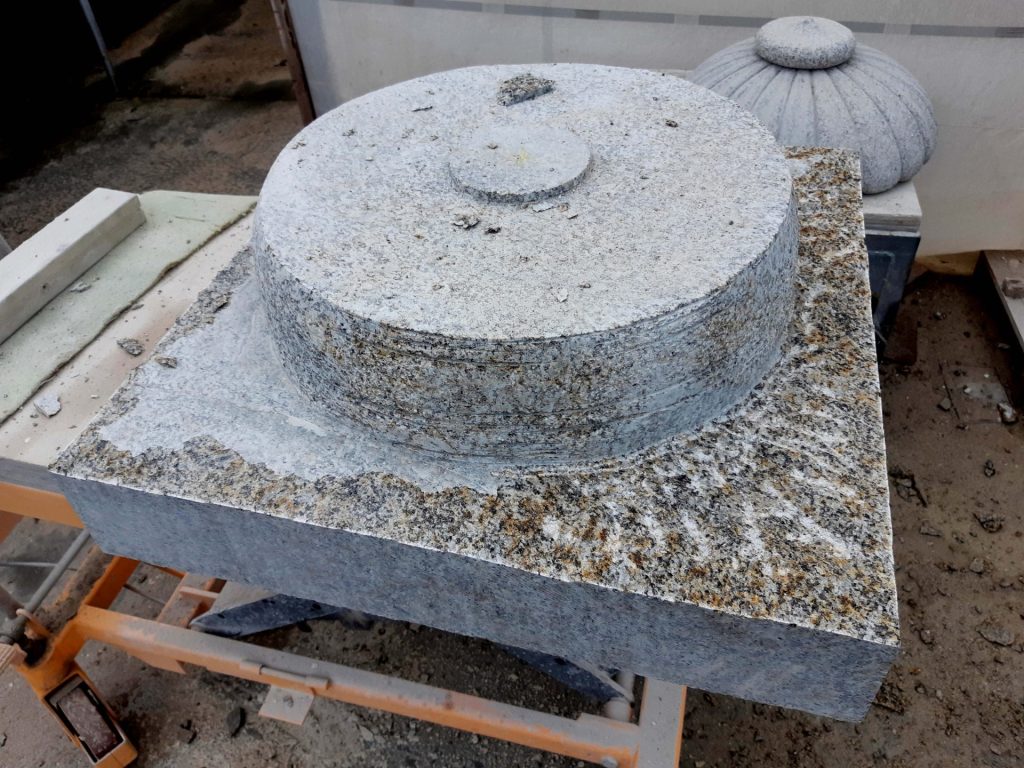
Carving the base of the lantern
The base was supposed to be partly covered in earth, and a layer of soil was to cover it. I thought it would be nicer to give the part that would end up underground a hand-carved finish as well. Of that, I made a short film. Carving granite with a chrome vanadium chisel is not easy! Only at the end I realized that I had a carbide (tungsten) point chisel lying around somewhere. That proved to go remarkably easier. In the first chisel, its tip was blunt after just a few hits, but with the carbide chisel, I could keep carving for a long time. I was afraid that the tip of the chisel would shatter at the first blows, but it all went without any problem.
A special way of experiencing a Japanese lantern
The Japanese garden in Wassenaar is actually too popular to let everyone experience it in peace. If there would have been access to the garden all year round, the moss would not survive the many photo sessions. Therefore, it is only accessible to the public for eight weeks a year. But not everyone keeps to that rule! It has happened a number of times that uninvited visitors entered the garden at night and went frolicking about with lanterns. Since all the parts are stacked loose, several times, parts have ended up in the pond.
Jam jar and cap
For that reason, we discussed how we could make the copy more stable. The result was that I was to make a kind of jam jar structure for each component. On top of the lower part, I would make a raised edge, and the portion above that was to receive a cavity that just fits over the lip. Like the cap of a jar.
As a result, the stack will no longer be easy to shift, but can still be lifted. That's why we've also applied a flexible adhesive between the parts during installation. In this way the components can always be removed someday, with some precaution, but they are anchored better in case someone wants to throw the thing over.
2019 was a great year! I've had all sorts of things in progress, among which a lot of ornaments for the Utrecht Cathedral and the Eusebius Church in Arnhem. Time for an annual review of 2019.
Blue sodalite
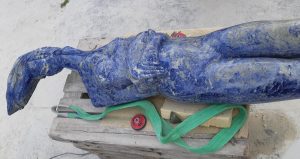
Not everything I've done this year has been published on my blog. For instance, I carved a few things for other sculptors. One was a large sculpture in blue sodalite, of a stylized lady. I copy-sawed the plaster maquette into the new stone and then carved and polished it. This material is difficult to work in, but it has an overwhelming color. I'm sure once installed in the right place, it will make a big impression. Through all those vivid colors it becomes hard to see its shapes in my photo, but upright and under good lighting conditions (not under my roof with subdued light) it will be easier to recognize the shapes. Since it was made for another sculptor, I made no mention on this blog at the time. I have in one blog post show how I cut the block to size with a chainsaw.
Holocaust Monument
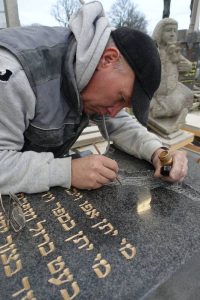
The painting in of the details in the crack
One of those projects for another sculptor was a small job that I did last week for Gerard Overeem in granite: the carving of a crack in a Monument to the Holocaust. The crack represents the suffering caused by the persecution of the Jews that has left its traces. Read here↑ the corresponding newspaper article. In an earlier newspaper article more information about the monument. It is to be unveiled on 27 January 2020 in Barneveld.
Thomas Aquinas
The copy of the statue of Thomas Aquinas was a project that almost took this entire year. In November 2018 I received the original sculpture in my yard and started with its reconstruction, in March 2019 I cut the block of Udelfanger sandstone to size and I started presawing. I also started enthusiastically on the rough carving of the two parts and fitting the pieces exactly together, but suddenly all kinds of commissions came and interfered before in October 2019 finally I was able to finish the statue.
Pope Leo the Great
After I had shipped this statue, I could skip ahead to the next statue for St. John's Cathedral in 's-Hertogenbosch: Pope Leo the Great. At the time of writing this, the work on this statue is halted as well because of a trip to India, the above holocaust memorial and a commission for carving a Japanese Lantern. But I was able to presaw the two parts of the statue entirely, so I can expeditiously start carving them in the new year. This statue also stands on the north side of St John's Cathedral in Den Bosch, The Netherlands, that is, to the left from the statue of Thomas I mentioned above.
A Japanese lantern
It may seem that I took a long time carving these two statues, but that's nothing compared to the last piece I worked on this year. For the Japanese Garden of Clingendael Estate in The Hague I made a quote in May 2017 already, and only now I get to carve it. I was asked to carve a reconstructed copy of a weathered Japanese lantern out of Bavarian granite. I'm already well on the way, but I still need to carve a lobed base and then sort out the details with the client. A blog post will follow soon!
A marble birdbath
Sometimes you get out-of-the-ordinary commissions. A client had modeled a bird bath in the shape of a duck as a boy and now he wanted it in his garden in marble. Of course that's possible. Unfortunately his clay model had disappeared, so I first had to reconstruct it. Alongside is a picture from halfway through the carving process.
Pan in porphyry… already?
At the end of October I was able to find two days for working on my sculpture of Pan in Red Porphyry. As you can read in my last post about it I had just started with rough carving when I had to put it aside. That was almost two years ago (March 2018).
But I had to put the sculpture aside again quickly this time as well because I had to take on other projects first, such as Pope Leo. Yet I was able to roughly carve the hooves, the face, the hands and the flute. I hope I can find more time in the coming year and be able to finish the sculpture.
The Eusebius Church contains various sculptural parts. The quality varies from very finely carved to fairly primitive, and dates from the construction time to present day. Somewhere in a side transept of the church, at the very top, a little man's head ↑ was missing out of a row of 9 rather primitively carved heads. Three of those were from the construction period of the church, and three of them dated from the 1960s. I was asked to carve a new head for the empty spot. It only had to look just as primitive as the others. That proved to be quite tricky! Someone told me that you'd best ask for a mason or a beginner to carve it, then you might find the right atmosphere. I just made it into a little man with a page's head.
More for St. Eusebius's church: Two huge finials
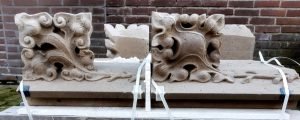
By far the majority of the work of this year was spent on carving ornamental work for two large finials and surrounding ornamental work on the northern transept of the Eusebius Church. Stide, Jelle, and myself, partly with support by Serge, had months of work to carve all that. We carved ornaments in two types of red sandstone for this north aisle, in Udelfanger sandstone and in Massangis limestone. It was so much work that I was in for a joke at the end.
Carving ornaments for the Utrecht Dom Cathedral twice
Admittedly, it was but a small pilot project, and the main work on the Utrecht Dom Tower has yet to arrive. But at a time when the scaffolding around the tower was still not up, Jelle and I scrambled up all 465 steps of the Dom Tower with all our tools on two days, and carved a few test ornaments at the very top, so that the approach of the next part can be determined. Fortunately it was beautiful weather and we had a magnificent view.
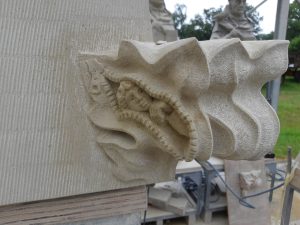
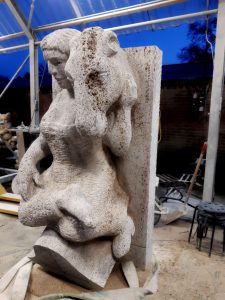
But it was not all ornamental carving work, I also had some sculptures in progress. For the west facade of the tower of St. Eusebius's Church I carved the large corbel with the sculpture of The Night out of new limestone: a naked lady with a nest of owls beside her. To accelerate the process, I cut it and its counterpart, The Day, at my presawing machine machine. It only just fitted: I had to cut away some corners, otherwise this lady couldn't even turn around inside the machine.
Flying Buttress Figurines: Seven Sins
It was last year and the year before especially with carving flying buttress figurines as well. That was a bit less this year, because the ornaments demanded all of our attention. We only had one flying buttress to go, with the Seven Sins depicted on it. Jelle made the Vanity, the Gluttony and the Greed, Stide got Envy and Lust, and I made the last two.
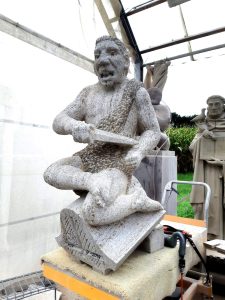
The Anger was a flying buttress statue of a man with a contorted face pulling a knife. He looked rather primitive, in his bearskin. As the only man among all the women, he actually had not much to complain, but he was clearly not happy with it.
The Idleness on the other hand, ie the Sloth, didn't mind so much. She sat back a little, caressing her workhorse, in her provocative dress, and seemed more concerned with her own laziness.
A boulder with house numbers
For a building in Amersfoort I carved a large boulder of red granite into a house number. Maybe I will be gilding the numerals one day for clarity.
A tree with rocks
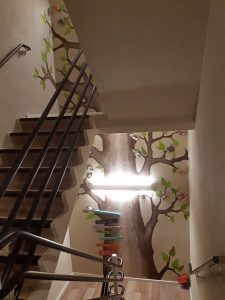
For the same building I helped making a work of art for its residents: for each resident I made a stainless steel tree leaf with their own rock on it, which were all made into one big tree. It was a lot of work to cut everything out, bending the leaves, welding and glueing them, especially since I'm not equipped too well for metalworking. It was a lot of fun to make. Painter Sandra Nanning turned the staircase into a three-story encompassing tree.
A spoonbill from Haarlem
Not all sculpture to be replaced has suffered from weathering. Sometimes sculpture disappears because of renovations and later on, residents want it back again on their building, and sometimes something is stolen. Such was the case with a buddha's head, a pelican and a spoonbill in Haarlem. Fortunately, the pelican was found again. I made a copy of the spoonbill after first reconstructing it, and Jelle accounted for the buddha head.
A lot of work for my colleagues
As you might have understood, I work regularly with my colleagues Serge van Druten, Stide Vos and Jelle Steendam. They, like me, all three have their own independent businesses. Only Jelle works in my shop; Stide has his own workshop next to me and Serge 20 kilometers away. I like having my colleagues around and being able to share larger contracts.
But I am the only one with his own presawing machine. That means that I regularly get the request to presaw something for the others too. Jelle also can properly handle the machine, so he'll be sawing for me sometimes and mainly for himself. But Jelle and I have also often enough presawn sculptures for Stide and Serge. I also usually keep track of the big picture, the tenders and the distribution of all joint projects, such as Eusebius Church and the Utrecht Cathedral.
Jelle mainly operates under my supervision, but he also takes on his own work (have a look at his website). So I regularly pass on things to him that are too much for me to take on. Sometimes he would take a little longer than I would do, that's because I've obviously been doing this work for some time. Unfortunately, we do not have specific training as a restoration sculptor in the Netherlands, so the work itself is his training. This year for example Jelle restored some garden ornaments.
New year: musicians and apostles
What's coming up next year? The most important work coming up is all of the ornamental work that we are going to get from the restoration of the Dom Tower in Utrecht. Balustrade finials, gargoyles and various other ornaments.
Next, we will be getting work from flying buttress no. 14 and 16 of St. Eusebius's Church in Arnhem. Flying buttress no. 14 consists of a group of 7 musicians and no. 16 contains a number of apostles. These are the last sculptures that sculptor Eduard van Kuilenburg made for the church, and in these we can see a transition to a somewhat more angular style. There were at the time of completion (round 1956) already alarmed questions from the church council about the "overcrowded flying buttresses’ that this led to, despite the fact that the block size was no larger than that of the previously made groups of statues around the choir. The apostles especially have massive fists and chunky heads. We're looking forward to copying them into new stone (if you want to know why these figuries are replaced: read this article about the Ettringer tuff ↑ of which they were made).
Boxes full of debris and more sculpture to go
So that adds up to fourteen sculptures for flying buttresses nos. 14 and 16, for which we expect to get the new stone blocks in early January. We have been reserving a spot for those. But there are still 12 boxes more in our storage and a group of loose sculptures outside in the yard, which will all have to be copied one day.
Some of these other sculptures are heavily weathered because they started to shatter after the impregnation process and fell to pieces, and they're lying as a layer of debris at the bottom of the boxes. It will still be an interesting project to reconstruct them. If that happens at all, because people are currently considering an alternative way to fill the empty spaces. We sent in our estimate already anyway. :)
All other blog posts from the past year
I didn't post everything in this year review 2019 that I wrote about this year. For instance, I shared two blog posts about the upcoming restoration of Notre Dame de Paris, about how the computer can play a role and on the approach and details of the restoration. You will have to wait a little longer for part three. It seems like I've been busy with other things.
And then of course there were all kinds of scaffolding visits, visits for quotes and small jobs in between that never get reported: so you might say, it was a busy year. I look forward to the coming year!
I wish you all a very good, educational and creative New Year. Thank you all for following this blog!