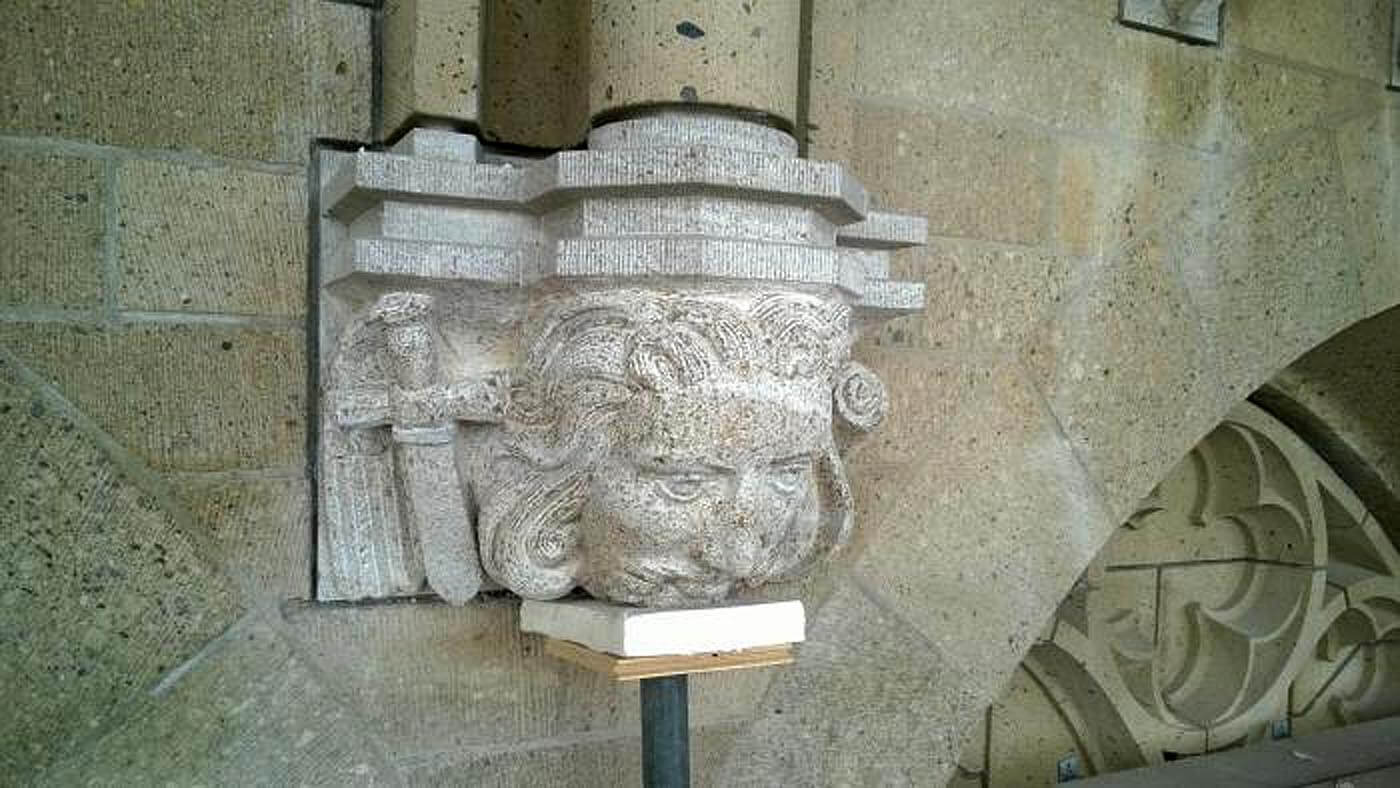
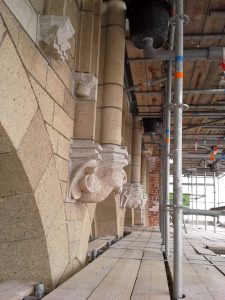
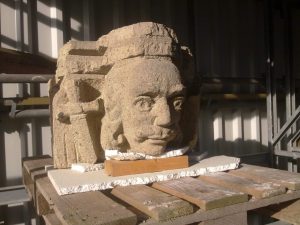
Flying Buttress figurines for St. Eusebius' Church Arnhem
Restoration St. Eusebius' Church gets going again
Good news! There is a budget again for the restoration of the St. Eusebius's Church in Arnhem (the Netherlands). Today a press release came out that the municipality and province have provided funding for a transitional period of a few months, and the expectation is that the rest of the restoration project will in time be provided for as well. As a result, I can now report that the next few months I will be busy carving a whole batch of new statuettes for the flying buttresses of this church. Below is an account of the first two that Stide and I made.
Read the first message about this restoration here.
Flying buttress sculptures for St. Eusebius's

The St. John's Cathedral in 's-Hertogenbosch is known to many people in the Netherlands. Quite recently, that church has also received a lot of attention flying buttress figurines as well: on account of the Jerome Bosch year, a scaffolding was built into the roof gutter, providing access so that everyone can view the famous flying buttress figurines with their own eyes, under the title ‘a Wonderful Climb‘.
However, less known is that there is another church in the Netherlands whose flying buttresses used to be covered in flying buttress figurines: the St. Eusebius's Church in Arnhem (the Netherlands). This church currently is mainly in the news because its restoration has met with financial difficulties. But I am hopeful of a positive course of the further restoration.
Much of the church and tower was heavily damaged by bombing and shelling in World War II, so after the war an enormous amount of new work had to be carved.

There have always been figurines on the flying buttresses of Eusebius, but after the war there was so little left to be found and so much had to be made in a short time, that the sculptors were given a lot of freedom to invent and carve new figures in their own style. So now the spirit of the fifties and sixties can easily be read from the figurines.
Weathered tuff replaced by Muschelkalk
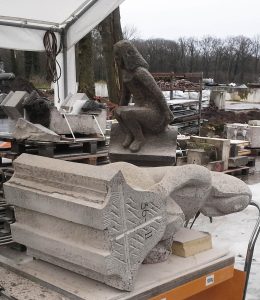
As I already explained in described previously in this article on my blog, Ettringer tuff was the material of choice in the after-war reconstruction period . Regrettably, this proved to be an unfortunate choice over the years: the Ettringer tuff responds poorly to changes in humidity and temperature and begins to fall apart a few decades.
To preserve the unique character of the Church it was decided to copy the figurines in new stone. In the past it was tried to preserve the sculptures by means of conservation, but that too has unfortunately not worked out well: the tuff continued to disintegrate. That would endanger bystanders. So they'd rather replace them altogether.
Copying
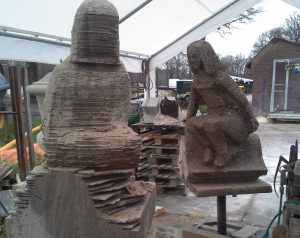
Now my colleague Stide Vos and I started carving the first figurines in Muschelkalksteen, a coarse limestone that matches the design and finish of the old sculptures. The figurines we started with were still in fairly good condition; only the big yellow sandy spots had washed out. Should funding for more statues arrive in the future, then there will also be some among these that will need complete repairs and reconstructing before we can copy them, and there are even a few that have disappeared altogether.
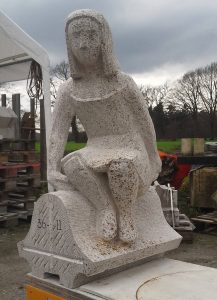
With the copying saw machine I own we can precut the figurines and then carve them, detailing and adding toolmarks after that. On the pictures the original in Tuff can be seen, next to the emerging copy in the new Muschelkalk limestone. By adressing it this way, we can work quickly and efficiently, and even a lot cheaper than a computer scan in conjunction with a CNC milling cutter.
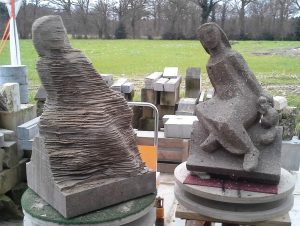
I've already had the opportunity to make some sculptural works in connection with the restoration of this church: Read here the archives of articles about this on this blog.
To the next one 7 flying buttress figurines as well.