In the previous two articles, here and here, I explained that the eight statues we've taken down from the Minervalaan 28-30 arrived in a very battered state. There ware several serious fractions and sometimes quite a loss of detail.
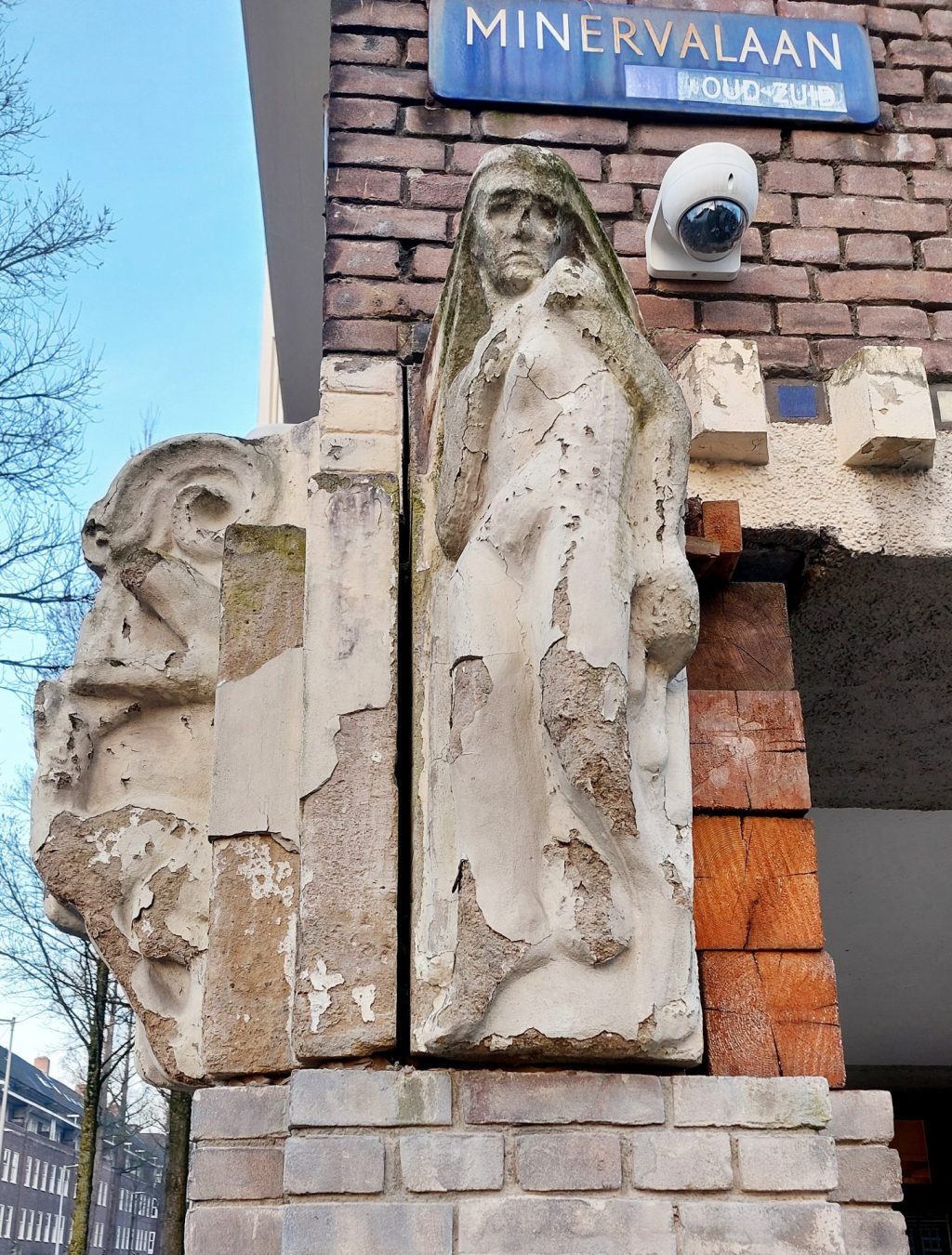
In addition, in the distant past they had already been repaired with a very hard mortar, which had started to detach from the surface in many places. The multiple paint layers didn't help this either. Time to repair them and make a reconstruction before we were going to carve the copies.
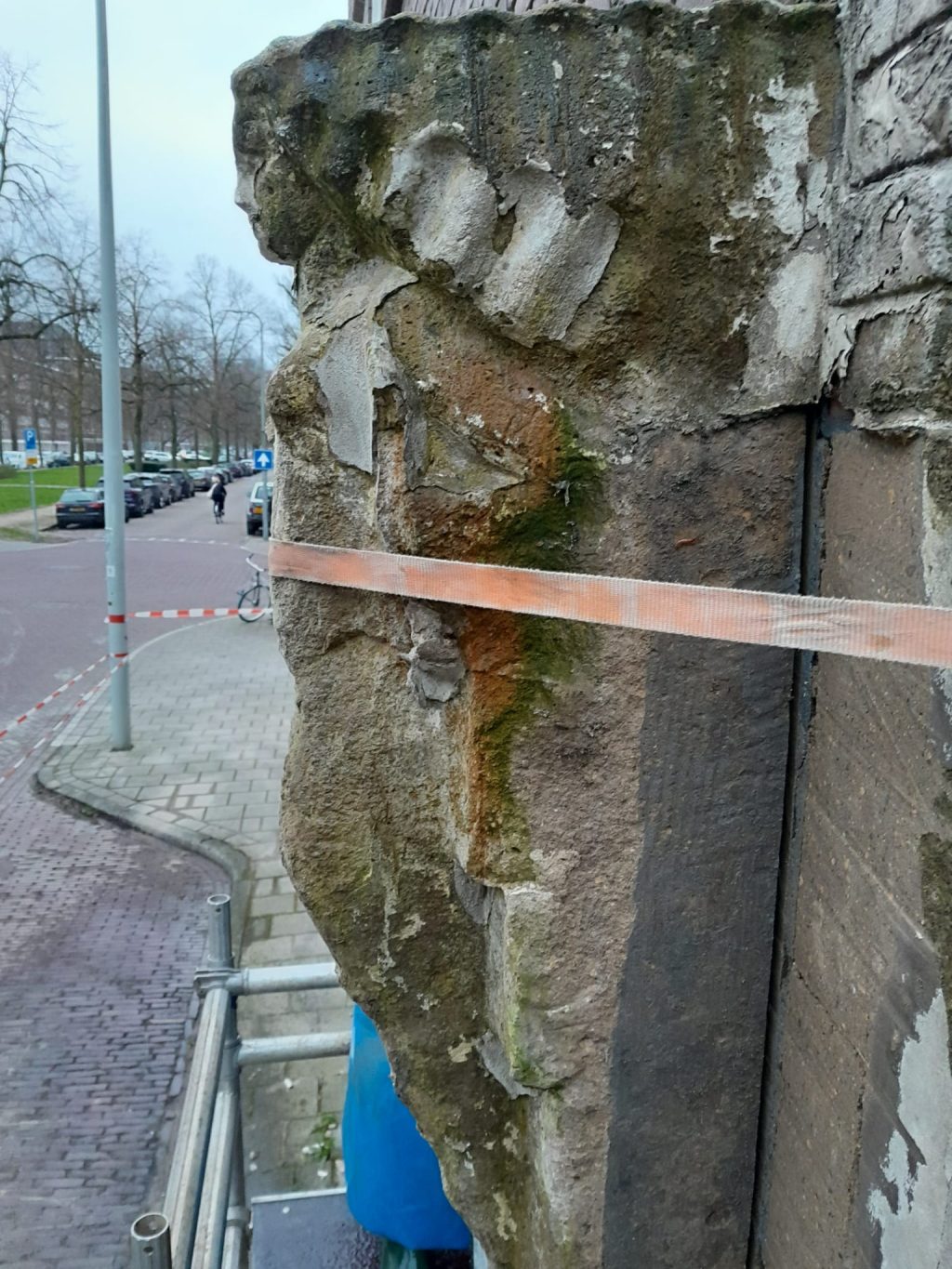
← Detail of the image Winter. Old repairs and rusty iron staples are clearly visible on the eroded pieces of of its surface.
Glue-up
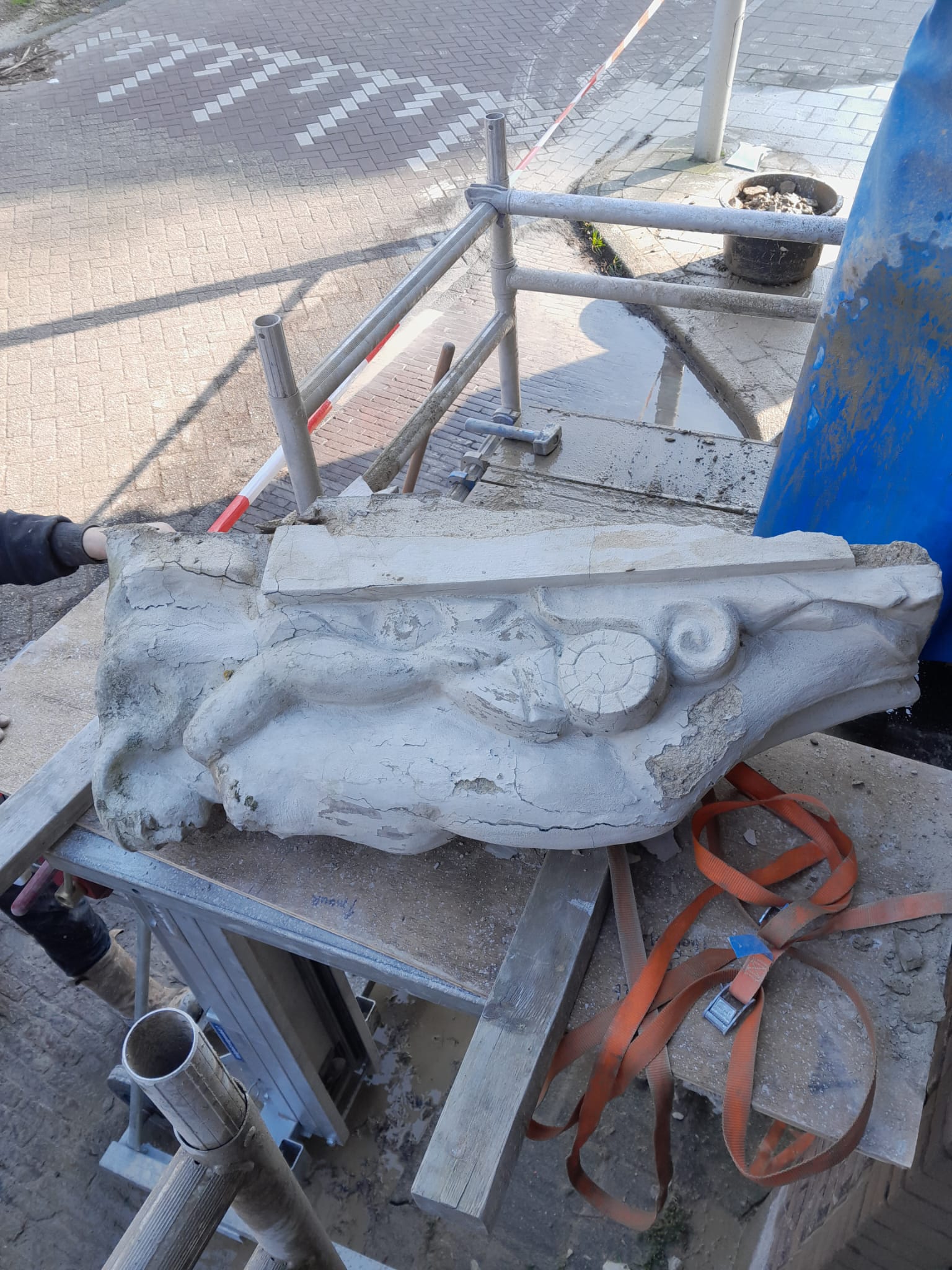
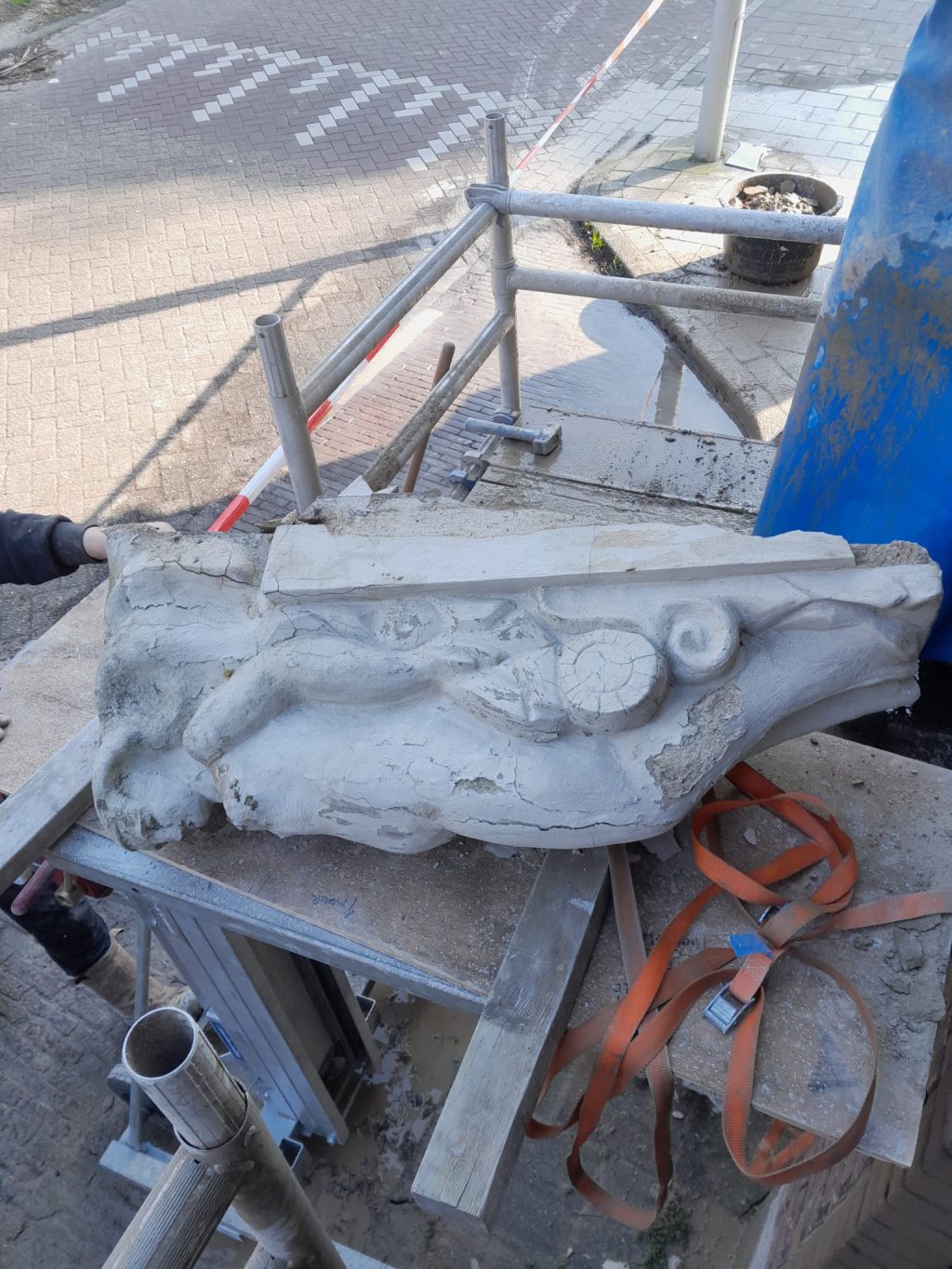
In particular the right hand Faun, the lady of Autumn and the Diggin Man of Winter came down in several pieces. Pressure from the building that rested on it and seeping rainwater will probably be to blame for this.
Because these sculptures are not going to be restored, but will be copied, glue-up was not a complicated matter in this case. Just gather up all the pieces, find out how they fit, fill the fracture surfaces with glue, and clamp them right up.
Moisture transport
Now this is not something you can do anywhere. Suppose a sculpture is to be reinstalled in an outdoor environment, then you'll be dealing with moisture penetrating it. That moisture will eventually have to come out again, and it will follow a transport process from top to bottom and from the inside to the outside. Should it encounter a full dense glue layer on that journey, then problems will be guaranteed.
Over a horizontal glue surface, for example, the moisture above the glue will remain within the stone for a long time, and it's difficult to get it out sideways. The result will be a strong deterioration of the stone above the glue layer, especially in a frost period after a wet fall or winter. So what we have done here with saturated glue surfaces was only possible because these sculptures are no longer placed outside.
Old repairs
After the bonding we started looking for the original shapes of the sculptures. In some cases this meant that we had to remove large chunks of old repairs. Sometimes too much material had been applied, which particularly ended up making legs too plump, with thick edema ankles. Not all repairs have been removed; we also counted on it that we would be carving a lot of details in the major volumes later on, in the phase of sculpting in the new stone.
If you'd remove all repairs, that would also mean a loss of information, all the more so since it irrevocably comes off only while taking a layer of the original sculpture with it. The underlying stone is much softer than the tough cement repairs that were often very much stuck onto it.
Shedding its skin
Not all repairs were stuck on that much. Due to this barely permeable repair layer, and especially in combination with that dense layer of latex paint, moisture was building up within the underlying tuff. As mentioned in the previous post, there was a rainpipe hidden in the facade on the right façade corner, which dripped its moisture into the statuettes for years.
The result was rich algae bloom, peeling skin of the statuettes, and, in the case of the Man Sowing, a total crumbling of the surface. I already mentioned that for this reason recovery was no longer a solution. The repairs would one day, in the future, just come back down, underlying stone and all.
Photographic material
For carving a good reconstruction in new stone, it was necessary to have usable models, based on the old statuettes. In this case we repaired the sculptures with a soft type of plaster. For this, I first collected as much photo material as possible, in particular from the sculptures on the other side of the street, which were in a much better state. A year and a half earlier I'd also taken a lot of photos of the views of each statue : from the left, left front, front view, front right, and right.
I first printed and laminated these photos on A3 format, but those big prints were very awkward to handle. I discovered that a small book with all views in size A5 was much more convenient: because you can quickly browse through those. Ideally, these booklets would be printed on plastic, so that they wouldn't be susceptible to moisture and rain, But luckily paper also worked.
Who does what?
Jelle and I took on the reconstruction of three statuettes each. Jelle the ladies from Spring and Summer and the left Faun with a goat, and I the Digging Man of Winter, the lady of Autumn and the right hand Faun with his deer. Tim enthusiastically started working on the old woman of Winter and the Sowing Man of Spring.
Plaster needs to set between the layers and we also needed time to assess the right shape, so this was work that we undertook in phases, sometimes in addition to other projects of sculpting at the same time.
Loss of information
During such a reconstruction you will always be faced with puzzle work when sculptures are so weathered. Details are no longer easy to trace back and you need to make choices. Which version is correct? That what we think to recognize here on this statue, or what is still visible on the other side of the street? It became clear that earlier restorers have not always known it either. Flat circles turned out to be the sunflowers of the Summer, and vague lines became ears of wheat or bunches of grapes.
We noticed that the four Muses of the seasons also depicted four phases of life: the young girl stands for Spring, the young woman for Summer, the mature woman for the Fall and the old woman for the Winter. Each had their own attibutes: flowers for Spring, ears of wheat and sunflowers for Summer, vines, grapes and apples for Autumn, and a cloak for Winter.
The lines of their hair also started to become much more defined as soon as we patched up the missing pieces: they continued into the facade.
Tim's Man Sowing
I've already mentioned it a few times before: the Man Sowing was the worst case. There was actually no recognizable detail anymore at all, and after dismantling even less was left of it
. Once crumbs are still hanging on with their last edge, just a touch would be enough to lose those as well. But we already knew that in advance, hence all those photos.
Now in addition to his work for me Tim also works as a volunteer at Museum De Dageraad, where everything can be found about the buildings of the Amsterdam School. And what do you know, he just happens to find the original plaster model of our missing sower hanging there, on the wall!
To make a long story short: he was allowed to borrow it for his reconstruction, and in return, he suggested that he would restore this plaster model (which he did beautifully and in a careful way!) and then, based on this plaster model, he was able to reconstruct the entire tuffstone Sower again .
The Man Digging
I myself had taken on the reconstruction of the Man Digging from Winter. He was missing his lower legs, the clogs and the shovel, and other details had become very unclear. However, the upper body was still so sharp that the original chisel strokes of Jaap Kaas still reappeared from under the thick paint layer.
This showed that the sculptor had finished his statuettes at the time with various chisels: the round chisel, the claw chisel and various flat chisels. This would give us guidance later during the sculpting in stone.
The Man Digging had something else that was unclear next to his shovel. It looked the most like a continuous beam with a jumble above it. After studying all the photos, I thought it could represent a bare tree, which is being planted by Man Digging.
Gallery: reconstruction of all figurines step by step
After this repair round an inspection followed. Once everything was approved, we went on to the next phase: carving them into new stone. Read more about this in the next blog post.
In the previous post I explained how we got involved in this project at the Minervalaan in Amsterdam. We were asked by Roderick Nijenhuis van Caho BV from Dordrecht to take care of the sculptural parts, but before the time came, the old statuettes had to be dismantled first.
When I gave a quote for this, I was quite optimistic on the one hand, because over 20 years ago I was closely involved with the restoration on the other side of the street, when I was still working at Mooy Sculptors Ltd. On the other hand, I was dreading it a bit as well, because it is just plain hard work to spend days on a small scafollding with a chainsaw.
Work across the street, 20 years ago
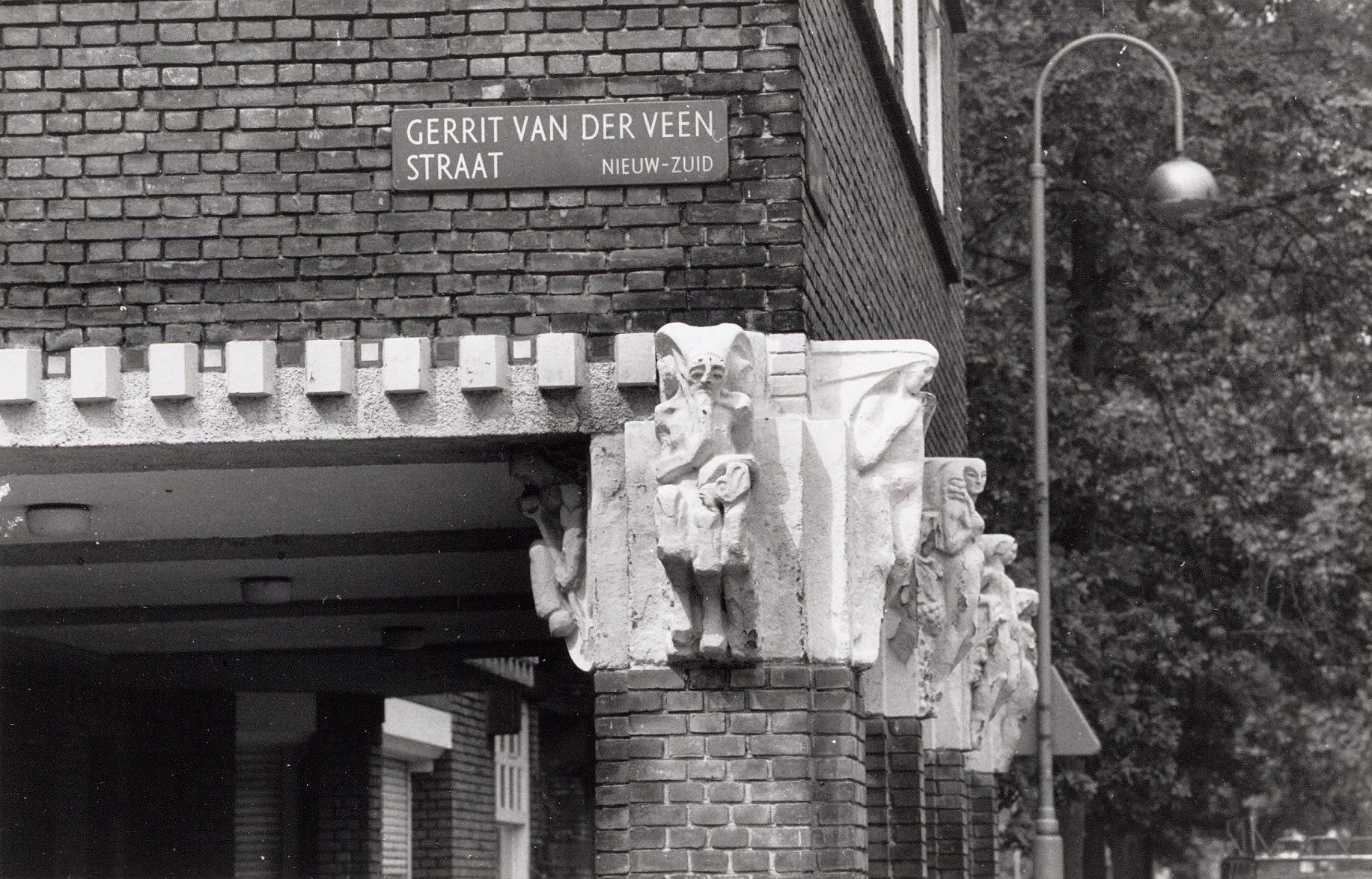
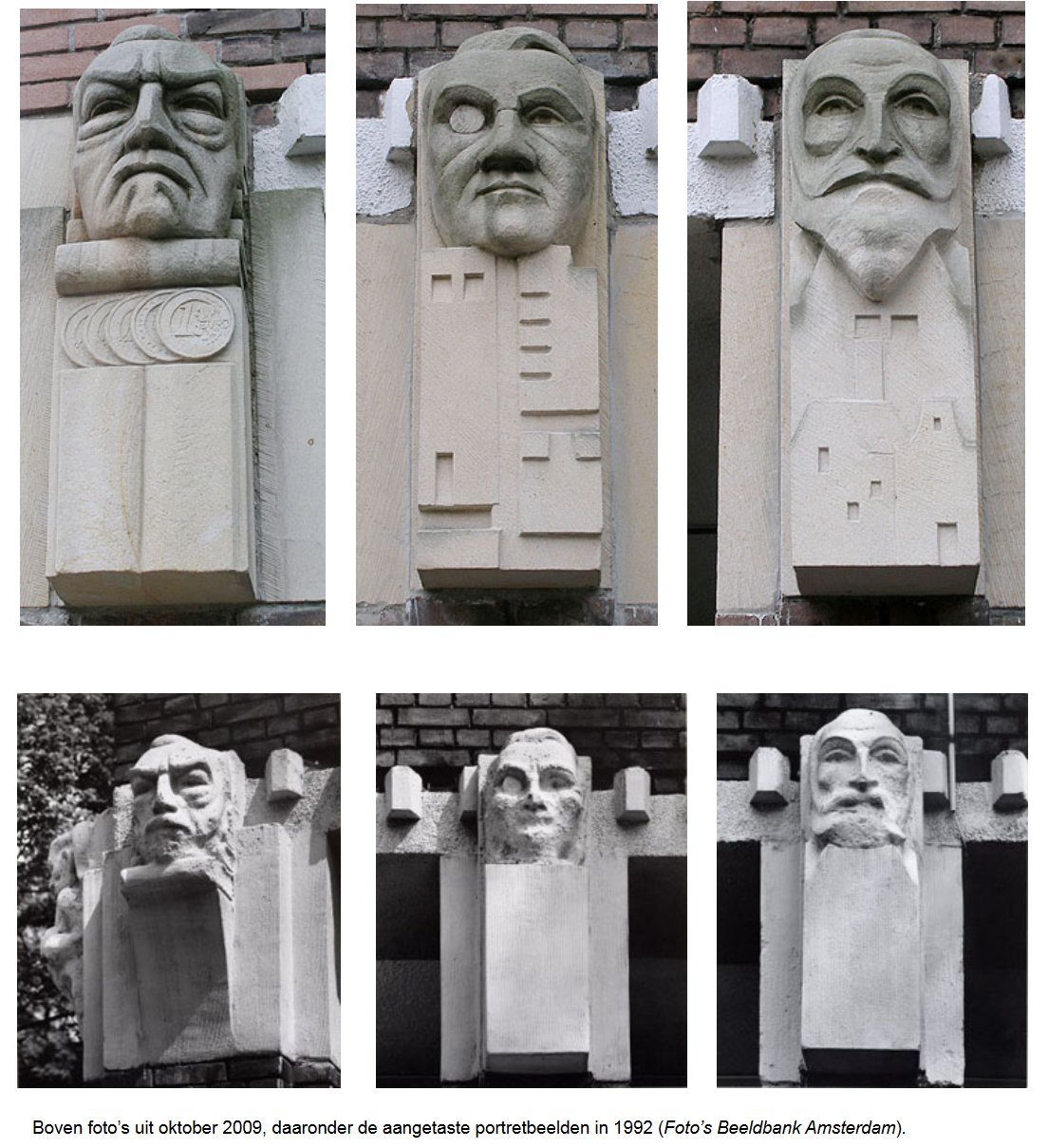
Around the year 2001 we started on the southeast corner of this intersection dismantling. We then had a diamond chainsaw on gasoline and with a lot of noise I could cut out the statuettes one by one. After a reconstruction phase we would carve the copies in Bentheimer sandstone. This choice was made because the stone is very weatherproof and lends itself to this kind of sculpture. Later there were a few comments about this choice, because sandstone catches dirt from the air and rainwater and will gradually darken, and also because nowhere else in this neighborhood this stone species has been used for sculpture. Usually you hear nothing about whatever was done well.
"Tuff is not strong enough’
The damaged portraits of the South East Corner, with the new copies above, dating from 2002
At that time we were cutting away the sculptures and I noticed that there was very little stone left standing. Would that even be enough to carry that entire building? A bit worried, I called the office about it. ‘No’, said Ton Mooy, "It's impossible that that building would rest on those blocks of tuff. That material is simply not strong enough to hold up an entire building. There has to be a pillar inside it, take a look.’ And yes, after some drilling and carving we found a concrete core inside the tuff blocks. Apparently a hole had been carved through the blocks during construction and concrete rebar had been put in it, after which everything was filled with concrete. This was clearly visible by the rough outline of the concrete pillar, which exactly matched the tuff's interior.
This time it went differently
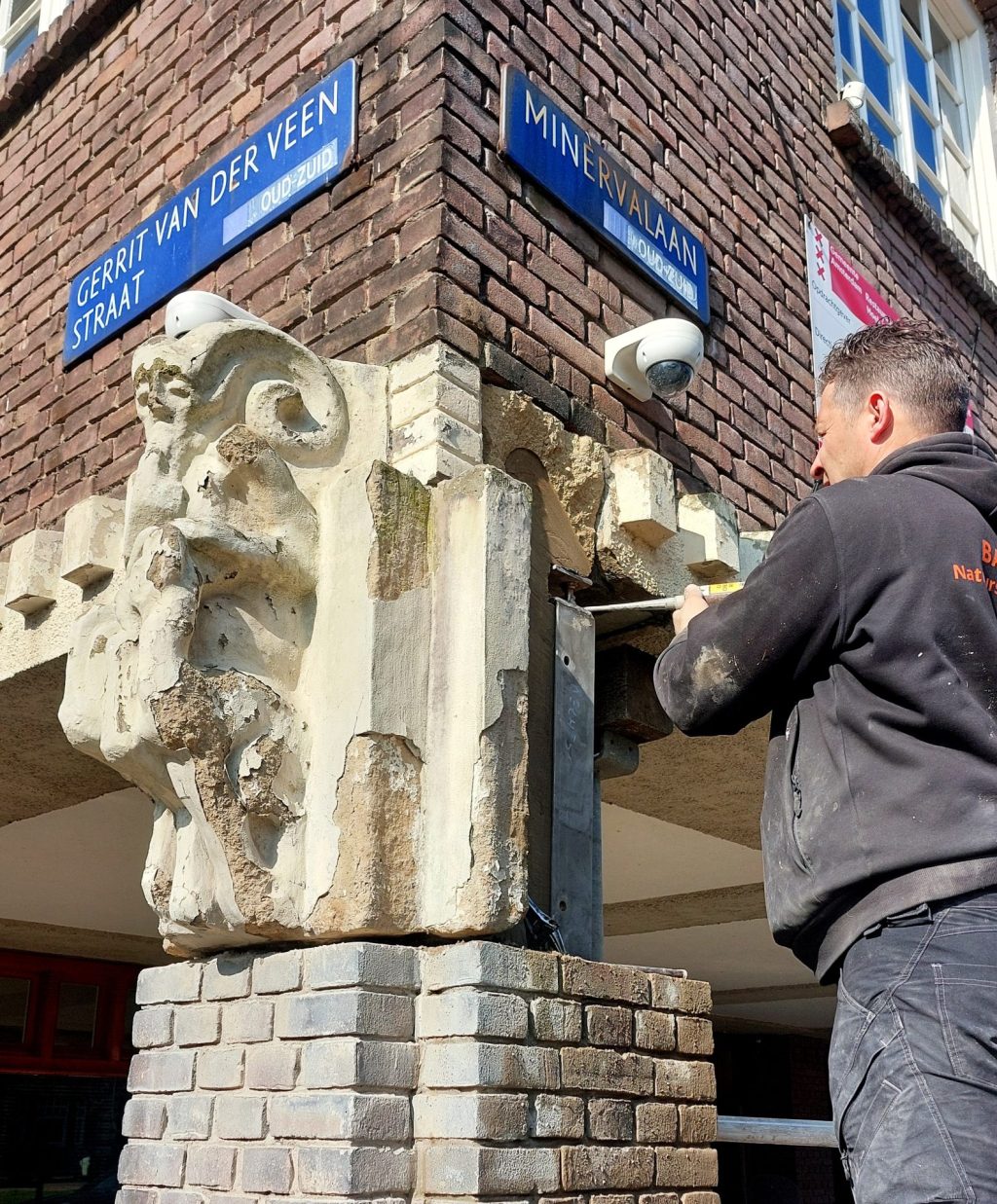
So this time, twenty years later, I went to work in good spirits with my diamond chainsaw. But once I had cut a few slices away, my colleagues started to worry. ‘Hold it for a minute, won't it all come caving in on us?!’ I said they shouldn't worry, because there would be a concrete core in it. But they didn't trust it and drilled a hole. And when after a lot of drilling and searching we still found no concrete, we immediately stopped the sawing.
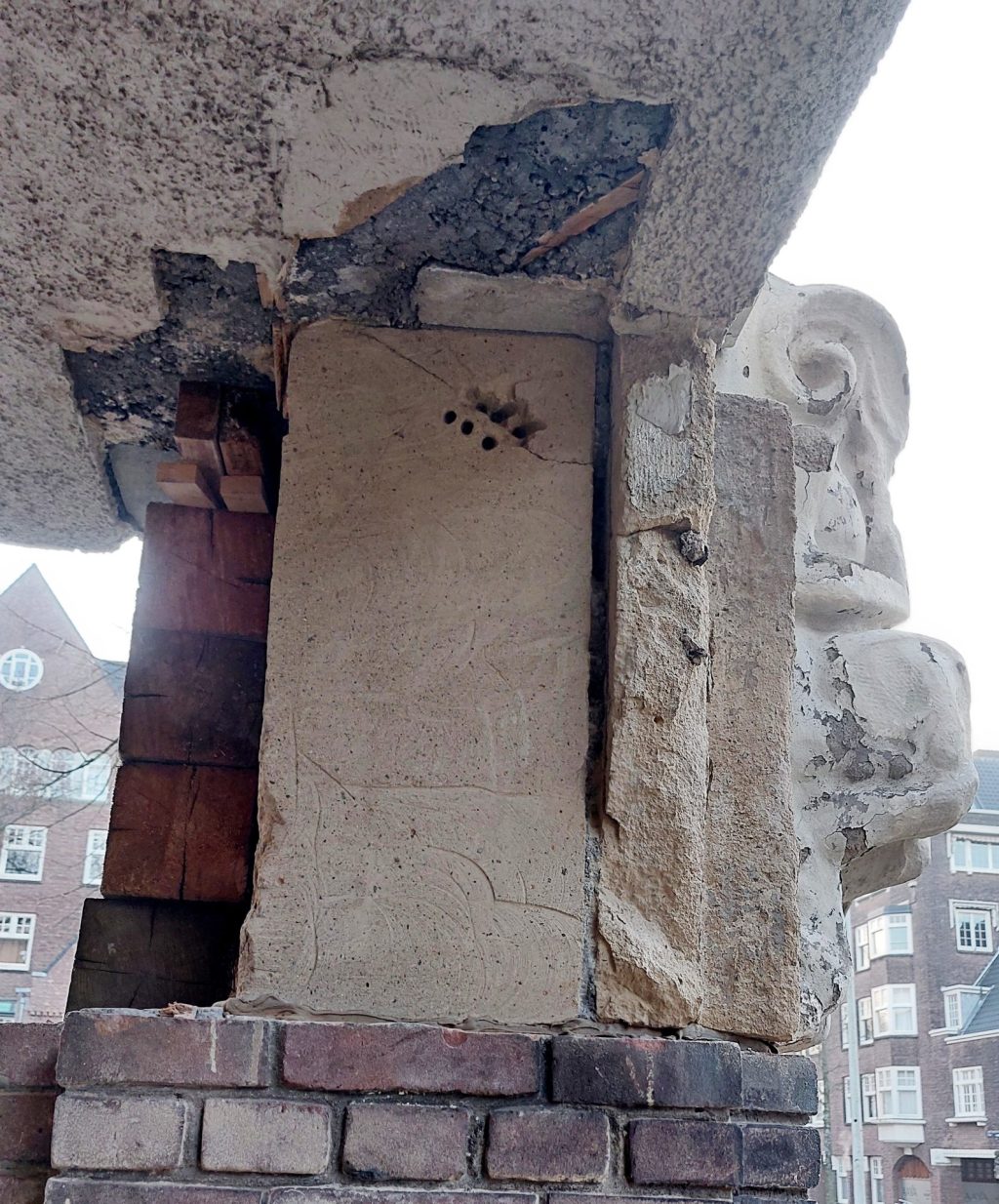
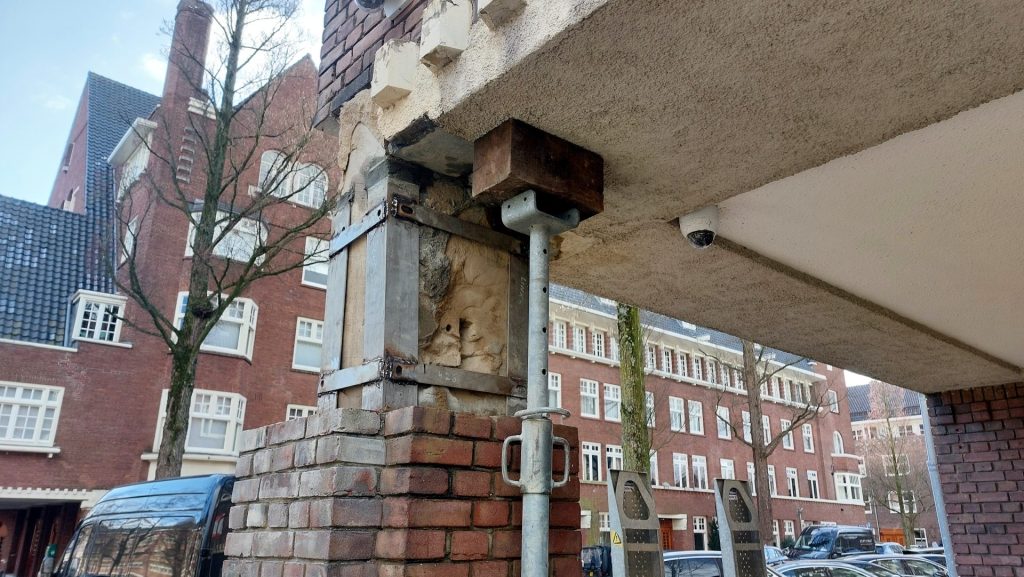
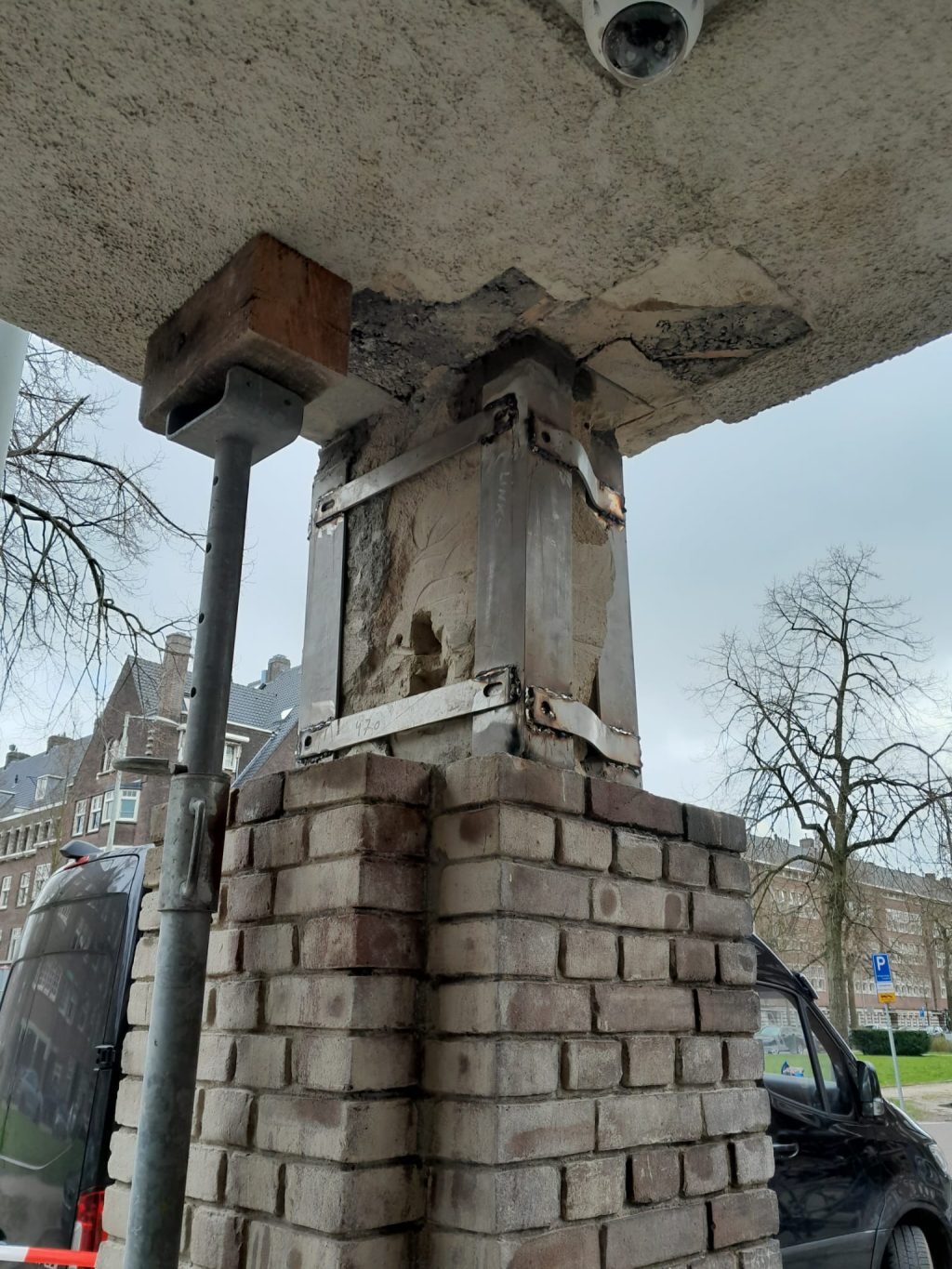
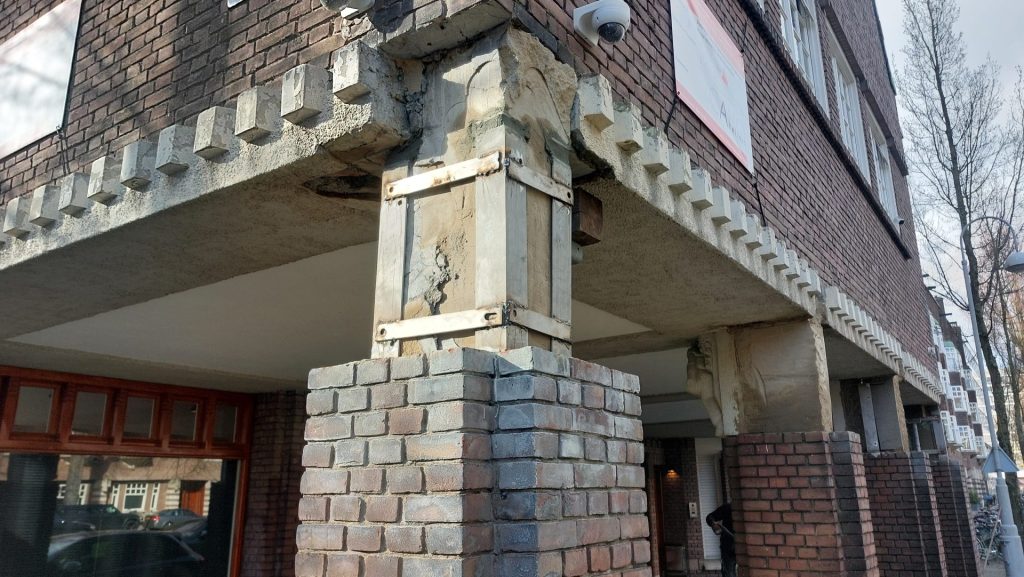
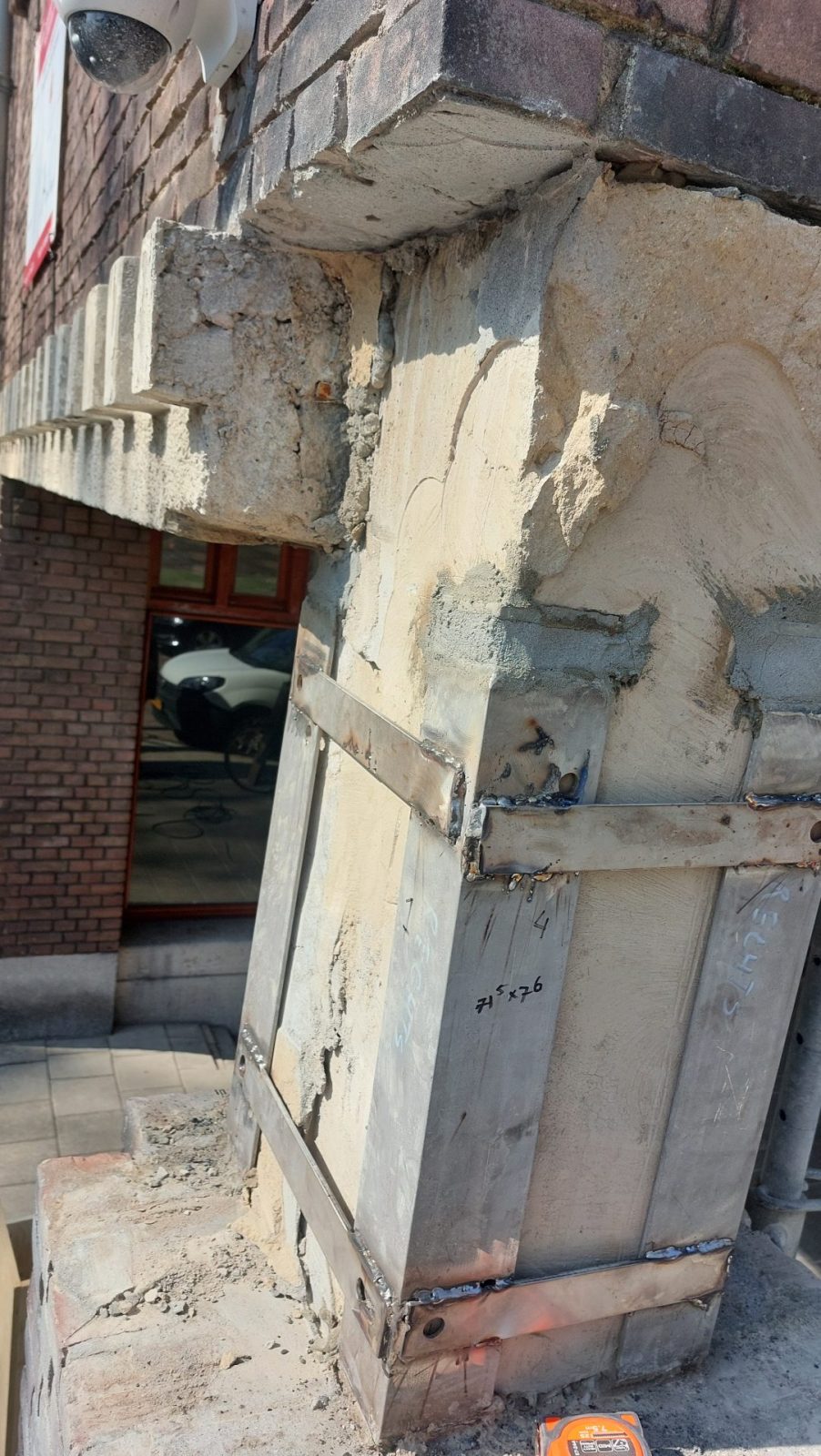
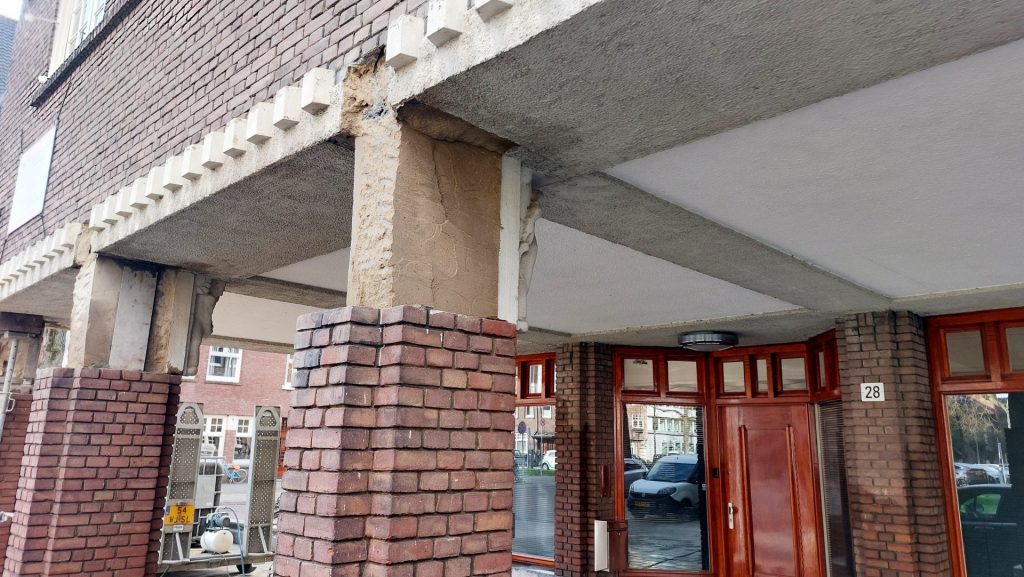
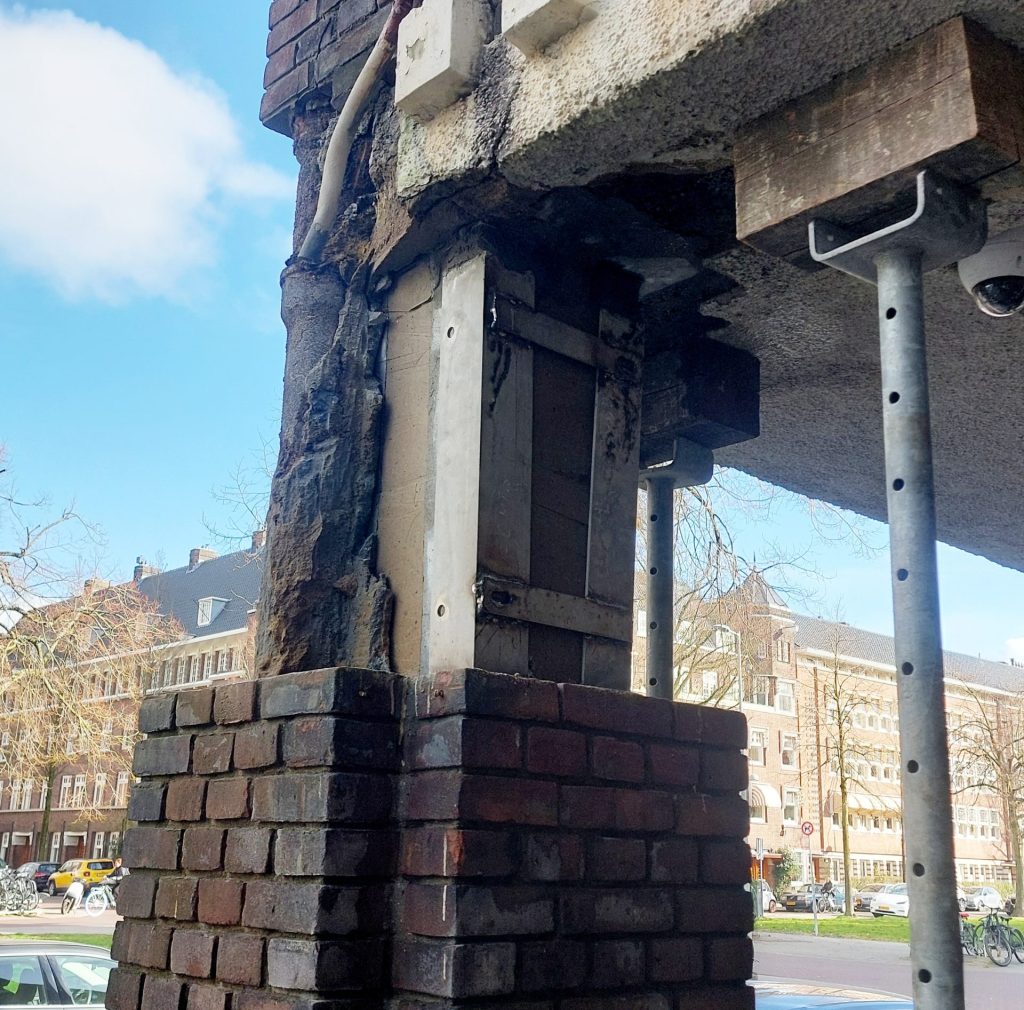
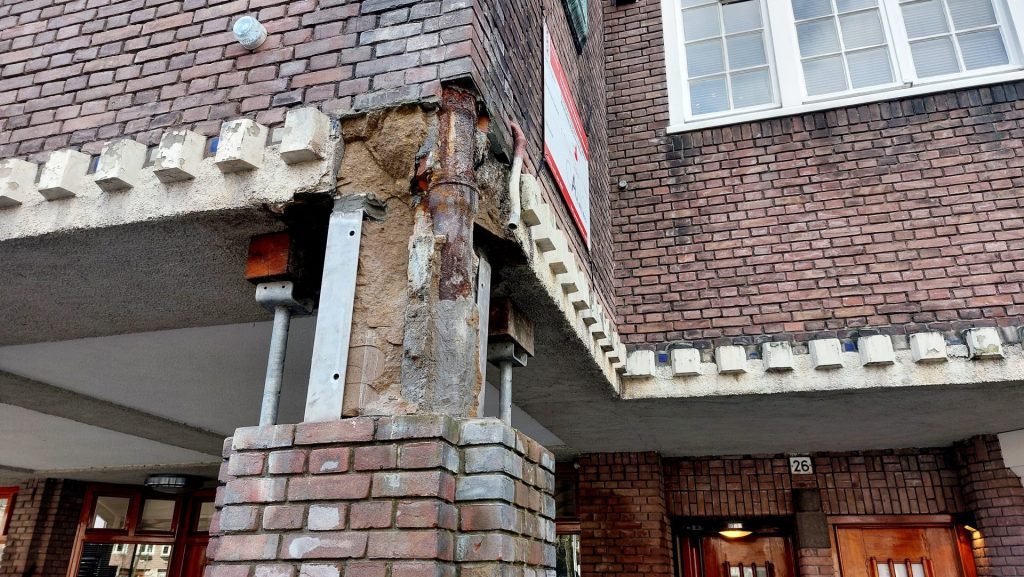
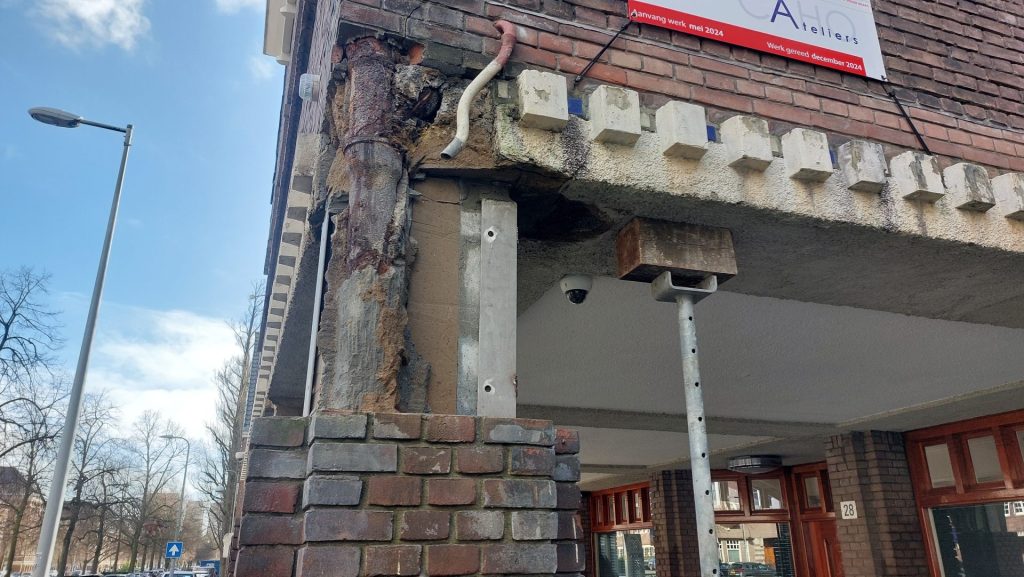
My colleague looked pale as a ghost and didn't want to stay under the underpass for a second. It turned out that these four cracked blocks of tuff kept up the entire facade! Before we cut out the sculptures, the blocks had a cross -section of 72 x 77 cms wide, But after that, only a small block of about 30 x 45 cm would be left! We stopped the job, installed supports (steel poles) and the wedged up the building with blocks of wood and wedges. Time for a new plan.
Stainless steel support props
Half a year later we came back. The action plan was approved and the extra budget too, and a construction engineer had made calculations. Big stainless steel props were welded and they would keep things together. During cutting out the statuettes, it became clear how much this restoration was needed. Many of the blocks were not only strongly weathered down on the outside, but they came down in three or more pieces. For years there had been unseen cracks throughout the sculptures.
The sculpture was cut loose and is being lowered down
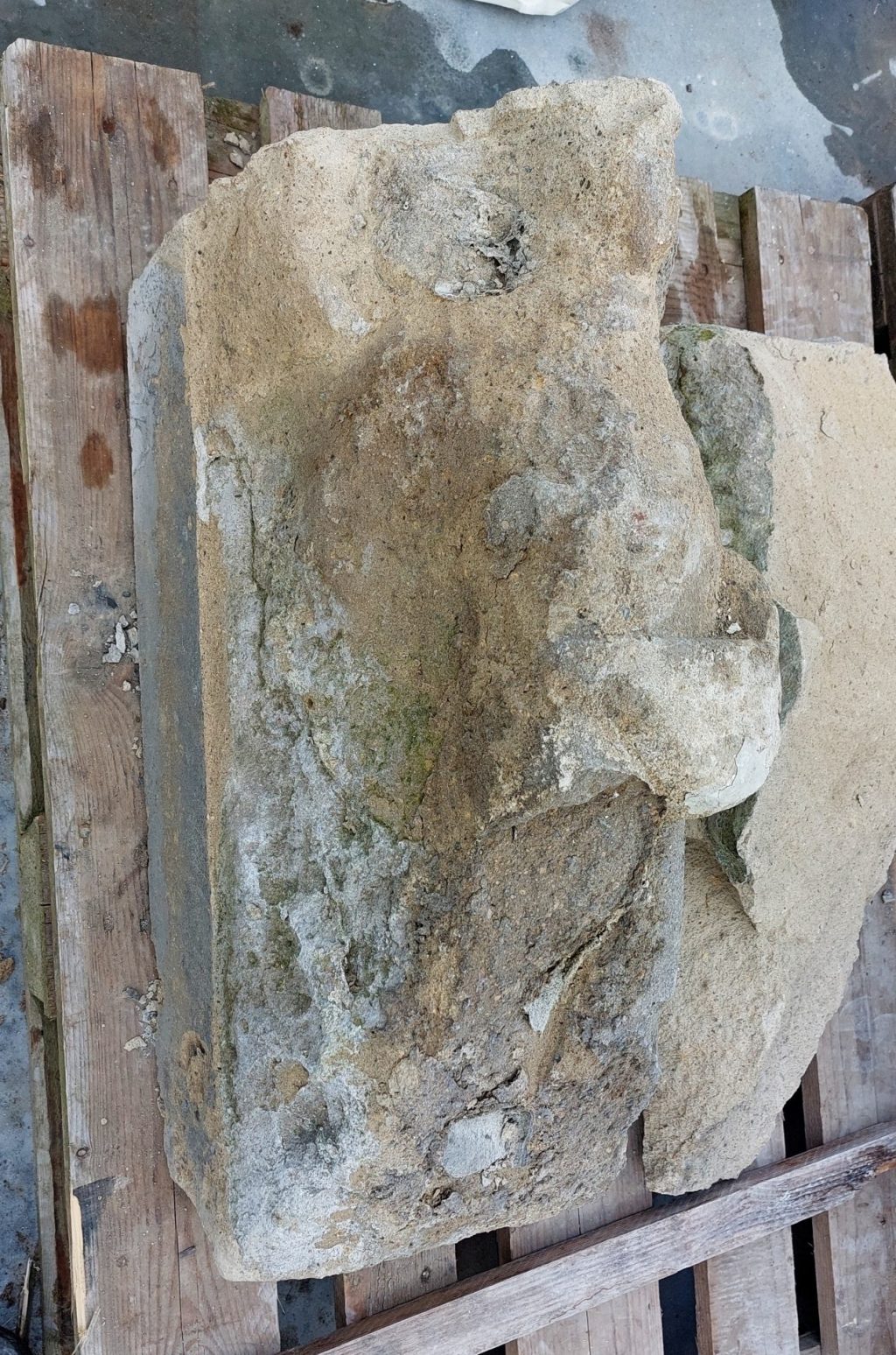
After a few days with the diamond chainsaw we had pallets full of whole sculptures, but also broken pieces, some of which barely looked like a sculpture anymore. It was a sad heap of rubble, while before, it had looked so nice on the facade! The props now kept the facade up, end then I welded the separate corner pieces together.
Video: Eight sculptures cut away with the concrete chainsaw
Found the culprit
The support anchors were properly secured
Only a thin layer of brick covers the pipe
Especially the right hand corner, with Spring, a Faun and a Man Sowing, was in particularly bad shape. We had already seen that there was a long crack running through the facade from top to bottom. Would that be because of sagging? But we quickly found out that the cause was due to a leaking rainwater downpipe. Apparently the architect hated rainwater downpipes and it seems he thought it would be much nicer if it was hidden inside the brickwork of the facade. But cast iron rain pipes will rust , and especially when they start leaking. And rust simply expands, it can be up to 7x as thick as the original iron.
It turned out that in most places only a sliver of about 2 cm brick covered this rainpipe. Not enough to protect it against rust. De downpipe had started leaking and the sculpture had become really soaking wet all the time. Just that in itself would be enough for tuff to weather and deteriorate, but if that moisture cannot go because there is a thick layer of paint covering it and especially when frost periods are added, then the consequences are easily guessed. The statues of Spring and Faun came down in pieces, torn and soaked.
Archiving
The sculpture of the sower had suffered severely under the moisture
Now I had already taken that into account. Experience had taught me that a lot of information could also be lost during dismantling. Simply because those loose crumbs that now look a bit like a face or a hand, immediately will crumble when you touch such a block. It will never get better once you start dismantling or cutting a sculpture free. That is why I had taken a whole series of photos of every statue, from the left, left front, front, front right and from the right, and preferably more. And from the sculptures on the other side of the street, on the North East Corner, I had taken loads of photos as well. We were going to need that during the reconstruction phase. The old statue would be leading in reconstruction, and hopefully, the photo material would provide enough information to be able to add the missing parts well.
Gallery: Disassembling the eight statues on the northwest corner