The flying buttress with the seven sins-2: carving!

As you may perhaps remember: at 9 March 2019 I posted a blogpost about our next series of flying buttress figurines to be carved for St. Eusebius' church, which arrived in pieces in our yard.
These images were impregnated with acrylic resin, to the core, but something went wrong and they burst at the seams. Literally. On an old photo you can see how the sculptures sat there under tension, arcing above the flying buttress itself, because they expanded so much.

Jelle then spent a long time gathering all the loose parts and bonding them into recognizable sculptures again. These were the seven sculptures from flying buttress no. 24, on the subject of The Seven Sins. The first sculptures are finished now.
I haven't even done that much work on this arc myself, mainly because I was busy with other projects: Thomas Aquinas, large crockets for The Utrecht Dom Cathedral, and family crests (I've been busy with the next one already, in Belgian bluestone).
Naughty ladies for Jelle


Stide has also been busy with other projects, so Jelle was the one who had the most momentum. He had presawn a number of sculptures and subsequently been carving away on Vanity and Gluttony. He is now working on Greed. I've only made Rage so far, and Stide is now working on Lust.

Vanity is a lady with long hair and a mirror, Gluttony is a fat lady stuffing something in her mouth, and Lust is a naked lady with toads to her chest. I'll keep it short about these sculptures here, the gentlemen can explain that on their own websites.
The Anger
One of the seven deadly sins is the rage, or anger. This was the statue that I got to carve myself. It represents a man pulling a knife and with a face distorted from rage and hair pulled back, frightening everyone else.


The original image had sharp teeth, but the eyes were closed, so that the expression was a bit half-hearted. So I took some pictures to find out how the eyes are in such a face.
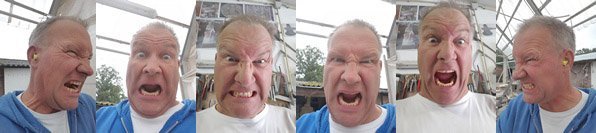
Latin terminology

Each of these seven vices has a latin term to it, and Ithought it would be nice to carve that word in the side of the profile for each of the sculptures. This would be Ira, the Latin word for rage, Gluttony becomes Gula, Vanity would be Superbia and Lust becomes Luxuria . Then there are Avaritia (greed/avarice), Acedia (laziness/sloth) and Invidia (envy/slander). And each virtue has its own term as well, but those will be coming up much later on, because after this, we first get to carve the Musicians and the Apostles from flying buttress no. 14 and 16.
Crates full of debris: old photos wanted!


We had a few weeks of good weather, so I took the opportunity to measure up all of the remaining flying buttress sculptures, so we'd -in due course- be able to order the new stone in advance. But I didn't find all the figurines in good condition in their crates! There were a few crates among them with only a thick layer of debris at the bottom. I have no doubt that if necessary we could also reconstruct these sculptures properly, but seven of these figurines will not return to the church. People are thinking hard about a modern interpretation to fill the holes they leave behind.

But for the rest of them, we'll have to restore everything and let our creativity fill in the missing parts. If anyone has any old pictures of the flying buttresses on which the sculptures still shine in full regalia, I can use those very well. My email address can be found on the contact page.
Almost 60 finished, some 38 more to go?

We're coming along nicely, carving all those new figurines: with these three we've landed at 56 , and number 57 and 58 are already in progress. It is hard to imagine that we've made so many already and it still is fun to do! I must admit that the Foolish Maidens and especially the Crippled were not as interesting, but these are definitely worth it because they are so expressive and clearly tell a story. And then you have to remember that we also did a lot of work for the tower of St. Eusebius's Church. Especially Stide spent months of carving in the workshop in Arnhem and made a lot of corbels into new stone.

There are still a lot of figurines to go, but not all of the sculptures can be saved. We do not know how many we'll still get to carve exactly, but for the curious among us, here's a list of all the flying buttress numbers and the themes for each arch (sorry, it's in Dutch only!).
To the next flying buttress image and on YouTube

