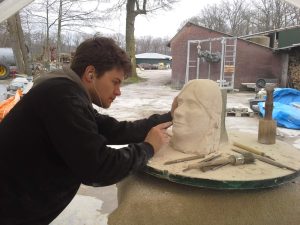
Last week my nephew Tim stopped by for a few days to sculpt a head in a piece of French limestone in direct carving method. In this picture he is far from done yet; eventually it became (and especially for a first attempt) a very nice female head, with a pleasant atmosphere to it. Along the way, all the pleasures and challenges of direct carving method came by.
The most important thing that you find when carving directly is that it requires a lot of concentration and thus, energy , but also that you will learn an enormous amount by doing it this way. It is an intensive process. Carving a head is not easy: what makes a mouth, an eye, a nose, and how do these relate to each other, what are the mutual angles of the cheeks, the forehead, the chin, etc. etc. And if you change anything somewhere, that affects all other parts. Sometimes you'll notice that you're heading in the right direction, but then you'll discover that somewhere else you need to do a lot again, and sometimes you'll discover that it hasn't improved at all. And by that slow process of carving, looking and carving Tim has come from a relatively flat beginning to eventually a nice 3-dimensional head. Chapeau Tim, a good start!
Today I found another video about the restoration out of St. Eusebius's Church in Arnhem (the Netherlands). It is a Gothic church that was richly decorated with sculpture – originally that is; a very large part of it has been rebuilt after the Second World War.
This video is about attention for the dying restoration profession, and it's also pointed out that there is no interest in the craft itself. It is always the question of 'the chicken or the egg': is there no interest in this work because there is no work in it, or there is a problem because we don't get any people who want to do it?
Training sculptors?
As for my own profession: so every now and then I get a request from someone who wants to learn this restoration sculpture, or from a sculptor who 'wants to do this work on the side'. But in recent years there has actually been no work and the four, five remaining restoration sculptors in the Netherlands (at least that I know of who do this work full-time) sat looking at each other waiting for a commission. It is not difficult to find interested people who want to learn the skill. More difficult is to find people who are both dexterous, as well as talented, who have a sense of shapes and forms, and are physically strong, as well as able to make a production, and finally want to continue to do this for years. But that's all still not too difficult; there just needs to be enough work.
Actually I noticed of late that this profession is so diverse, and that it takes quite a long time before you've mastered all kinds of aspects. You can keep learning until your eightieth birthday.
Seven years training
I recently talked with the owner of a major restoration stone masonry firm about education, that it easily takes half a year before a student starts to produce a little bit. 'Half a year?’ he said, 'I'm counting on seven years before anyone is well versed in this work!’ And that's about right. In Germany you must will need to complete four years training and work as a stonemason, before you can start training as a sculptor. I believe the training as a sculptor then takes another six more years. Even the masons and carpenters in restoration were talking about seven years before someone can work well independently, which matches very nicely the standard of 'it takes 10,000 hours before you can master a topic or skill'. That is nearly impossible for a small company to do.
There is no point in training some new sculptors every few years when it's already clear that there will be no work for them afterwards. So the conclusion of the video is exactly right: It's a dying craft. But that is simply because there is not enough work. As my generation ceases working, I fear that one will have to go abroad for these items, where the supervision of the quality is less and consultation more difficult , and a piece of knowledge gets lost, unfortunately.
Batavia
In 1985 the construction of the Batavia ship was begun in Lelystad. It was a learning- and training project that in many ways an example could have been an example. People were trained in various disciplines, including wood carvers. But if there is no further employment after such a wonderful project, then the effect of the entire program will evaporate again within a few years. The only thing that could provide a stable knowledge base (something that I don't control myself) is a cultural change, which provides new employment for people practicing those 'old’ crafts. For example, that it would be quite common again to decorate buildings with sculpture, or that a sudden demand arises for religious statues, for example. The model of the Batavia would then certainly be usable , and I have long dreamed of making beautiful things together with enthusiastic young people. Maybe we'll see that happen one day!
Update 19-08-2015:
Another video, in which the workshop near St. Eusebius's Church can be seen. Among other things is shown how two stonemasons work, my colleague Stide Vos is copying a tuffstone dragon in Muschelkalk, and at the very end I'm flashing by for about 1 second. Unfortunately, we are mentioned as students, but the moment we can go train new students has not yet arrived. It would be a pity if with our generation (Stide and I in our fifties belong as I believe to the 'cubs' of the restoration sculptors) the skill would die out in the Netherlands. With enough work it would also make sense to now start training the next generation.
Would you still love to learn classical sculpture? In Amsterdam is there then Figura-Dutch Academy of of Figurative Sculpture, where part-time training is given and individual shorter courses can also be taken. In Antwerp There was once part-time stone training- and restoration sculpture (recommended), but since the change of teacher, this program has ended.