Last Wednesday I was at the gardens of Estate De Schaffelaar in Barneveld, the Netherlands. I had to remove a plinth of Belgian bluestone, that was anchored with four stainless steel pins of 2 centimetres thick to a concrete foundation. Of course the solution was the concrete chainsaw at 230 Volts (Cardi Coccodrillo 35 so you might say Renova chainsaw). The base will in due course be reinstalled inside the main building itself, but more on that later.
Camera and editing: Joram van Velzen
The anchors were very tough and it took a lot of strength in an awkward crouching position to cut them, but the machine did not budge. We had brought water, a pressurized water system ( a pressure tank with pump) and an generator of 6 kilowatt with us, so we were completely self-sufficient.
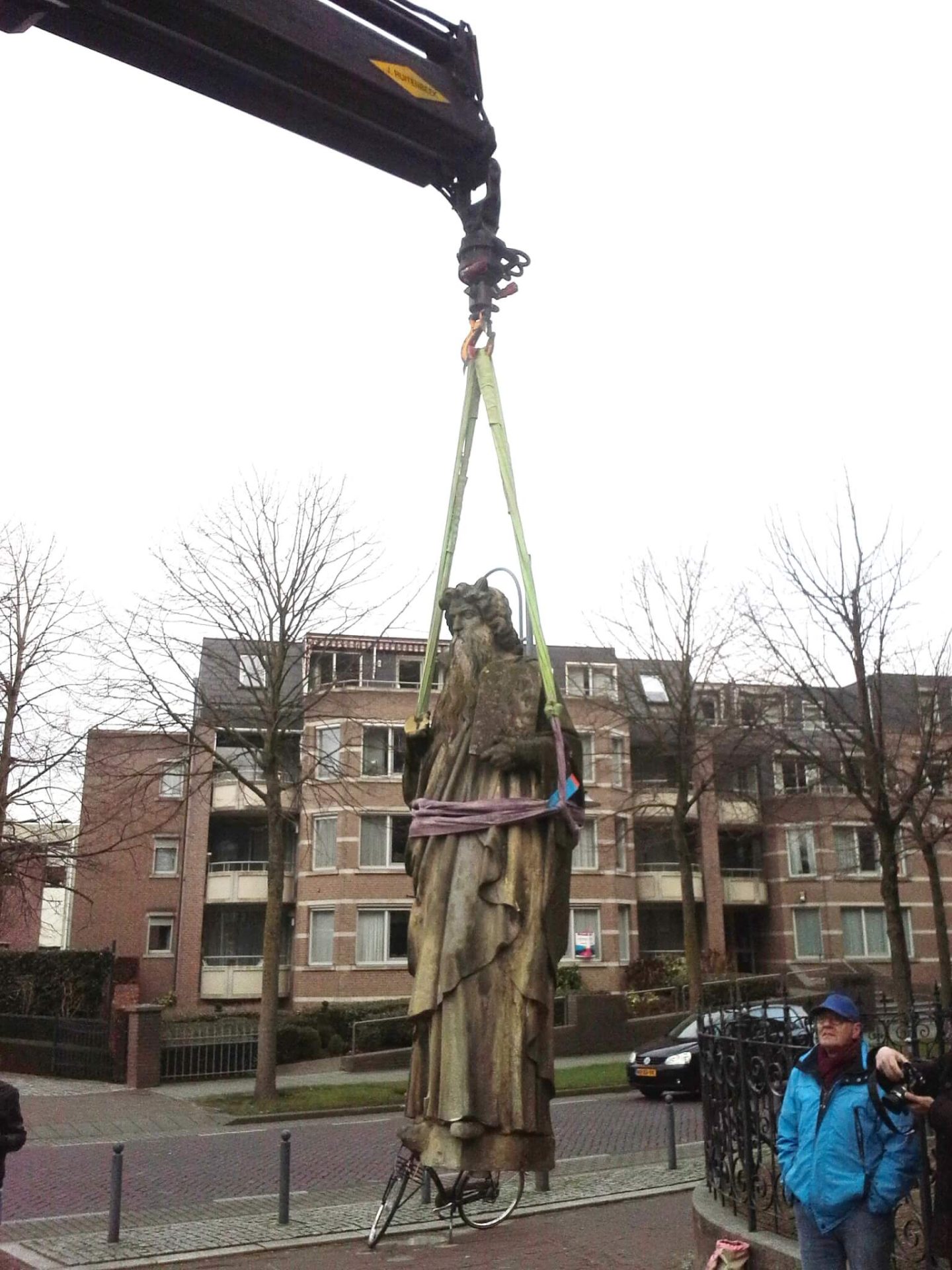
Today I once again started on an interesting restoration job. I went to St. Lambert's church in Veghel to collect two statues: Moses and Aaron, carved in Udelfanger sandstone. The statues date back to about the construction time of the church, round 1860.
There are many statues above and around the portal of the church, that were nearly all replaced in the 1990s because they were weathered down so much. Only four original statues remained, and two of those are now in need of restoration. I was asked to clean and repair them, after which they'll go to Germany to be impregnated with acrylic resin. That should ensure they can be preserved for a very long time to come.
But first the statues had to be hoisted away. Luckily, they were not too high up, on a pedestal of about a metre. I'd brought along my chainsaw and would cut them loose and hoist them out. But it all went rather more difficult than I thought. I was sure I had cut Moses loose from its anchors, but he wouldn't budge even for one millimetre! When we finally got him hoisted away, it became clear why: somewhere in the not-too-distant past, he had been bonded to the wall with a strong adhesive. That caused problems during cutting and taking away, but also caused decaying stone to the rear.
In the coming weeks I will be working on repairing damage and replacing old repairs with proper repairs using restoration mortar.. Aaron's condition was not too bad, but Moses still needs some work. When I removed the rod a bad previous repair broke off. The hand was repaired with cement and cemented to the staff; which could also be seen in its anatomy. He will get a new hand.
Moses is often depicted with horns. That is the result of a translation error in the Vulgata, the Latin translation of the Bible from the 4th century. The Hebrew word keren was translated as usual as 'horns’ instead of interpreted as 'beaming', so that the text now stated: 'his face was horned by the conversation with the Lord', instead of that Moses was radiant.
the dismantling of the statues with a concrete chainsaw. photo: Stadskrant Veghel
In any case, it makes it easy to see who is depicted, even if you couldn't tell by the stone tablets. And Aaron is shown with the bronze plate to the chest in which the twelve precious stones are put, that help the priest in the contact with the Lord, and the sacrificial loaves of bread in his hands. On the edge of his robe Aaron carries all kinds of decorations, that are described in the book of Exodus: 'The lower edge of the mantle should be decorated with pomegranates — made of blue purple, red purple and scarlet — and golden bells, to and to.'