Which diamond chainsaw for which job?
My diamond chainsaw
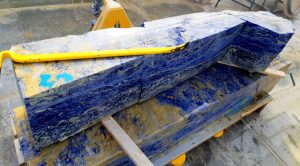
I recently cut up a blue block of sodalite with my diamond chainsaw. Because it's quite an expensive material, I could save quite a large chunk by this method. If I'd made this sculpture in the normal way with the angle grinder, lump hammer and point chisel, I would have had some wheelbarrows full of expensive rubble for the dumpster. So in this case my chainsaw came in handy. But I actually rarely cut up or spalt large stone blocks. I actually bought this saw for removing blocks from historic buildings, or cutting loose heavily anchored statues from their foundation.
The diamond saw I chose in 2015 was a Cardi Coccodrillo35. But what types are there actually, what kind of job do you use them for, and which one is the best for which job?
Petrol engines
The first type diamond chain saw for stone and concrete was made by the American company ICS. The older types ran on an extra greasy oil mixture, were heavy and noisy, and often choked because of a wet air filter, caused by the water spray thrown up by the chain. I hope that they have solved this now. ICS has also developed the first diamond chain, and now makes it for a lot of other manufacturers as well. ICS has several petrol versions on offer and make different kinds of chains.
Then also Husqvarna came with their own machine. They obviously have been making gasoline engines for chain saws and also for power cutters since a long time , so it fitted in well with their own range of machines. I know no further details. The price is around 3400 euros.
So their competitor Stihl could of course not lag behind. They have also developed their own version, plus their own chain with twice as many diamond bits on it.
Hydraulically driven
Now a gasoline engine makes a lot of noise and stench, and the torque at low revs is not great. That's why ICS soon developed a hydraulically powered version when he, in three types. Hydraulic power is supplied by a separate hydraulic drive. This hydrostation of course also needs power supply, and this may be either via a gasoline engine (yet again noise and stench) or with an electric motor on 400 Volts (and then you'll need a 400 Volt power supply). The oil pressure goes to the chainsaw through two thick heavy hydraulic ducts. These are quite rigid and make the operation very difficult because they continually work against the operator.
Electric chainsaws
Then since the last few years there are also electric diamond chainsaws. I happen to own the machine shown above, the Cardi Coccodrillo35, by the Italian brand that also makes diamond drills and wall saws. It works on 230 volts at 3420 Watt.
But the German brand Dr. Schulze (if it says Herr Doktor in front of it, then it must be good!) has created a competitor to it that runs on both 230 Volt and on 400 volt. For the latter, you'll need a separate frequency converter, but then it suddenly consumes 6500 Watt, so it's a lot stronger on 3-phase power. Dr. Schulze uses the same motor for both their cutter and their ring saw as well. It is striking that this machine also has a kind of quick-release button and a handle that can be adjusted to various positions. Electric diamond chainsaws are a lot quieter, but not necessarily lighter than gasoline versions.
Pneumatic concrete chainsaw
For applications where sparks are absolutely undesirable because of fire hazard, an air powered version is also available. ICS provides one of those, for use in places where for example many utility lines are running.
For- disadvantages of the various types
Strong and light

I do not pretend that I know all about the different types of diamond chainsaw. I worked in the past with hydraulic chainsaws from ICS, with older petrol versions from ICS which kept choking and were very noisy and smelly, and now with my own 230Volt saw. But in short: gasoline saws are very flexible to use because they only require a water supply. This can already be done with a tank and a pump, though the pump will need to be powered by a generator or gasoline motor. It gets a lot easier if a water supply is simply available. Drawback therefore is their noise and stench. For the latter, you can adjust the fuel, that makes a bit of a difference already. But if, just a when I was working in Nijmegen at the Stevens Church, you need to cut for hours on end in a densely populated area, then it just wouldn't be right to start chainsawing right in the middle of city centre. Stihl would be my choice if I ever wanted a gasoline powered saw, because I've worked a lot with Stihl (chainsaw for wood, hedge trimmers and brushcutters), and was impressed by their quality. In addition, it's also fairly lightweight.
Much power and deep cutting
The hydraulic version is already a lot quieter. You can hear it clearly, but it's not deafening. The hydraulic power unit on gasoline makes a bit more noise. This machine is actually particularly suited to work in a well-organized construction site. You can cut very deep with the hydraulic version and have a lot of torque, but with that big power pack for the oil pressure it's just not as easy to move. Especially if you work on 3-phase power. I've always hated these machines because those heavy hydraulic hoses make using them so exhausting. I was always searching for places that I could hang them up on with a length of rope or I had them slung over my shoulder. But it's a very reliable machine; not much to get damaged on it. It can take a beating and can even do its work under water just fine.
No sparks

I'm not familiar with the pneumatic version of the diamond chainsaw, but judging from all air powered equipment, it seems to me that these don't have much torque left at low rpms. Added to that, a large air consumption always leads to a cooling effect, So I wonder how this would work at lower ambient temperatures. Maybe then you'll need to have an air dryer as well. Plus, you'll need to rent a large diesel compressor. I expect this one would also make a pretty loud howling noise.
No odor and flexible
My electric version was the solution for me. It's obviously not silent, but generates much less noise than a petrol engine. You can't cut as fast as some gasoline- and hydraulic saws, because you've got less power. The version of Dr. Schulze promises several options for chains and sword. However, an electric motor of 3500 Watts is no light thing, so it is as heavy or heavier than a gasoline engine.
Chains and quick release

At Stihl they have developed their own sword and chain, though I do hear that a chain with diamonds on each link is not always convenient: sometimes the chain itself wears out faster than the diamonds do, so that would unecessarily raise the costs. For example if you're cutting sandstone or brick. That is why ICS is sporting various different chains, for example, for brick, fresh concrete, hard concrete, granite and an economic version.
Now a diamond chain stretches out really fast. While cutting, you're continually checking to ensure that the tension is still right. A too tight chain pulls the blade sideways and thus gets stuck in the kerf, and a too loose chain get unrailed and starts to 'wander about’ inside the kerf. It should hang loosely so that the links at the bottom of the blade just clear the rails. Once the engine starts pulling it will be just right. Tensioning is a tedious job: you always keep unscrewing the two nuts again that you just tightened up, then tightening a difficult to reach nut behind the chain and finally tightening the two lock nuts again . At Mito they have since found a solution: a quick tensioner on top of the diamond chainsaw. This machine is by Chicago Diamond Supply and works on hydraulics, but I think there will be many more to follow suit soon.
Dr. Schulze has also something like that, as I think I noticed. Unfortunately no videos of how this thing works.
Applications for the diamond chainsaw
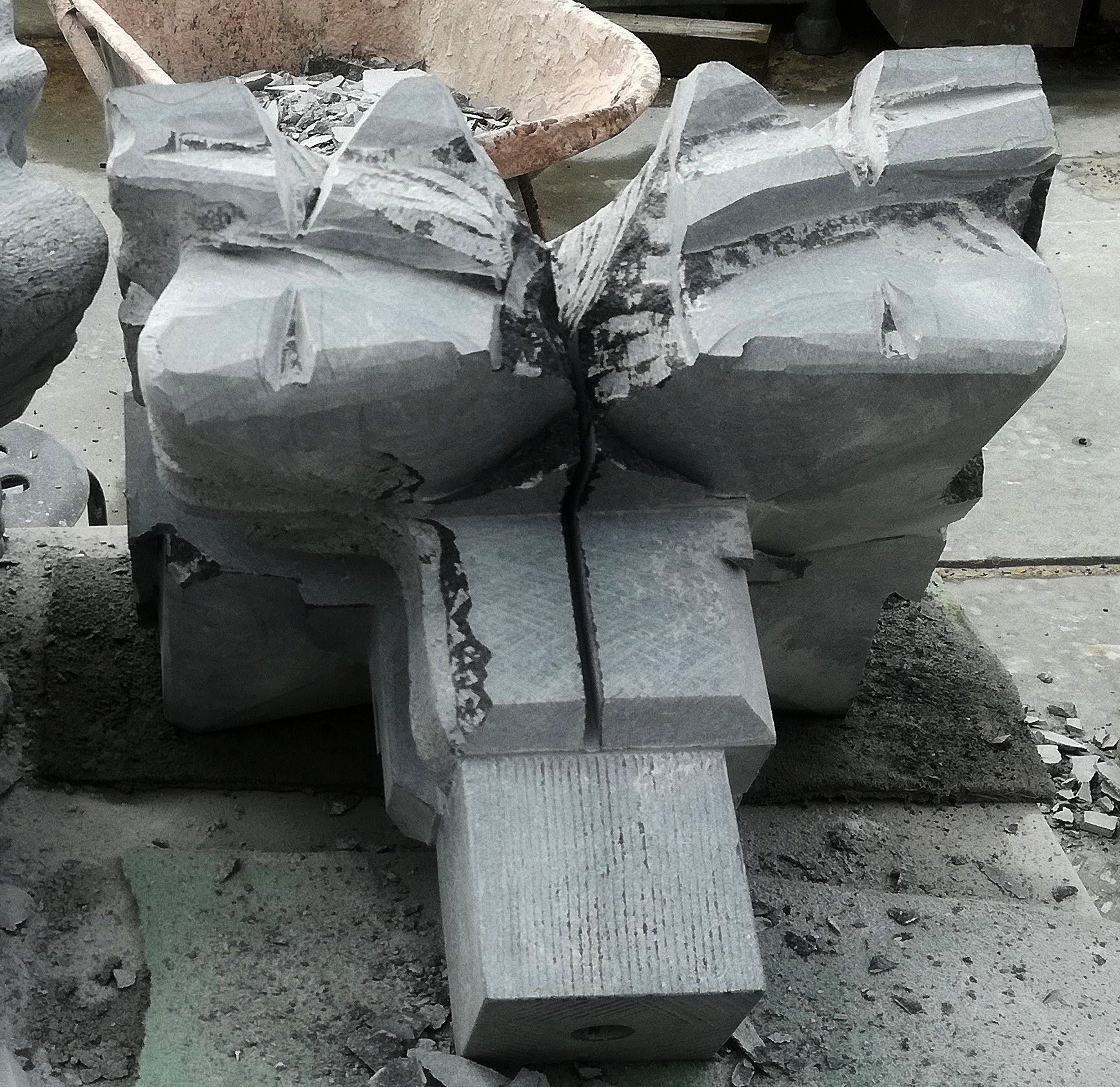
I use my diamond chain for cutting loose statues and stone blocks, in case I want to cut any deeper than the 7 cm from my angle grinder. In recent times I've done for example deep cuts in stone finials, cutting smaller some old tufa side flowers, cutting behind the back of Noah, and cutting Moses and Aaron free from their walls, and removing a pedestal.
In restoration these machines are used for removing large blocks from a facade with minimal damage to the surroundings. In construction they use it for all kinds of modifications to existing buildings, though large circular saws and wire saws are much in use there as well.
Table
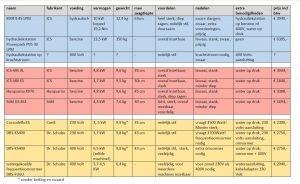
Deep cutting with a diamond chainsaw still remains a very expensive stone cutting method. If you know of a different method you should definitely try that. Certainly during cutting abrasive material it only takes a few hours to use up a chain of € 300,- completely. The chains are still made by ICS, but a very big advantage is that the modern chains stretch much less. So you'd spend much less time tensioning your chain.
Update 2 april 2019: Apparently it's all a lot cheaper if you go shopping in Germany (for example, the Cardi Coccodrillo costs € 1988,45 there, incl VAT, And you get an extra chain!)
Update 2 February 2025: I recently tested my chainsaw for a few hours again, this time on a gigantic block of black granite. With some patience it cut through quite well, and now I also understand better how the thing wants to cut. But when it suddenly jammed, a small nut of the chain tensioner broke inside. That would be easy to replace, but it just takes almost a month before you can continue. Pffft.
The WEKA-TK40 ANNA Machine
I have noticed that the German firm Ströbel Diamant is still the cheapest site for this type of tool over here, as far as I know at least. But the Coccodrillo, plus 1 extra chain still almost costs 2200 euros.
The electric chainsaw from Dr. Schulze is now for sale there as the WEKA tk40 Anna. You'll need an inverter to go with it, but then you can cut at both 240 Volts as well as 400 Volt 3-phase power. The engine is water-cooled and the inverter as well. All in all an expensive set of almost € 6.000,-. If you have enough work for it's definitely worth it, because it's got a super easy quick-tensioner and it cuts over 40 cms deep. I have also seen the same machine with other brand names and with other colours, but it's always the same machine that can cut at both 3700 Watts by 240 Volts and at 6500 Watts by 400 Volts. Especially if you see that inverter there, then you'll know it's the same machine.
At Ströbel they have two variants of the "Weka Kettensäge’ for sale, the difference is in the hardness of the chain. There are chains for abrasive stone, for universal and for hard stone. I assume most people would just want a universal chain. Just do a quick search on their website.
That inverter can also be used for Weka's other tools with the same electric motor, such as the ring saw and the cutter.
I hope you'll benefit from these tips. Good luck with your new purchase!
UPDATE 20 FEBRUARY 2025:
I just discovered that Husqvarna also makes an electric diamond chainsaw on both 1 and 3 phase current (240 and 400 Volts and I think also for 110 Volts).
These K7000 Chain can, just like the WEKA machine mentioned above, can run on both normal power and on three phase current, But in this case as well, you'll need a separate inverter, the PP70. The whole package looks very solid, but it all amounts to almost 9.000 euros!
There is also of this machine a flush cut version, which means that you can cut tightly along a floor or wall with it. Only for the real professionals, I would say. Husqvarna also still makes their petrol version.